
Reconstruction Quiz
How the Scales are Structured
Who Usually Takes This Test?
See How You Compare
Below is a preview of how scores are typically distributed across each scale.
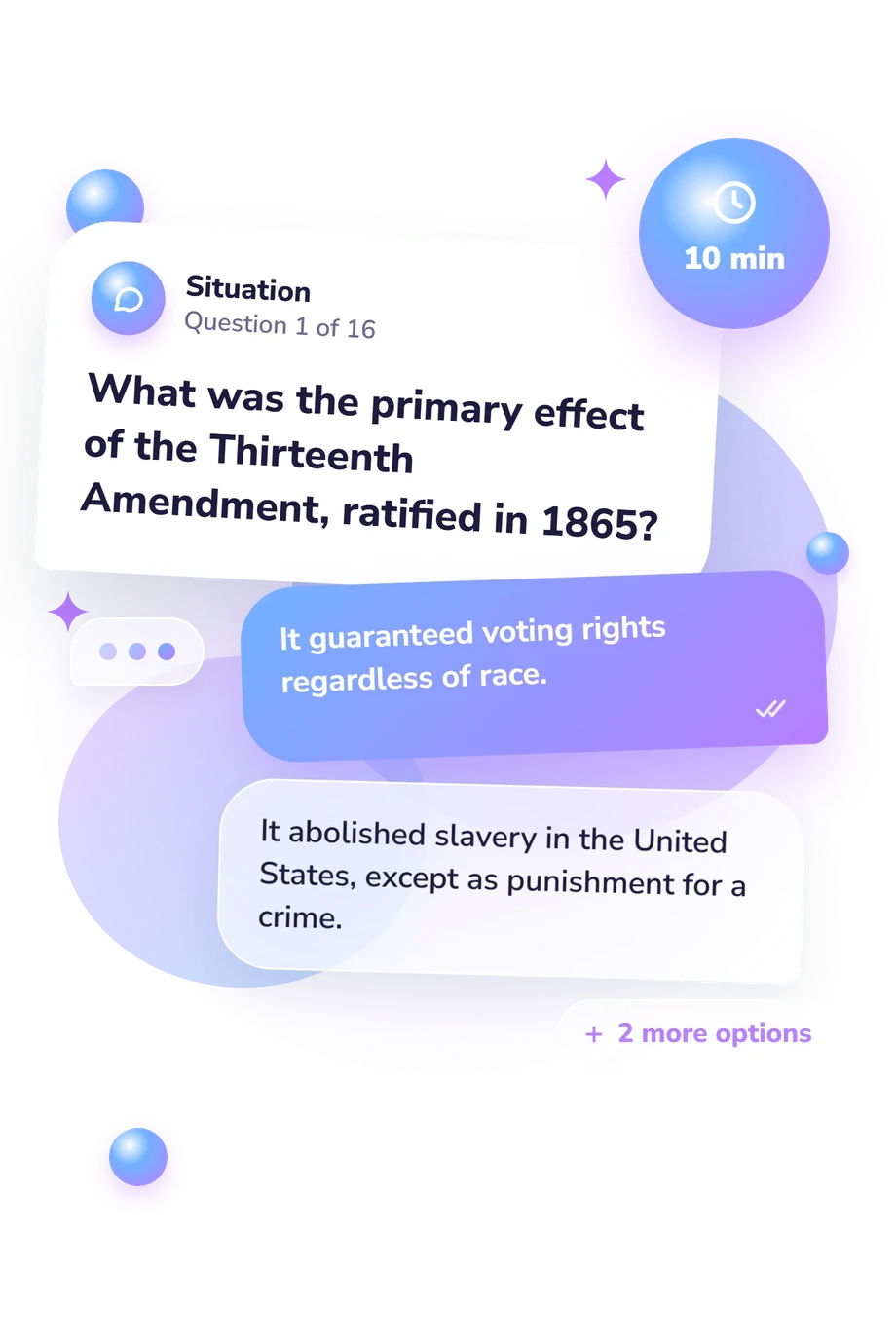
Example Questions From the Test
- Expanding federal land redistribution to formerly enslaved families
- Ending Republican Reconstruction governments and restoring conservative white Democratic control
- Strengthening military enforcement of Black voting rights
- Creating a new national party led by freedpeople
- The Enforcement Acts
- The Compromise of 1877
- The Missouri Compromise
- The Pendleton Civil Service Act
- The Wade-Davis Bill
- The Civil Rights Act of 1866
- The Dawes Act
- The Sherman Antitrust Act
Reconstruction Quiz - Description and methodology of the test
People seeking a focused review of the post-Civil War United States can use this reconstruction quiz to examine connections among constitutional change, political conflict, and social consequences. It is suitable for learners, teachers, and anyone checking historical understanding before deeper study. A reconstruction era quiz can also help place laws and events within the transition from emancipation to contested citizenship.
What This Assessment Explores
Reconstruction Knowledge (0-16) is the sole scale, counting correct answers about amendments, federal measures, political groups, court decisions, labor systems, and conflicts over rights. Scenario-based prompts ask you to match policies with purposes and connect constitutional protections with uneven enforcement. It suits anyone seeking a focused historical self-check.
The main themes are:
- Constitutional change shows whether you recognize the Reconstruction Amendments and their protections.
- Federal and political action shows whether laws, agencies, groups, and leaders are distinguished by purpose.
- Social consequences show whether policy is connected with violence, labor, citizenship, and lasting effects.
Foundation to Build (0-6) marks core topics to review; Developing Knowledge (7-12) shows central understanding with links to strengthen; Strong Knowledge (13-16) indicates a well-developed grasp. Afterward, the score can guide a reconstruction history review of relevant laws, amendments, and conflicts.
Methodology and Evidence Base
Each item presents a short historical prompt with four answer choices. Some require direct identification; others give a scenario that asks you to apply period knowledge to a policy, decision, or conflict. This selected-response format measures historical knowledge and interpretation rather than attitudes or personality.
Scoring counts correct answers, producing the displayed 0-16 total. The questionnaire uses the displayed descriptive bands to place that total in a knowledge category. For study, this reconstruction knowledge test is a content-based online knowledge self-check that locates topics to revisit and helps you check whether later study improves recall and connections.
The question content is consistent with the historical accounts of Reconstruction in Downs and Masur (2017), Foner (1988), Foner (2019), and Zietlow (2022); these works provide context for institutions, conflicts, amendments, and civil-rights measures but do not validate the online questionnaire. Results can be affected by prior study, recall, interpretation of wording, and guessing, so the total is a focused content check rather than a complete measure of historical understanding.
- Downs, Gregory P., and Kate Masur. The Era of Reconstruction: 1861-1900. Washington, DC: National Park Service, U.S. Department of the Interior, National Historic Landmarks Program, 2017.
- Foner, Eric. Reconstruction: America’s Unfinished Revolution, 1863-1877. New York: Harper & Row, 1988.
- Foner, Eric. The Second Founding: How the Civil War and Reconstruction Remade the Constitution. New York: W. W. Norton & Company, 2019.
- Zietlow, Rebecca E. Review of The Second Founding: How the Civil War and Reconstruction Remade the Constitution, by Eric Foner. Journal of American History 108, no. 4 (2022): 836-837. 10.1093/jahist/jaac049
Updated: