
Is My Brother Gay Quiz
How the Scales are Structured
Who Usually Takes This Test?
See How You Compare
Below is a preview of how scores are typically distributed across each scale.
Example Questions From the Test
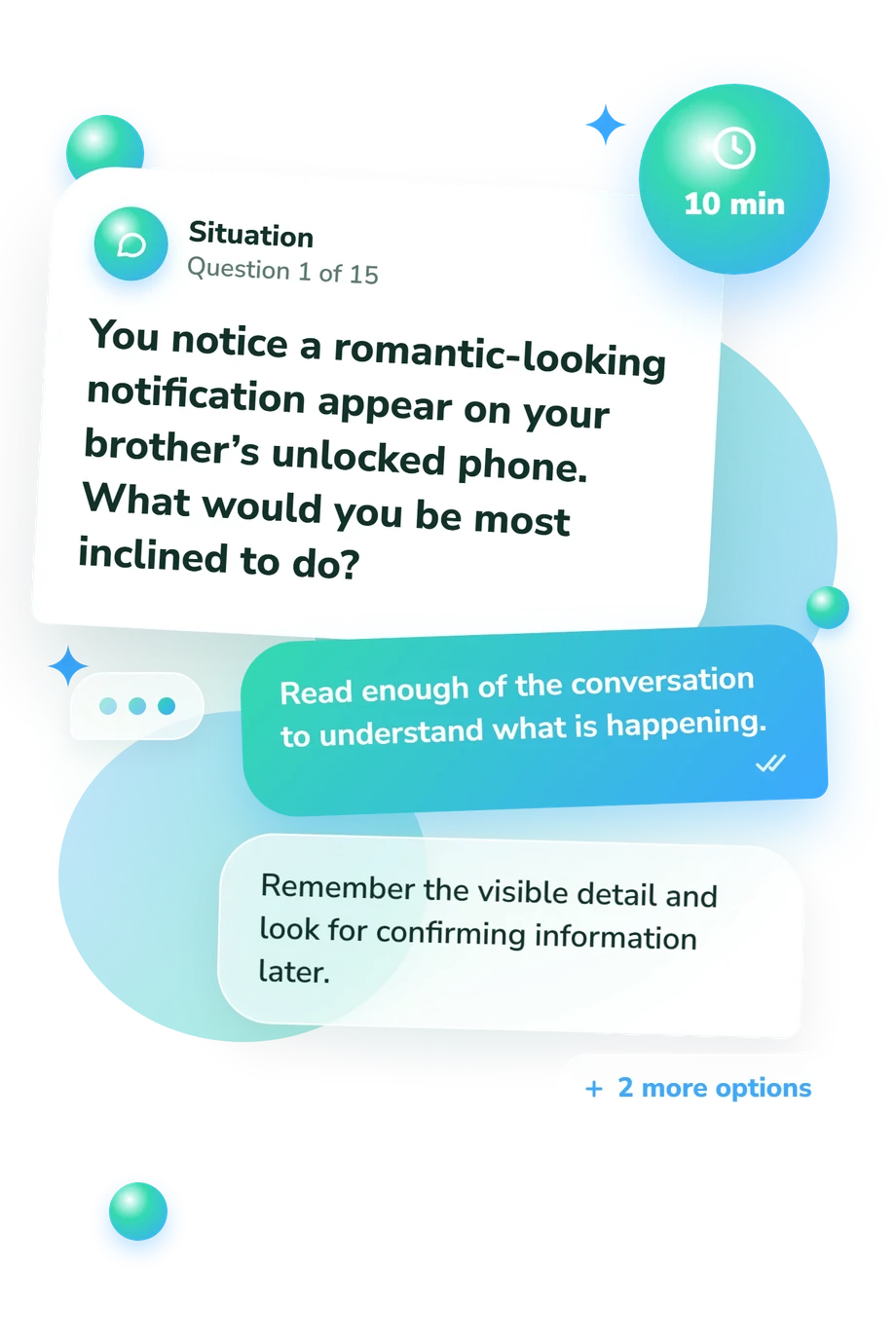
- Read enough of the conversation to understand what is happening.
- Remember the visible detail and look for confirming information later.
- Avoid opening anything, though I might ask a broad question about whether he is dating.
- Look away and let him decide whether to share anything personal.
- Ask him directly and promise not to judge his answer.
- Bring up LGBTQ topics often enough that he should understand my position.
- Express inclusive views naturally and be consistently respectful in everyday situations.
- Share a general statement of acceptance when a relevant topic comes up.
- Ask how long he has known and whether he is certain.
- Thank him for trusting me and ask what kind of support he wants.
- Reassure him that it does not change the relationship, then give him space.
- Say I need a little time to process before continuing the conversation.
Is My Brother Gay Quiz - Description and methodology of the test
Relatives who feel pulled toward guessing, checking, or asking can use this questionnaire to examine their own response before interpreting a brother’s private life. The Is My Brother Gay Quiz offers a structured way to reflect on uncertainty, privacy, and acceptance. The result focuses on how you behave around unanswered questions rather than trying to identify his orientation.
What This Assessment Explores
Rather than estimating your brother’s orientation, the questionnaire examines how you handle clues, stereotypes, privacy, and disclosure. Scenarios involve phones, dating, friendships, family jokes, hostile language, and moments when your brother sets a boundary or seeks acceptance. The result describes your approach to uncertainty, not his identity.
The three dimensions show what you may reconsider when respecting your brother’s privacy:
- Assumption Awareness (0-15) reflects whether you separate observable behavior from stereotypes: Assumption-led (0-5), Questioning (6-10), and Perspective-aware (11-15) mark increasing tolerance of uncertainty.
- Privacy and Boundaries (0-15) reflects how you balance curiosity with his control over personal information: Curiosity-forward (0-5), Boundary-conscious (6-10), and Privacy-respecting (11-15) describe that balance.
- Supportive Communication (0-15) reflects readiness to communicate acceptance, listen without pressure, and respond constructively if sexuality comes up: Outcome-focused (0-5), Support developing (6-10), and Support-centered (11-15) describe increasingly supportive responses.
Methodology and Scientific Basis
Each item presents a family situation with four possible responses, so you select the reaction closest to what you would probably do. The result is reported across three displayed scales, and the bands describe your current stance in these situations.
D'Augelli et al. (1998) is the closest conceptual source for treating disclosure as a personal process affecting family relationships. Ryan et al. (2010) provides context on family acceptance and LGBT young-adult well-being, while Freeman et al. (2010) offers context on how gendered facial cues shape perception, not evidence that the questionnaire’s wider cues reveal orientation. Ben-Ari (1995) adds a privacy perspective in which intimacy and disclosure are negotiated.
For someone supporting your brother, these studies supply context rather than validation: the online questionnaire is conceptually consistent with their work, not an adaptation of any one published instrument. As a self-report reflection tool, it is shaped by current worries, family beliefs, and self-awareness. The displayed bands are descriptive and cannot establish your brother’s orientation; use the scenarios to reconsider investigation, stereotypes, pressure, and responses if sexuality comes up or safety is threatened.
- D'Augelli, Anthony R., Scott L. Hershberger, and Neil W. Pilkington. (1998). Lesbian, gay, and bisexual youth and their families: Disclosure of sexual orientation and its consequences. American Journal of Orthopsychiatry, 68(3), 361-371. 10.1037/h0080345
- Ryan, Caitlin, Stephen T. Russell, David Huebner, Rafael M. Diaz, and Jorge Sanchez. (2010). Family Acceptance in Adolescence and the Health of LGBT Young Adults. Journal of Child and Adolescent Psychiatric Nursing, 23(4), 205-213. 10.1111/j.1744-6171.2010.00246.x
- Freeman, Jonathan B., Kerri L. Johnson, Nalini Ambady, and Nicholas O. Rule. (2010). Sexual Orientation Perception Involves Gendered Facial Cues. Personality and Social Psychology Bulletin, 36(10), 1318-1331. 10.1177/0146167210378755
- Ben-Ari, Adital. (1995). Coming Out: A Dialectic of Intimacy and Privacy. Families in Society, 76(5), 306-314. 10.1177/104438949507600504
Updated: