
How Romantic Are You Quiz
How the Scales are Structured
Who Usually Takes This Test?
See How You Compare
Below is a preview of how scores are typically distributed across each scale.
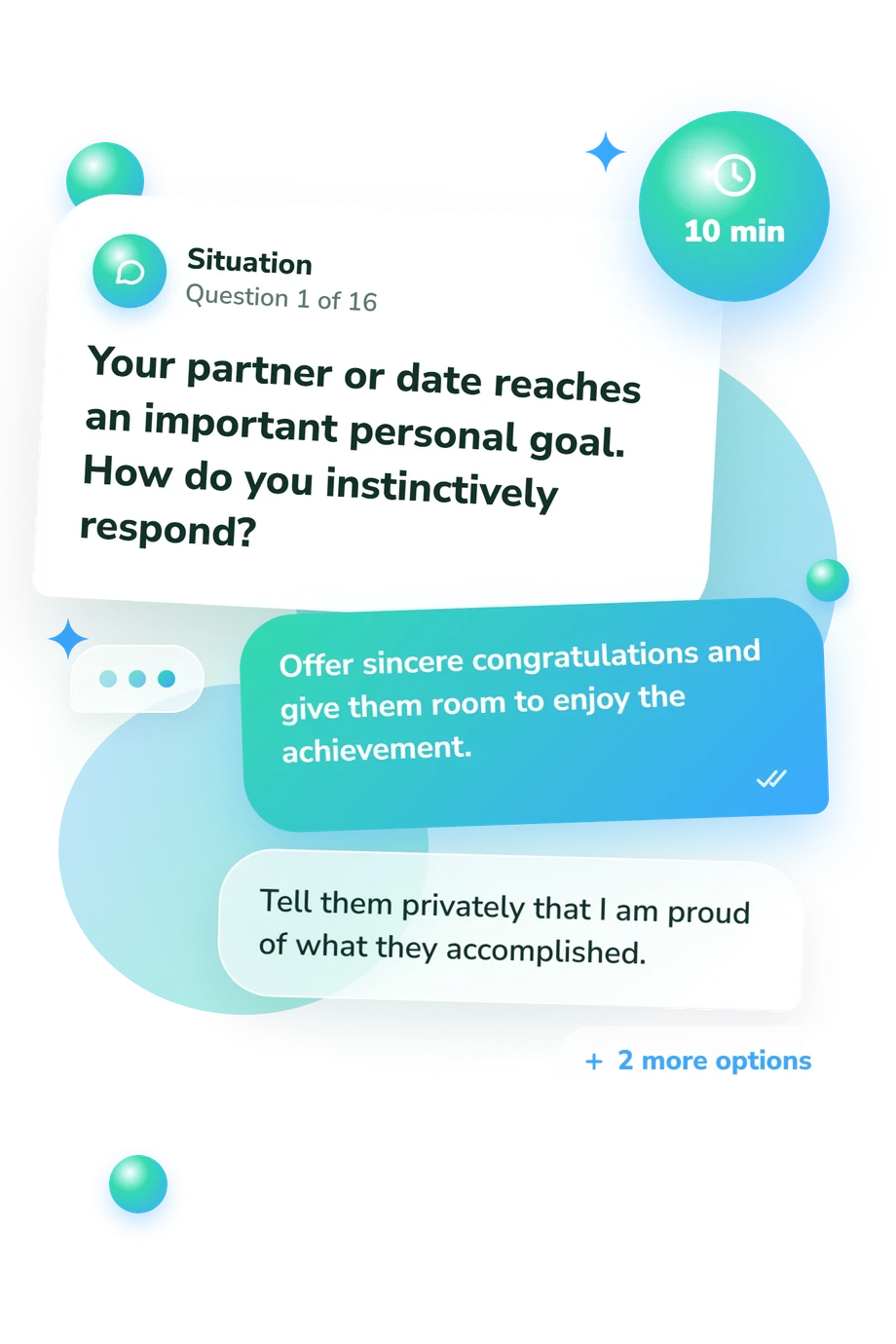
Example Questions From the Test
- Offer sincere congratulations and give them room to enjoy the achievement.
- Tell them privately that I am proud of what they accomplished.
- Share an enthusiastic message or toast explaining what impressed me.
- Create an emotionally expressive tribute that makes my admiration unmistakable.
- A calm evening revisiting a place we both love.
- A well-planned celebration with one unexpected moment.
- The first time we tried something unfamiliar together.
- A spontaneous detour that became a story we still tell.
- A simple signature that keeps the card uncluttered.
- A warm sentence marking the occasion.
- A personal paragraph about something I value in our relationship.
- A detailed declaration of affection, memories, and hopes for us.
How Romantic Are You Quiz - Description and methodology of the test
For people curious about how they create closeness, the How Romantic Are You Quiz offers a structured profile of romantic preferences rather than a pass-or-fail judgment. Visitors wondering how romantic they are can use it as a how romantic am i quiz to compare their instinctive ways of showing care and understand which patterns may shape dating or established relationships.
What This Assessment Explores
Romantic style means preferred connection, not fixed warmth. Scenarios cover affection, support, plans, promises, routines, and details. Four dimensions make it a what type of romance am i quiz:
- Adventurous Romantic (0-12) measures affinity for novelty, spontaneity, and discovery: Familiar-Setting Explorer (0-4) prefers comfort; Flexible Explorer (5-8) mixes plans and novelty; Bold Explorer (9-12) embraces surprise.
- Expressive Romantic (0-12) measures open affection: Quiet Expression (0-4) stays understated; Selective Expression (5-8) varies with context; Open Expression (9-12) makes feelings visible.
- Steady Romantic (0-12) measures dependable care: Moment-Led Connection (0-4) favors spontaneity; Grounded Connection (5-8) balances warmth and ritual; Constant Connection (9-12) centers reliability.
- Thoughtful Romantic (0-12) measures personalized gestures: Broad-Strokes Thoughtfulness (0-4) keeps support simple; Attentive Thoughtfulness (5-8) uses preferences; Deep Personalization (9-12) makes details central.
Methodology and Evidence Base
Each scenario presents four response options that move from less to more affinity for a particular romantic approach. The respondent selects the option that feels most instinctive, so the task captures preferred patterns rather than a performance score or an idealized answer. Responses produce four separately displayed dimension scores, and scores within one point indicate a blend.
Conceptually, selected themes have parallels in the Love Attitudes Scale, affectionate-communication research, relationship-maintenance work, and self-expansion research. These are conceptual comparison points, not validation of this questionnaire or evidence that its structure matches those published measures. The questionnaire is not an adaptation of them; it functions as a what type of romance are you quiz, offering a descriptive profile for people considering what type of romance feels natural to them.
Results use the displayed ranges and bands to show whether each tendency is lower, middle, or higher within its dimension. Self-report answers can shift with mood, current relationship context, and self-awareness, so the profile is best treated as a reflection prompt rather than a clinical conclusion.
- Hendrick, C., Hendrick, S. S., & Dicke, A. (1998). The Love Attitudes Scale: Short Form. Journal of Social and Personal Relationships, 15(2), 147-159. 10.1177/0265407598152001
- Floyd, K., & Morman, M. T. (1998). The measurement of affectionate communication. Communication Quarterly, 46(2), 144-162. 10.1080/01463379809370092
- Stafford, L., & Canary, D. J. (1991). Maintenance Strategies and Romantic Relationship Type, Gender and Relational Characteristics. Journal of Social and Personal Relationships, 8(2), 217-242. 10.1177/0265407591082004
- Reissman, C., Aron, A., & Bergen, M. R. (1993). Shared Activities and Marital Satisfaction: Causal Direction and Self-Expansion versus Boredom. Journal of Social and Personal Relationships, 10(2), 243-254. 10.1177/026540759301000205
Updated: