
Quantum Mechanics Quiz
How the Scales are Structured
Who Usually Takes This Test?
See How You Compare
Below is a preview of how scores are typically distributed across each scale.
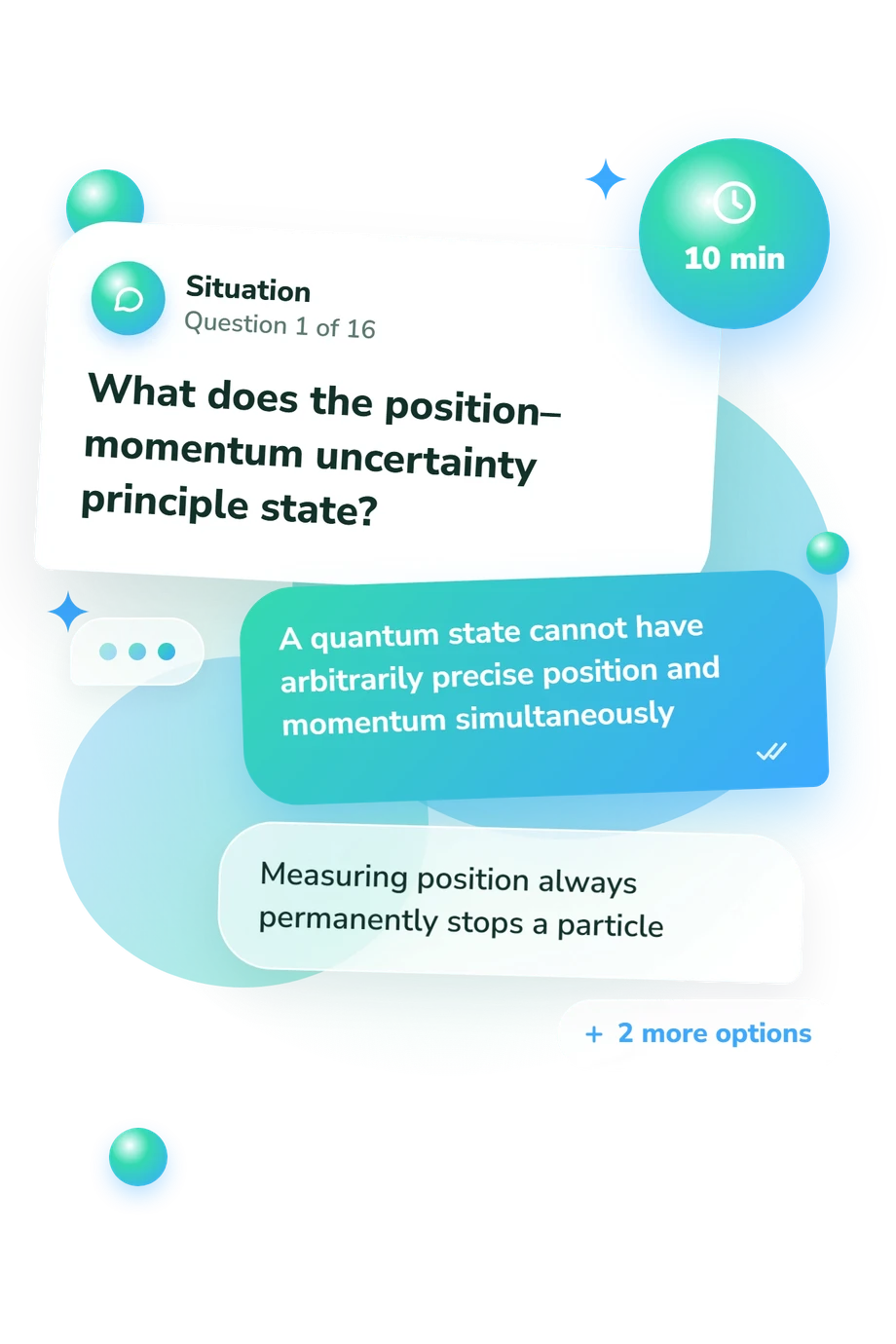
Example Questions From the Test
- The particles gain enough energy to emit photons
- The interference fringes become twice as close together
- Each particle passes through neither slit
- The interference pattern disappears
- Its frequency, through E = hf
- Its speed, through E = mc²
- Its brightness, through E = IVt
- Its electric charge, through E = qV
- It doubles
- It is squared
- It is halved
- It remains unchanged
Quantum Mechanics Quiz - Description and methodology of the test
Students, curious learners, and anyone revisiting introductory physics can use this quantum mechanics quiz to check whether core ideas fit together beyond memorized formulas. It focuses on conceptual recognition across thought experiments, equations, and physical situations, helping distinguish connected understanding from recall of isolated formulas. As a quantum physics quiz, it suits self-study before a course, during revision, or after learning the basics.
What This Assessment Measures
The questionnaire samples introductory reasoning about quantum states, measurement, evolution, and observation. Questions connect principles with applications involving interference, uncertainty, entanglement, photons, tunneling, spin, wavefunctions, and matter waves. Taking this quantum quiz can show how well the sampled concepts fit together as a coherent picture.
The result is one broad knowledge summary, not a personality or learning-style profile. The main themes are:
- Core principles show whether quantum descriptions are separated from classical intuition.
- Measurement and experiments show what probability, observation, and entanglement imply.
- Applications show whether key relations for waves, photons, and particles can be used.
- Quantum Mechanics Knowledge (0-16) summarizes performance: Foundations to build (0-6) signals core review needs; Developing understanding (7-12) reflects useful grasp with gaps; Strong foundation (13-16) reflects understanding of most introductory concepts.
Methodology and Evidence Base
Each item uses four-option multiple choice. Prompts ask for the best conceptual explanation, prediction, or application rather than extended calculation. Responses are aggregated into one displayed knowledge score, with bands describing levels of introductory understanding.
The content is conceptually consistent with the Quantum Mechanics Conceptual Survey, a published assessment of central quantum ideas. The Quantum Mechanics Conceptual Survey is a separate published instrument, so its validation evidence cannot automatically be applied to this questionnaire. Griffiths and Schroeter’s textbook provides the theoretical reference for state evolution, probability amplitudes, uncertainty, photons, and tunneling.
For this quantum mechanics assessment, the displayed bands are questionnaire-specific interpretations of introductory knowledge across sampled concepts, and the result does not indicate professional expertise. A higher total indicates stronger performance across the sampled concepts; a lower total points toward review of definitions, experiments, and equations. Results can also reflect prior exposure, guessing, and current study context, so they work best as a focused learning snapshot rather than a complete evaluation of physics ability.
- S. B. McKagan, K. K. Perkins, and C. E. Wieman. "Design and validation of the Quantum Mechanics Conceptual Survey." Physical Review Special Topics-Physics Education Research, 6(2), 020121 (2010). 10.1103/PhysRevSTPER.6.020121
- David J. Griffiths and Darrell F. Schroeter. Introduction to Quantum Mechanics. 3rd ed. Cambridge University Press, 2018. 10.1017/9781316995433
Updated: