
GHS Pictogram Quiz
How the Scales are Structured
Who Usually Takes This Test?
See How You Compare
Below is a preview of how scores are typically distributed across each scale.
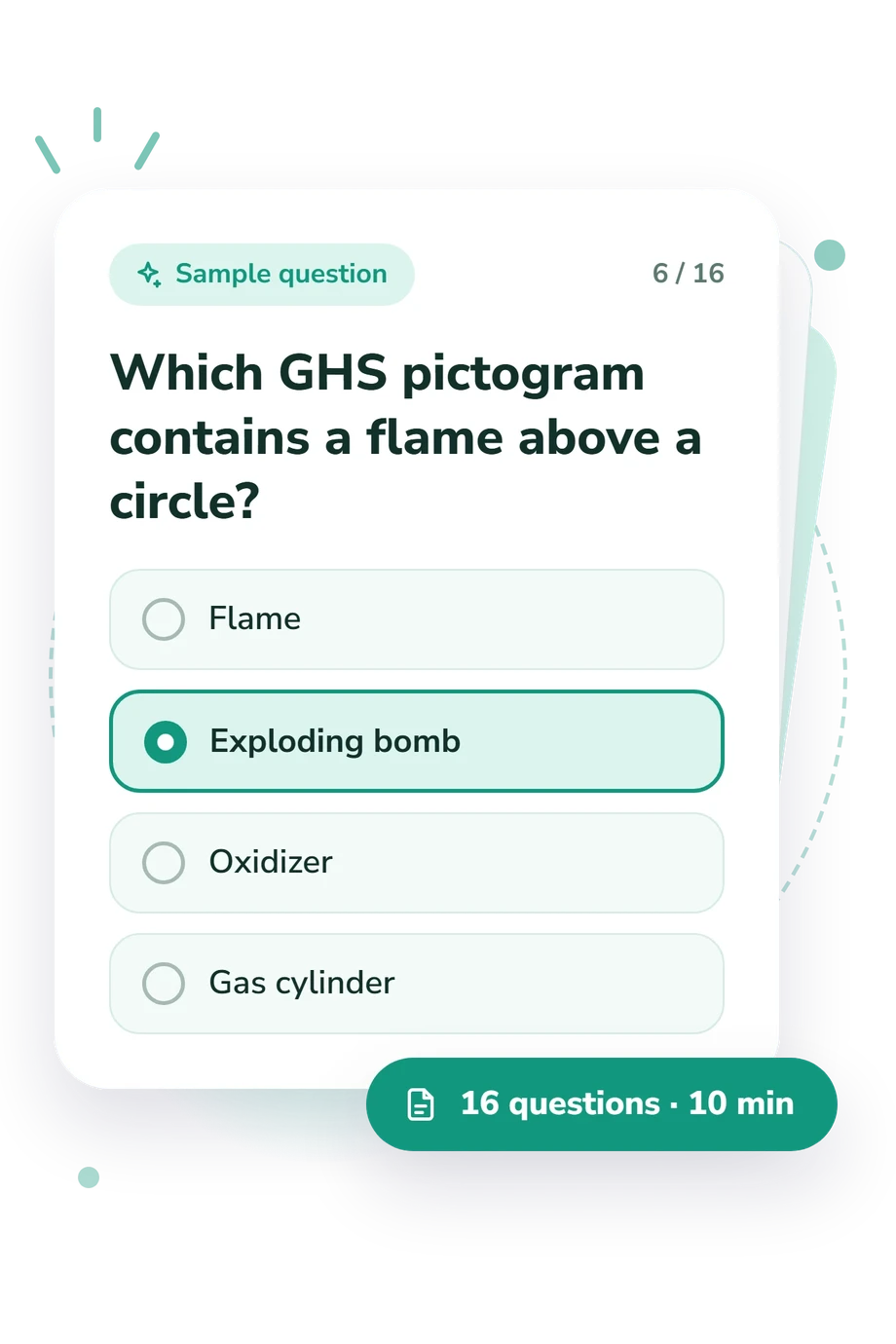
Example Questions From the Test
- Corrosion
- Exclamation mark
- Health hazard
- Skull and crossbones
- Skull and crossbones
- Exclamation mark
- Corrosion
- Health hazard
- Explosives
- Corrosive substances
- Flammable substances
- Gases under pressure
GHS Pictogram Quiz - Description and methodology of the test
People who read chemical labels, prepare materials, or study workplace hazard communication can use the GHS Pictogram Quiz to check how clearly they connect symbols with the dangers they represent. As a GHS quiz, it offers a practical snapshot of recognition and interpretation, helping learners decide which hazard categories deserve closer review. It suits self-checking before training or while refreshing familiar safety concepts.
What This Assessment Explores
Questions test distinctions that blur when a symbol is viewed without its hazard context. They connect pictograms with burns and eye damage, sensitization, acute toxicity, flammability, oxidation, pressure, explosion, and aquatic harm. This GHS pictogram test helps learners and workers check whether recognition leads to practical meaning.
The topic groups are:
- Corrosion and irritation show whether severe tissue damage is distinguished from severe harmful effects.
- Health hazards show whether chronic and sensitizing risks are linked to the chest-silhouette symbol.
- Fire, explosion, oxidation, and pressure show whether red-diamond symbols are separated correctly.
- Environmental hazards show whether the aquatic pictogram is connected with harm to the environment.
GHS Pictogram Knowledge (0-16) summarizes performance: Foundation to build (0-6) calls for review of nine symbols, Developing knowledge (7-12) reflects many core meanings, and Strong knowledge (13-16) reflects accurate interpretation across most items.
Methodology and Evidence Base
Each item presents a pictogram or hazard scenario with four answer choices. The respondent selects the meaning that best matches the symbol or situation, so the format tests both pictogram recognition and applied interpretation through direct identification and hazard scenarios. Responses are keyed to the intended GHS meaning, and the total is presented with its educational band.
Hesse et al. (2010) offer a conceptual reference for how people understand GHS hazard symbols, while the 2023 United Nations GHS framework defines the pictograms and hazard distinctions. This questionnaire is conceptually consistent with Hesse et al. (2010) and the UN GHS framework, but is not presented as an adaptation of their study. Rossete and Ribeiro (2021) add practical context by showing why label users must connect communication elements with associated hazards.
The displayed educational bands are educational categories, and performance may be affected by attention, prior GHS training, and guessing within a four-option format, particularly when closely related pictograms are confused; the result is not certification and does not replace a product label, safety data sheet, workplace training, or emergency procedure. The result is best used to identify distinctions that merit further study before applying GHS information in practice.
- Hesse, Robert G., Nicholas H. Steele, Michael J. Kalsher, and Claudia Mont'Alvão. "Evaluating Hazard Symbols for the Globally Harmonized System (GHS) for Hazard Communication." Proceedings of the Human Factors and Ergonomics Society Annual Meeting 54, no. 21 (2010): 1832-1836. 10.1177/154193121005402101
- United Nations. Globally Harmonized System of Classification and Labelling of Chemicals (GHS), Tenth Revised Edition. New York and Geneva: United Nations, 2023.
- Rossete, Celso A., and Marcela G. Ribeiro. "Laboratory Technicians’ Use and Interpretation of Hazard Communication Elements on Chemical Labels." ACS Chemical Health & Safety 28, no. 3 (2021): 211-223. 10.1021/acs.chas.0c00125
Updated: