
Adjective Quiz
How the Scales are Structured
Who Usually Takes This Test?
See How You Compare
Below is a preview of how scores are typically distributed across each scale.
Example Questions From the Test
- She brought useful something to the workshop.
- She brought something useful to the workshop.
- She brought something usefully to the workshop.
- She useful brought something to the workshop.
- Hyphenate only “known-author.”
- Insert a spaced dash between “well” and “known.”
- Combine the modifiers as “wellknown.”
- Hyphenate the modifiers as “well-known.”
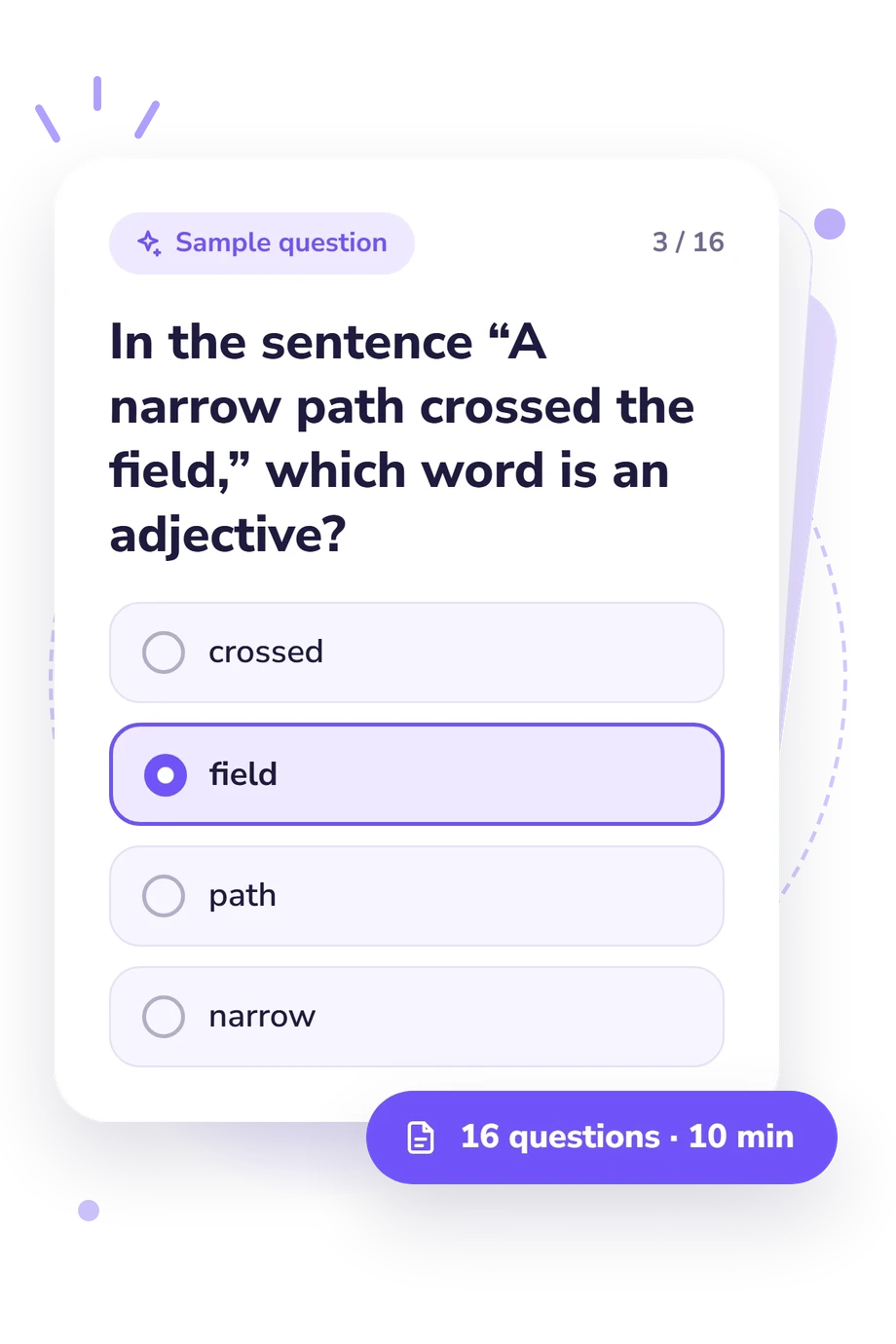
- crossed
- field
- path
- narrow
Adjective Quiz - Description and methodology of the test
Readers who want to check how confidently they recognize and use English adjectives can approach this adjective quiz as a focused grammar exercise. It suits learners, writers, and anyone revising sentence structure through an online quiz about adjectives. Rather than asking for opinions, it asks you to choose forms and constructions that fit real sentences. The result identifies areas of strength and topics worth reviewing.
What This Assessment Explores
The questions examine whether you can identify adjectives, select appropriate forms, and understand their work in complete sentences. As a quiz about adjective rules, it turns grammar labels into editing decisions involving form, comparison, punctuation, order, and meaning. Its main areas are:
- Identification and grammatical role show whether you can locate adjectives and distinguish attributive, predicative, phrase, and object-complement uses.
- Forms and comparison show whether you can choose adjective, comparative, and superlative forms in context.
- Position, order, meaning, and punctuation show whether you can place modifiers correctly, interpret contrasts such as bored and boring, and punctuate adjective groups.
Performance is summarized by Adjective Knowledge (0-16), with one point for each correct answer. Foundations to Build (0-6) marks patterns needing review; Developing Command (7-12) reflects understanding of common uses; Strong Command (13-16) reflects accurate application across varied sentence contexts.
Methodology and Scientific Basis
Each item presents a sentence or editing situation with four answer choices, and the respondent selects the option that follows standard English grammar. The displayed scoring uses one point for every correct answer, so the total reflects accuracy on the tested constructions rather than confidence, preference, or self-rating. This adjective grammar quiz offers a focused snapshot.
Methodologically, Nadee and Harnwongsa (2026) is the closest subject-specific source because it addresses adjective order and meaning. The questionnaire is conceptually consistent with that work, but it is not an adaptation of the board-game intervention. Huddleston and Pullum (2002) supplies the grammatical framework for placement, comparison, phrase structure, complements, and modifier order.
Ahangari and Barghi (2012) supports cautious interpretation: accuracy on grammar knowledge items may not transfer automatically to accurate writing in every context. The displayed bands are score descriptions for this questionnaire, not population norms or a standardized proficiency scale. Attention, prior instruction, and familiarity with sentence patterns can influence responses, so the result is best read as a snapshot of adjective knowledge rather than a complete measure of English ability.
- Jiraphat Nadee and Peewara Harnwongsa. (2026). Enhancing Thai EFL Learners’ Knowledge of English Adjective Order and Meaning Through a Board Game-Based Intervention. Journal of Liberal Arts Prince of Songkla University, 18(1), 301523. 10.14456/jlapsu.2026.3
- Rodney D. Huddleston and Geoffrey K. Pullum. (2002). The Cambridge Grammar of the English Language. Cambridge University Press. 10.1017/9781316423530
- Saeideh Ahangari and Ali Hamed Barghi. (2012). Consistency of Measured Accuracy in Grammar Knowledge Tests and Writing: TOEFL PBT. Language Testing in Asia, 2, Article 5. 10.1186/2229-0443-2-2-5
Updated: