
Ramadan Quiz
How the Scales are Structured
Who Usually Takes This Test?
See How You Compare
Below is a preview of how scores are typically distributed across each scale.
Example Questions From the Test
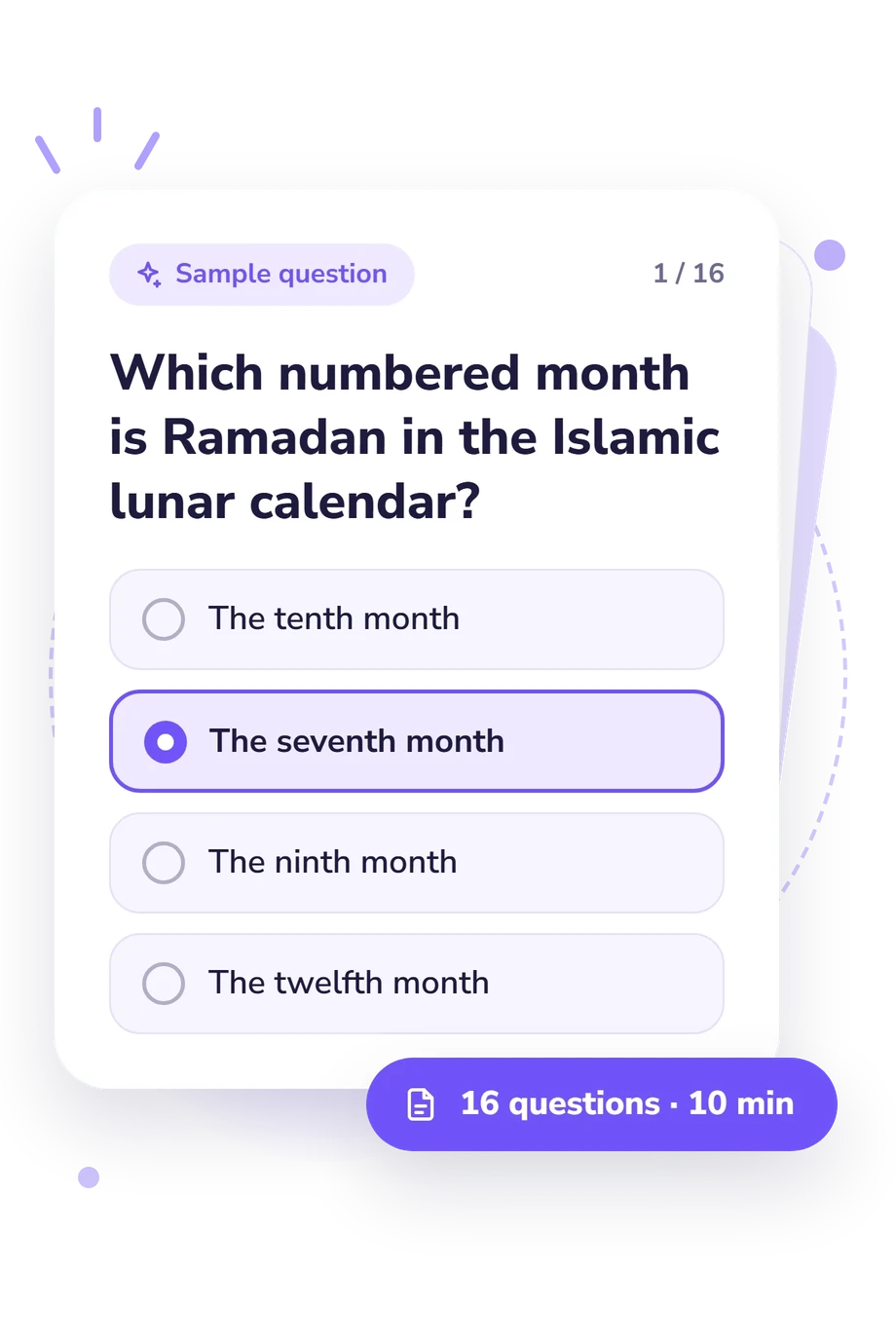
- The tenth month
- The seventh month
- The ninth month
- The twelfth month
- Eid al-Fitr
- The Islamic New Year
- Eid al-Adha
- The Day of Arafah
- The fasting period ends
- The fasting period begins
- The fast pauses until sunrise
- Only drinking stops; eating may continue
Ramadan Quiz - Description and methodology of the test
For learners revisiting Ramadan’s calendar and observances, the Ramadan Quiz offers a focused check of core religious knowledge. It suits students, families, educators, and curious readers who want to identify familiar concepts and useful gaps. The result can guide personal reflection or further study. Its questions and answers about Ramadan cover the month’s timing, practices, scriptural context, and major observances.
What This Assessment Explores
The questionnaire examines knowledge connected with Ramadan’s place in the Islamic lunar calendar. Themes include the preceding month, crescent-sighting conventions, the shorter lunar year, and the timing of dawn and sunset. It also covers suhoor, iftar, missed fasts, accidental eating, travel concessions, and common acts of worship.
Further items address Qur’anic revelation, fasting’s purpose, Zakat al-Fitr, Tarawih, i’tikaf, Laylat al-Qadr, and Eid al-Fitr. As quiz questions on Ramadan, they show which widely taught essentials are familiar and which merit review; practices may differ by legal school or community.
The results are organized on the Ramadan Knowledge scale (0-16) through three bands:
- Foundation Building (0-6) indicates recognition of some essentials while pointing to areas for strengthening.
- Developing Knowledge (7-12) shows understanding of many central ideas with details still to review.
- Strong Knowledge (13-16) reflects a well-rounded grasp of widely taught Ramadan essentials.
Methodology and Evidence Base
Across the items, each question presents four answer options and asks the respondent to choose the best answer to a calendar, practice, historical, or scriptural prompt. The format tests recognition and understanding rather than feelings, sincerity, or worship frequency. As a Ramadan knowledge test, it is an educational exercise rather than a trait inventory.
Each selection is checked against a keyed answer, and the total is placed into the displayed band. It summarizes performance on the sampled topics, not faith, character, or observance.
Mohamed et al. (2024) offers a relevant comparison by examining knowledge used in managing patients during Ramadan fasting; Alsunni et al. (2020) examines knowledge, attitude, and practice around Ramadan fasting. The questionnaire is conceptually consistent with these works, but is not an adaptation or validation of either study.
Qur’an 2:183 supplies context for the fasting-purpose item, including God-consciousness, using Abdel Haleem’s translation. No standardized norms are specified for this online questionnaire, so its result is not a standardized score.
Results can be affected by prior education, language, guessing, and legal or community differences. They indicate familiarity with selected essentials rather than devotion or religious standing.
- Mohamed, Hatem Abdulgabbar, Ramzi Naim Nasser, and Jacqueline Doumit. “Physicians’ Knowledge from Different Religious Background on Management of Diabetic Patients during Ramadan Fasting in Saudi Arabia.” International Journal of Religion, 2024, 5(6), 457-463. DOI 10.61707/8wke8930
- Alsunni, Ahmed Abdulrahman, Waleed Ibrahim Albaker, Abdulelah Hassan Almansour, Abdulaziz Saud Alenazi, Mohammed S. Alaftan, and Ahmed Badar. “Knowledge, Attitude and Practice Regarding Ramadan Fasting and Related Determinants in Patients with Type 2 Diabetes at a Saudi Diabetes Clinic.” Diabetes, Metabolic Syndrome and Obesity: Targets and Therapy, 2020, 13, 151-159. DOI 10.2147/DMSO.S241496
- Abdel Haleem, M. A. S. The Qur’an: A New Translation. Oxford University Press, 2004.
Updated: