
Skeletal System Quiz
How the Scales are Structured
Who Usually Takes This Test?
See How You Compare
Below is a preview of how scores are typically distributed across each scale.
Example Questions From the Test
- Fibula
- Tibia
- Patella
- Femur
- Thoracic region
- Cervical region
- Lumbar region
- Sacral region
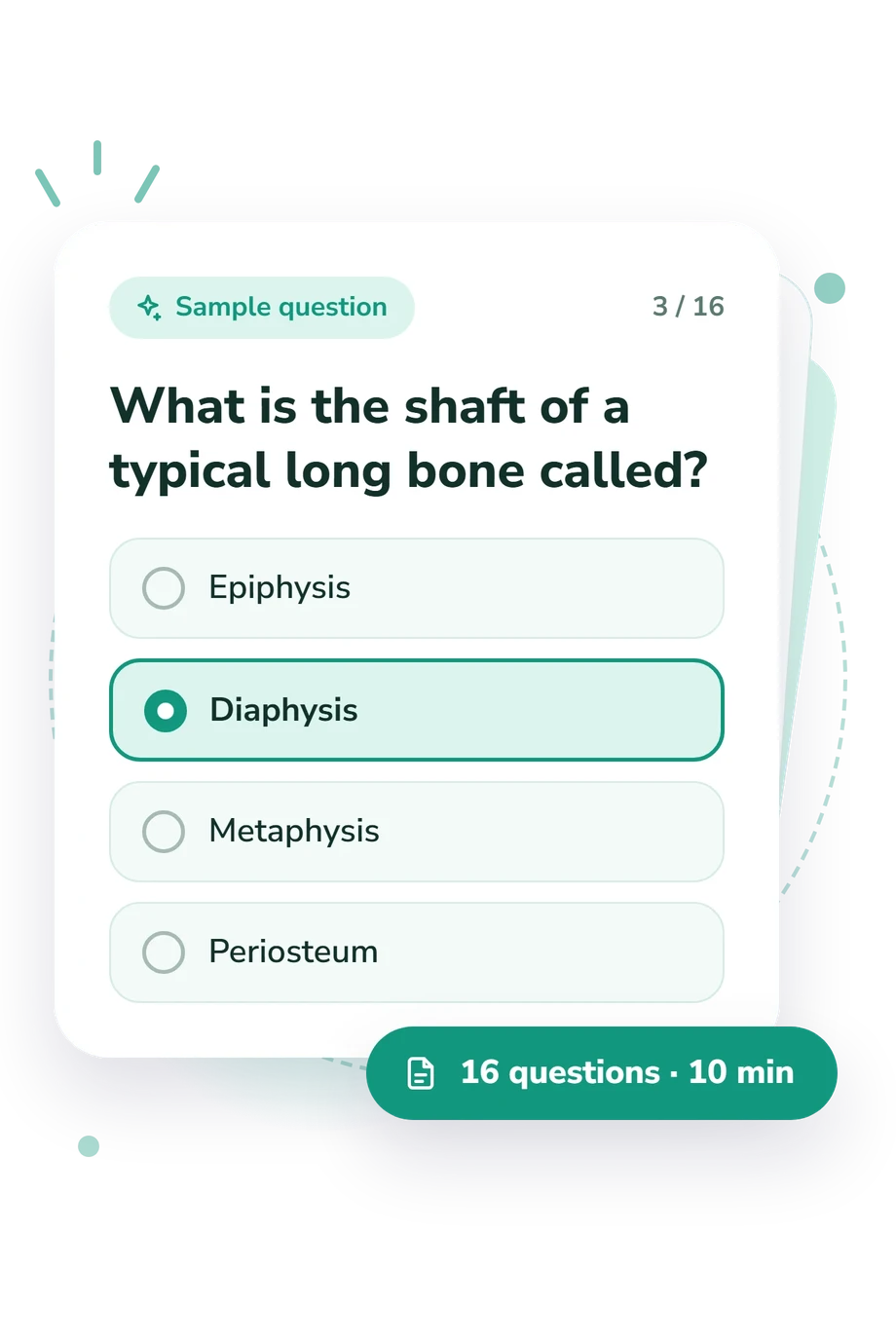
- Epiphysis
- Diaphysis
- Metaphysis
- Periosteum
Skeletal System Quiz - Description and methodology of the test
For students, curious learners, and anyone revising basic anatomy, the skeletal system quiz offers a focused way to check whether key structures and functions are firmly understood. It can serve as a practical bone quiz when you want to locate gaps before studying further. The result gives an overall level of knowledge about the skeletal system, indicating whether your current understanding is foundational, developing, or strong.
What the Test Measures
Designed for introductory anatomy review, this assessment checks whether you can connect skeletal structures with their locations, classifications, and functions. As a quiz about the bones of the body, it uses short anatomical situations rather than simple name recall.
Its main question groups address these areas:
- Major bones and regions are identified by location.
- Axial and appendicular divisions are distinguished.
- Joints, tissues, cells, and growth structures are matched with functions.
- Terminology and bone classifications are applied in context.
The result appears as Skeletal System Knowledge (0-16), based on correct answers. Foundational (0-6) signals concepts to review; Developing (7-12) indicates useful knowledge still to consolidate; Strong (13-16) reflects accurate coverage of core structures and functions. The profile can help prioritize further study, giving the assessment a practical role in revision.
Methodology and Evidence Base
Each item presents four answer choices, and the task is to select the best response. The set moves between direct identification and applied reasoning: you may locate a bone, classify a joint, recognize a tissue or cell, or infer a structure from its function. The questions require identifying structures and connecting them with functions, locations, classifications, and processes, which makes this skeleton quiz a compact review of core anatomy.
The NBME Musculoskeletal Subject Examination (Grunfeld et al., 2012) provides a conceptual comparison for broad musculoskeletal knowledge; this online questionnaire is not an adaptation of that examination. The anatomy reference by Drake et al. (2023) supports the terminology and structural relationships used here.
Scoring reports the total correct and places it in the three descriptive bands above, so the result is best read as a learning snapshot. Performance can vary with memory, wording, and current study context; use the result to guide review rather than high-stakes academic or clinical decisions.
- Grunfeld, Robert, Sharon Banks, Edward Fox, Bruce A. Levy, Clifford Craig, and Kevin Black. "An assessment of musculoskeletal knowledge in graduating medical and physician assistant students and implications for musculoskeletal care providers." The Journal of Bone and Joint Surgery, vol. 94, no. 4, 2012, pp. 343-348. 10.2106/JBJS.J.00417
- Abrahams, Amaal, Lunelle Pienaar, Kishor Bugarith, Geney Gunston, and Elmi Badenhorst. "A foundational knowledge assessment tool to predict academic performance of medical students in first-year anatomy and physiology." Advances in Physiology Education, vol. 46, no. 4, 2022, pp. 598-605. 10.1152/advan.00017.2022
- Drake, Richard L., A. Wayne Vogl, and Adam W. M. Mitchell. Gray's Anatomy for Students. 5th ed., Elsevier, 2023.
Updated: