
Fairy Quiz
How the Scales are Structured
Who Usually Takes This Test?
See How You Compare
Below is a preview of how scores are typically distributed across each scale.
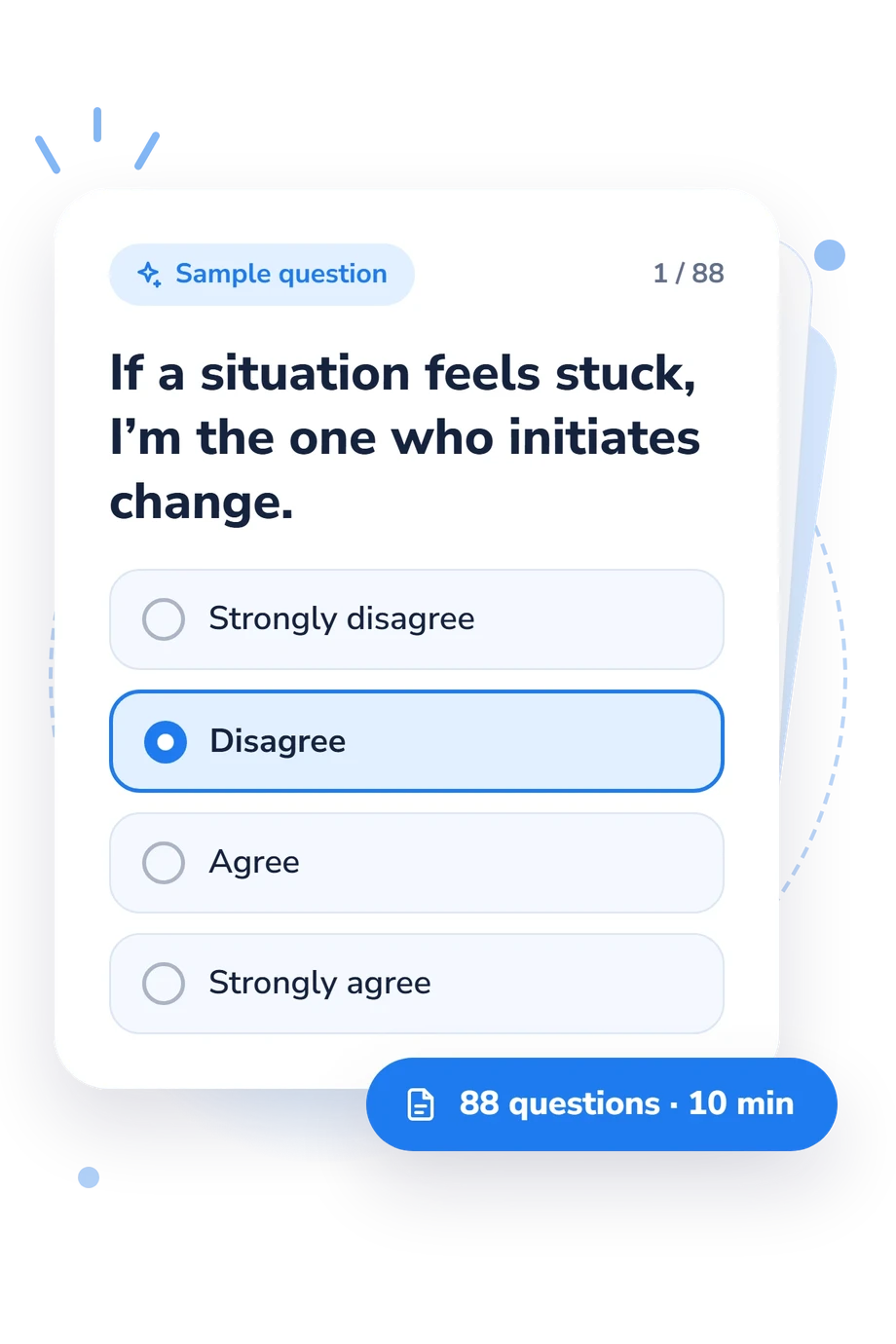
Example Questions From the Test
- Strongly disagree
- Disagree
- Agree
- Strongly agree
- Strongly disagree
- Disagree
- Agree
- Strongly agree
- Strongly disagree
- Disagree
- Agree
- Strongly agree
Fairy Quiz - Description and methodology of the test
People who enjoy symbolic self-reflection can use this assessment to explore how intuition, care, playfulness, and directness shape everyday choices. The fairy quiz is designed for readers who want a light but structured way to understand a personal archetypal pattern. Approached as a which fairy are you quiz, it offers a profile rather than a fixed identity.
What This Assessment Explores
Questions focus on preferences in situations involving change, meaning, care, humor, boundaries, and conflict. The aim is to describe a flexible style, not assign a permanent identity.
For anyone treating it as a fairy personality quiz, the profile keeps the result playful while linking it to recognizable choices.
These are the three displayed dimensions and their result bands:
- Mystic Intuition (0-30) places you in Grounded & Literal (0-10), Balanced Blend (11-20), or Moonlit Mystic (21-30), from practical to symbolic inner knowing.
- Nurturing vs. Mischief (0-30) indicates Nurturing (0-10), Balanced (11-20), or Mischievous (21-30), from protective care to playful disruption.
- Stormfire Assertiveness (0-30) shows Gentle Breeze (0-10), Steady Gust (11-20), or Storm Spark (21-30), from harmony-seeking to direct action.
Read together, they show whether your symbolic style is more reflective, caring, mischievous, gentle, or forceful.
Methodology and Evidence Base
Items are first-person statements about change, symbolism, support, protection, mischief, boundaries, and unfairness. Responses use ordered agreement choices, usually from Strongly disagree to Strongly agree, with Not sure appearing on some items. The task is to rate your typical tendency, not solve a knowledge test.
Responses are combined into the three displayed dimensions. Their ranges and bands are descriptive categories, not population norms or clinical cutoffs; interpretation depends on the catalogue definition and the pattern across the profile.
Although presented as a fairy archetype quiz, its framework is conceptually consistent with the Pearson-Marr Archetype Indicator (Pearson & Marr, 2002), but this questionnaire is not an adaptation of that instrument. Epstein et al. (1996) offer a relevant intuitive-experiential and analytical-rational comparison; Arrindell and van der Ende (1985) a relevant assertiveness comparison; and Glynn and Webster (1992) a relevant playfulness comparison.
As a self-report profile, it can be influenced by current mood, self-awareness, and the desire to identify with a particular fairy style. Treat the result as a reflective snapshot, especially near a band boundary.
- Pearson, Carol S., and Hugh K. Marr. Introduction to Archetypes: The Guide to Interpreting Results from the Pearson-Marr Archetype Indicator Instrument. Center for Applications of Psychological Type, 2002.
- Epstein, Seymour, Rosemary Pacini, Veronika Denes-Raj, and Harriet Heier. Individual differences in intuitive-experiential and analytical-rational thinking styles. Journal of Personality and Social Psychology, 71(2), 390-405, 1996. 10.1037/0022-3514.71.2.390
- Arrindell, Willem A., and Jan van der Ende. Cross-sample invariance of the structure of self-reported distress and difficulty in assertiveness: Experiences with the Scale for Interpersonal Behaviour. Advances in Behaviour Research and Therapy, 7(4), 205-243, 1985. 10.1016/0146-6402(85)90013-X
- Glynn, Mary Ann, and Jane Webster. The Adult Playfulness Scale: An Initial Assessment. Psychological Reports, 71(1), 83-103, 1992. 10.2466/pr0.1992.71.1.83
Updated: