
Freudly+971 508685814hello@freudly.ai
Freudly

Charisma Test

Charisma Test: How Charismatic Are You? Social Test - FreudlyCharisma Test: Assess your social magnetism and influence. Free personality quiz with leadership insights. Take it now!en
With 64 questions taking about 10 minutes, the charisma test explores how your confidence, communication, and warmth shape your social presence. Your result highlights strengths and areas for growth in how you connect with others, offering a practical starting point for self-reflection and more intentional interactions.
Questions: 6410 minutes
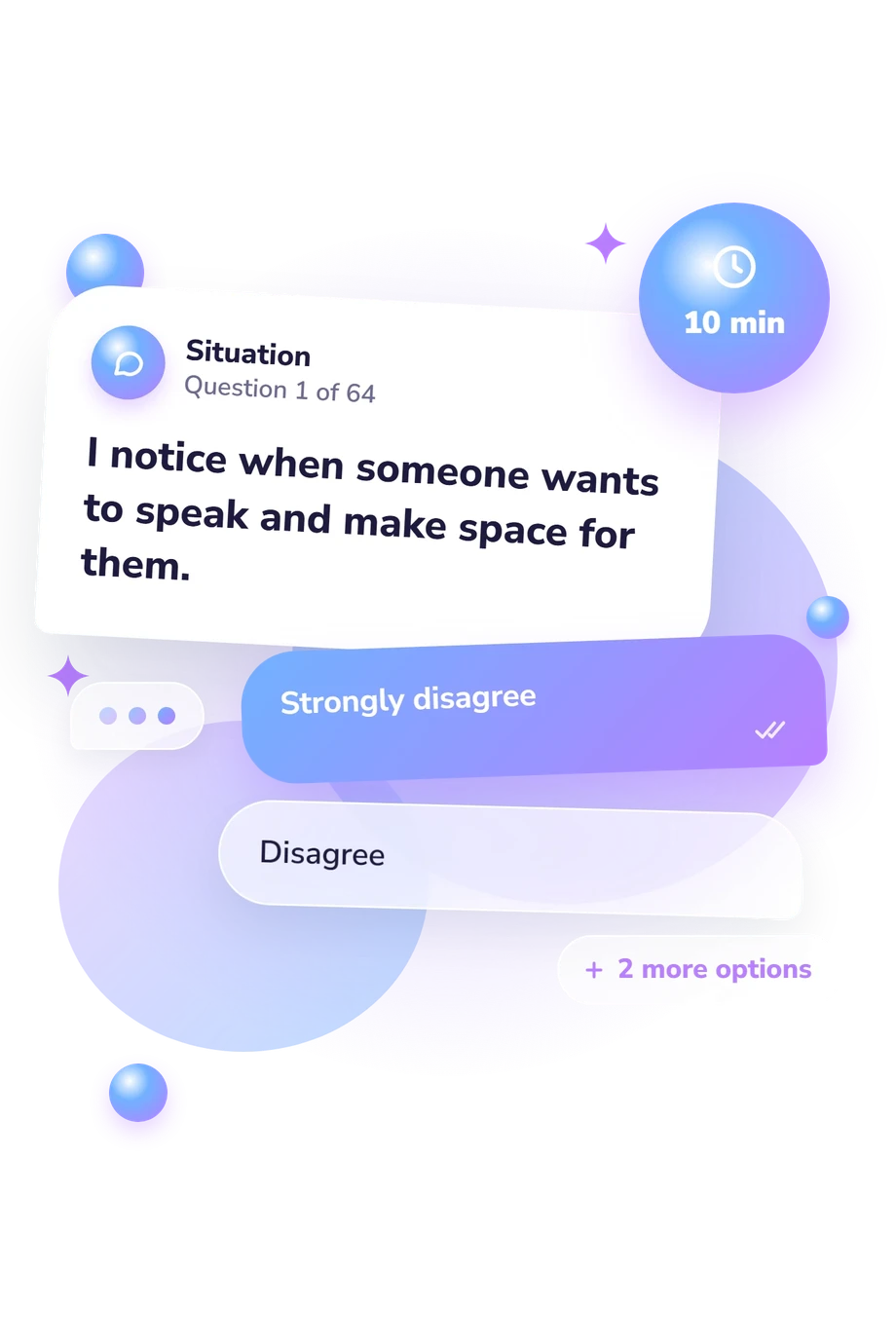
Charisma Test: situation and reply bubbles
March 25, 2026March 25, 2026Material has been updatedMarch 25, 2026Material has been published
8,240 views
2,304 completions
655 likes
Daniel HallPsychologist · Test reviewer
655 likes
Scale Explorer

How the Scales are Structured

Confident PresenceCP
Measures how self-assured and socially present you tend to appear through composure, clarity, decisiveness, and comfort taking space.
example score11/40
11/40Reserved Presenceexample score
0 – 13Reserved Presence
14 – 27Developing Presence
28 – 40Strong Presence
A score of 11 suggests you may come across as more reserved or hesitant in groups, which can make your confidence and visibility less immediately noticeable.
Engaging CommunicationEC
Measures how effectively you connect in conversation through listening, responsiveness, humor, storytelling, and making others feel heard.
example score16/40
16/40Needs More Sparkexample score
0 – 19Needs More Spark
20 – 30Engaging
31 – 40Highly Magnetic
A score of 16 suggests your conversations may sometimes miss cues or feel less energizing, with room to strengthen rapport through more active listening and responsive engagement.
Warmth & ApproachabilityW&A
Measures how friendly, kind, and emotionally welcoming you tend to come across in everyday interactions.
example score21/40
21/40Balancedexample score
0 – 16Reserved
17 – 27Balanced
28 – 40Highly approachable
A score of 21 suggests a balanced level of warmth, where you often seem friendly and open but may come across as more guarded in some situations.
just completed the test
DATA-BASED USER COHORTS

Who Usually Takes This Test?

Socially Curious Improvers
41%OF USERS
People who want a clearer read on how they come across in everyday interactions and what small changes could make them more engaging.
Emerging Leaders and Hosts
34%OF USERS
Students, managers, and community organizers who want to strengthen presence, influence, and group rapport without feeling fake.
Dating and Networking Boosters
25%OF USERS
People preparing for dates, interviews, or new social circles who want to project warmth, confidence, and better conversational flow.
BASED ON AGGREGATED, ANONYMIZED DATA FROM TENS OF THOUSANDS OF FREUDLY USERS.
Benchmarking

See How You Compare

Once you complete the test, your results are compared with real-world data from people in your country.
Below is a preview of how scores are typically distributed across each scale.
Shaded area — where most people score
Dot — the average
You — your score lands on each curve after the test— your score, after the test
Confident PresenceCP
You?
Average28.6
Typical rangeTypical23.6 – 33.7
Possible0 – 40
Engaging CommunicationEC
You?
Average16
Typical rangeTypical9.6 – 22.3
Possible0 – 40
Warmth & ApproachabilityW&A
You?
Average19.1
Typical rangeTypical12 – 26.1
Possible0 – 40
Featured On
SAMPLE QUESTIONS

Example Questions From the Test

    • Strongly disagree
    • Disagree
    • Agree
    • Strongly agree
    • Strongly disagree
    • Disagree
    • Not sure
    • Agree
    • Strongly disagree
    • Disagree
    • Not sure
    • Agree
WHAT THE TEST MEASURES

Charisma Test - Description and methodology of the test

For people entering leadership roles, building professional connections, or joining unfamiliar groups, the charisma test offers a way to examine how they handle social momentum. The charisma assessment can help identify adjustments for introductions, discussions, and first meetings, making unfamiliar situations easier to approach with deliberate, observable habits.

What This Assessment Explores

This questionnaire treats charisma as a social pattern: how composed, engaging, and welcoming you seem in everyday interaction. Items touch on listening, group entry, nonverbal cues, disagreement, and inclusion.

For readers using this charisma quiz, the profile highlights visible strengths and less developed habits rather than a fixed identity.

The result reports three dimensions:

  • Confident Presence (0-40) reflects projected composure and decisiveness: Reserved Presence (0-13), Developing Presence (14-27), or Strong Presence (28-40).
  • Engaging Communication (0-40) reflects listening, responsiveness, humor, and rapport: Needs More Spark (0-19), Engaging (20-30), or Highly Magnetic (31-40).
  • Warmth & Approachability (0-40) reflects friendliness and emotional welcome: Reserved (0-16), Balanced (17-27), or Highly approachable (28-40).

Methodology and Evidence Base

Items are self-report statements answered with graded agreement choices. They ask respondents to rate personal behavior in social situations rather than choose a correct answer. The result reports the three dimensions on the displayed ranges and bands; the questionnaire does not state how individual answers are weighted.

The questionnaire is conceptually consistent with the General Charisma Inventory (Tskhay et al., 2018), which treats charisma as everyday social effectiveness and influence. Verčič and Verčič (2011) add measurement context, while Antonakis, Fenley, and Liechti (2011) support the possibility of practicing some social behaviors. This questionnaire is not an adaptation or revalidation of that instrument.

Read the social magnetism quiz as a self-report profile: a higher band means the tendency is more characteristic of your responses, not a permanent trait. Mood, setting, self-awareness, and impression management can affect answers. No normative or clinical cutoffs are stated for this profile; use the result to guide reflection on how you listen, speak, include, and reassure others.

Literature:
  • Tskhay, Konstantin O., Rebecca Zhu, Christopher Zou, and Nicholas O. Rule. (2018). Charisma in Everyday Life: Conceptualization and Validation of the General Charisma Inventory. Journal of Personality and Social Psychology, 114(1), 131-152. 10.1037/pspp0000159
  • Verčič, Ana Tkalac, and Dejan Verčič. (2011). Generic charisma - Conceptualization and measurement. Public Relations Review, 37(1), 12-19. 10.1016/j.pubrev.2010.12.002
  • Antonakis, John, Marika Fenley, and Sue Liechti. (2011). Can Charisma Be Taught? Tests of Two Interventions. Academy of Management Learning & Education, 10(3), 374-396. 10.5465/amle.2010.0012

Updated:

Popular tests
Comments
Leave a Comment