
Am I Goth Quiz
How the Scales are Structured
Who Usually Takes This Test?
See How You Compare
Below is a preview of how scores are typically distributed across each scale.
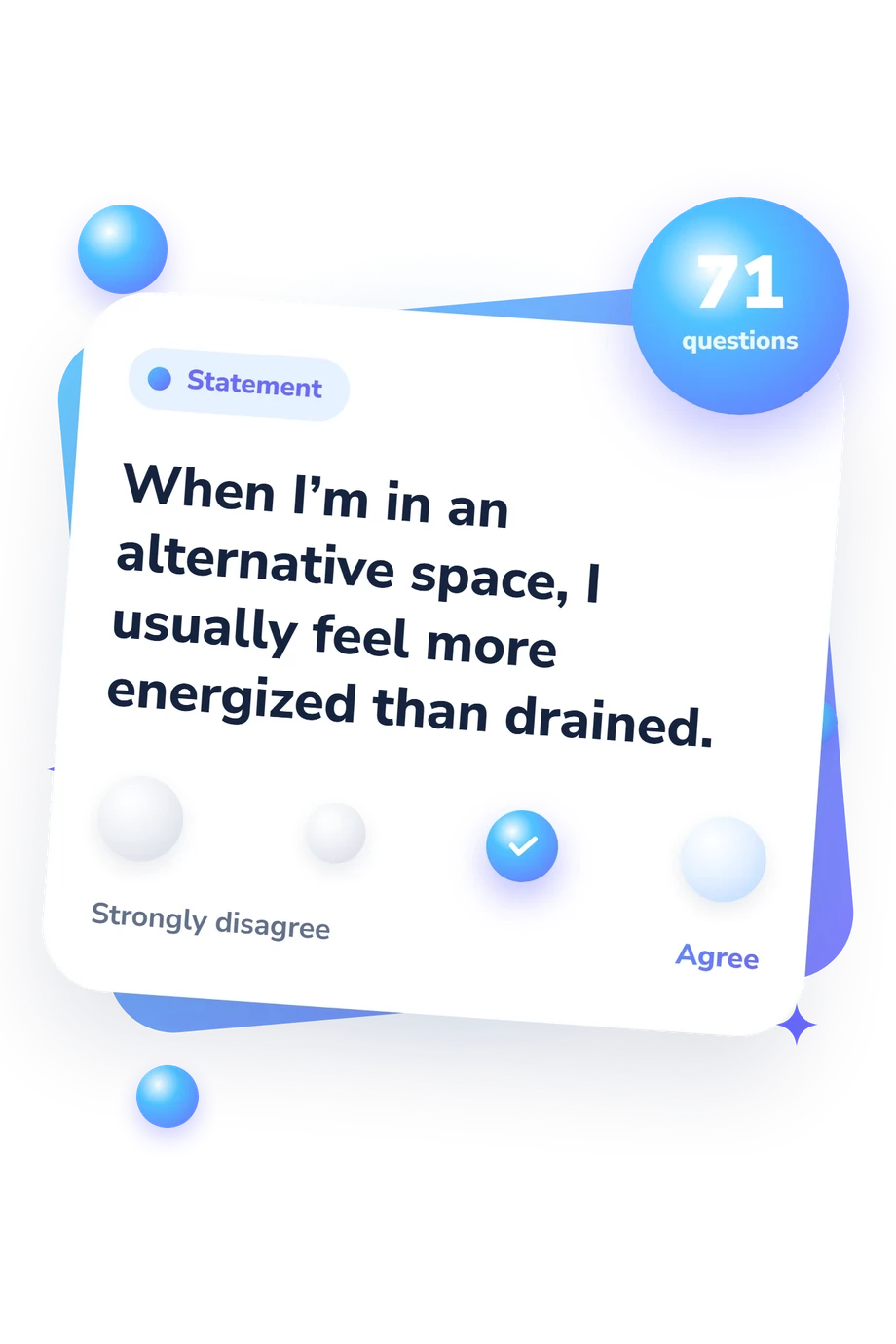
Example Questions From the Test
- Strongly disagree
- Disagree
- Not sure
- Agree
- Strongly disagree
- Disagree
- Not sure
- Agree
- Strongly disagree
- Disagree
- Not sure
- Agree
Am I Goth Quiz - Description and methodology of the test
People curious about their relationship with goth culture can use the Am I Goth Quiz to organize feelings that may be difficult to name. It suits anyone exploring dark fashion, music, self-expression, or alternative communities, whether the interest is new or long-standing. The profile describes how visual, musical, and social preferences fit together, making this goth identity quiz useful for exploring a connection without assigning a permanent identity.
What This Assessment Explores
Questions link clothing, décor, music, self-expression, and participation in alternative spaces. The assessment distinguishes occasional dark interest from a stable aesthetic, social comfort, and broader fit with goth traits, so this goth quiz maps related dimensions rather than one type.
The three displayed dimensions are:
- Aesthetic Consistency (0-20) measures consistency in clothing, décor, visuals, and self-presentation: Occasional Dark Vibes (0-7), Mixed but Intentional (8-14), or Consistently Goth-Leaning (15-20).
- Alt Scene Comfort (0-20) measures ease and engagement in clubs, shows, online communities, and thrift or DIY spaces: Tentative (0-6), Comfortable Explorer (7-13), or Scene-At-Home (14-20).
- Goth Alignment (0-40) measures how strongly style, music, aesthetics, and values fit recognized goth traits: Light Goth Lean (0-13), Moderate Goth Fit (14-26), or Strong Goth Alignment (27-40).
Together, they profile aesthetic consistency, scene comfort, and overall alignment; the dimensions can vary independently rather than assigning one dominant category.
Methodology and Scientific Basis
The demonstrated questions use four responses-Strongly disagree, Disagree, Not sure, or Agree-and cover dark visuals, goth music, DIY style, self-expression, or alternative communities. Responses feed the displayed dimensions, but the questionnaire does not state item-by-item weights, so readers should not reconstruct point values from the ranges.
Hodkinson’s (2002) account connects goth identity with style, subcultural participation, and meaning, and the questionnaire is conceptually consistent with that account without being an adaptation of the published work. The themes also align with Healey and Fraser’s work on style and spirituality and with Darchen, Browning, and Willsteed’s account of goth and punk scenes as alternative social spaces.
The displayed bands are descriptive rather than normative, showing how answers group within this questionnaire rather than defining a threshold for goth identity. The result’s value as a goth style assessment lies in showing how self-reported preferences and comfort come together. Mood, wardrobe, social access, musical exposure, self-awareness, and label interpretation can affect answers, making broader personal context important.
- Hodkinson, Paul. Goth: Identity, Style and Subculture. Berg Publishers, 2002. ISBN 9781859736005.
- Healey, Kevin, and Leigh Fraser. “A common darkness: Style and spirituality in Goth subculture.” Journal of Popular Music Studies 29(3), e12231, 2017. 10.1111/jpms.12231
- Darchen, Sébastien, Yanto Browning, and John Willsteed. “Alternative Brisbane: Evolution of goth and punk subcultures as ‘counter-cities’.” Cities 141, 104484, 2023. 10.1016/j.cities.2023.104484
Updated: