
Spanish Speaking Countries Capitals Quiz
How the Scales are Structured
Who Usually Takes This Test?
See How You Compare
Below is a preview of how scores are typically distributed across each scale.
Example Questions From the Test
- Peru
- Ecuador
- Chile
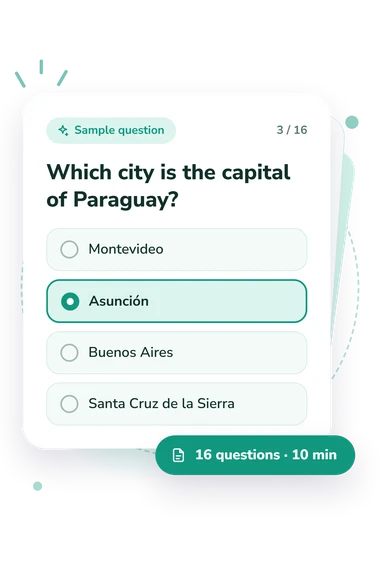
- Paraguay
- Montevideo
- Asunción
- Buenos Aires
- Santa Cruz de la Sierra
- Santiago
- Quito
- Caracas
- Lima
Spanish Speaking Countries Capitals Quiz - Description and methodology of the test
Anyone brushing up on world geography can use the Spanish Speaking Countries Capitals Quiz to test how accurately they recognize country-capital pairs. Readers can approach it as a quiz about the capitals of Spanish-speaking countries for focused practice, whether they are learners, travelers, or curious adults. The result places overall performance in one of the knowledge bands and can suggest general review without identifying specific strengths or weaknesses.
What This Assessment Measures
This quiz measures national-capital recall across Spanish-speaking countries, including Spain. A quiz about Spanish-speaking countries and their capitals asks readers to identify capitals from countries or countries from capitals while distinguishing nearby distractors. It suits learners, travelers, and anyone reviewing geography.
These item themes contribute to the single overall knowledge score:
- Country-to-capital recall shows whether you can select the city linked to a nation.
- Capital-to-country recognition shows whether a city leads you to its country.
- Regional discrimination shows whether you can separate neighboring Central and South American capitals.
- Contextual geography shows whether you can apply facts in travel or civic situations.
The scale Spanish-Speaking Countries Capitals Knowledge (0-16) records the number of correct answers. Foundations to build covers 0-6, Developing knowledge covers 7-12, and Strong knowledge covers 13-16. These bands summarize performance here, not total geography knowledge.
Methodology and Evidence Base
Each item uses four-option multiple choice. Prompts name a country and ask for its capital, reverse that relationship, or place the fact in a travel, news, civic, or clue. Because this test is a quiz about Spanish-speaking countries and capitals, its format checks retrieval when wording changes; distractors include nearby places, former capitals, and cities from other countries.
Scoring is direct: the result is the number of correct responses. No weighting, penalty, or separate subscale is stated, so the total is a performance summary rather than a detailed learning profile.
Conceptually, the quiz is consistent with Crutch and Warrington (2003) on geographic proximity in country and city knowledge. Friedman and deWinstanley (2006) and Crutch and Warrington (2010) likewise describe geographic concepts as linked, spatially organized place knowledge. These papers provide conceptual background only; they do not validate this questionnaire or turn it into a standardized adaptation.
Its bands summarize performance on this location set rather than the whole of geography. Results may reflect education, travel, language exposure, regional familiarity, and attention; use them to guide review of capitals.
- Crutch, Sebastian J., and Elizabeth K. Warrington. "Spatial coding of semantic information: knowledge of country and city names depends on their geographical proximity." Brain 126, no. 8 (2003): 1821-1829. 10.1093/brain/awg187
- Friedman, William J., and Patricia A. deWinstanley. "The mental representation of countries." Memory 14, no. 7 (2006): 853-871. 10.1080/09658210600782925
- Crutch, Sebastian J., and Elizabeth K. Warrington. "Spatially coded semantic information about geographical terms." Neuropsychologia 48, no. 7 (2010): 2120-2129. 10.1016/j.neuropsychologia.2010.04.003