
Freudly+971 508685814hello@freudly.ai
Freudly

College Major Quiz

College Major Quiz - Free Academic Pathway Test - FreudlyTake a free college major quiz to explore your college major knowledge and discover your results. Quick, no sign-up needed. Start now!en
With 20 questions taking about 10 minutes, the college major quiz helps you explore which broad academic pathways match your current interests. Your result highlights affinities across creative, business, technical, scientific, and social fields, giving you a clearer starting point for comparing majors and planning further exploration.
Questions: 2010 minutes
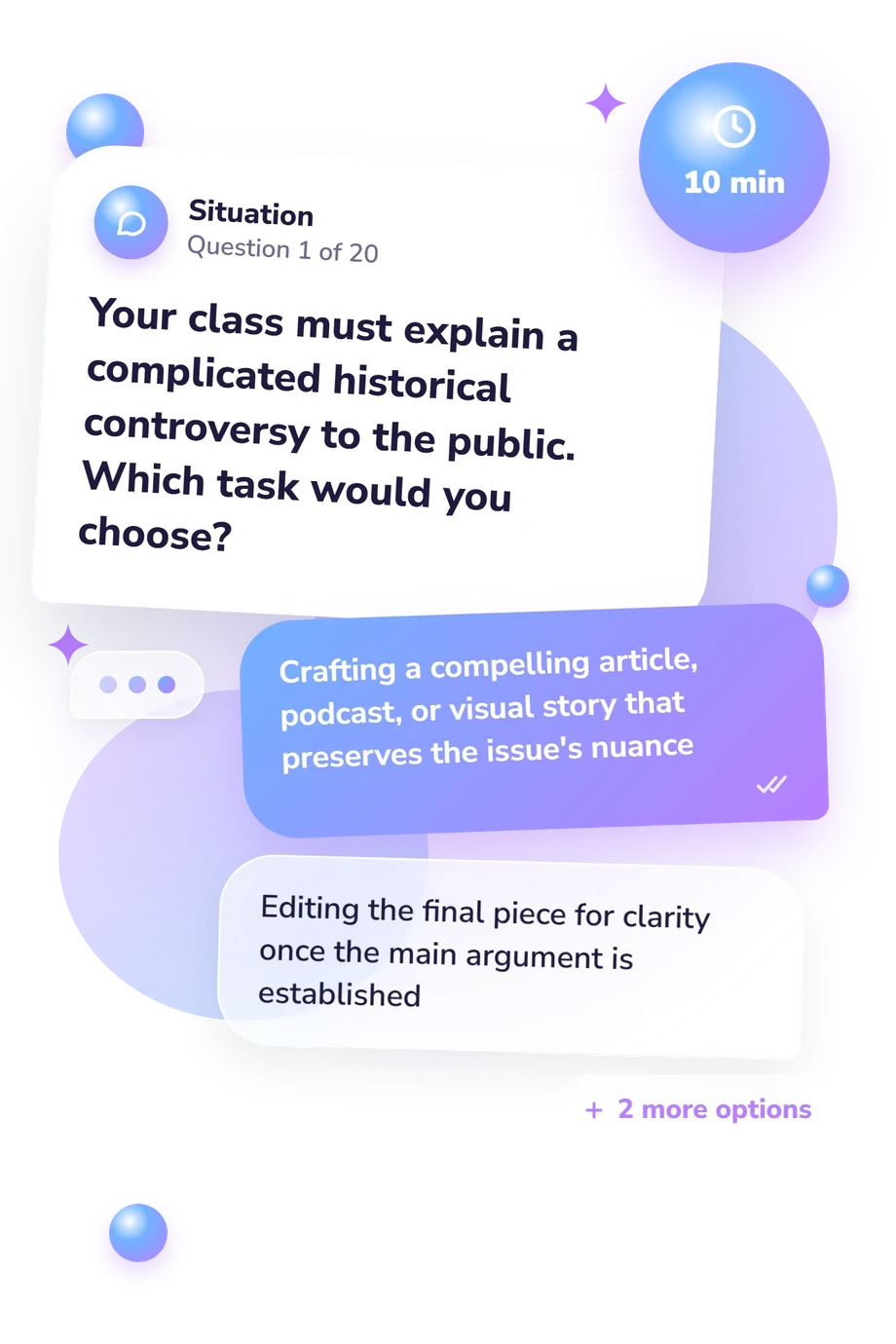
College Major Quiz: situation and reply bubbles
July 22, 2026July 22, 2026Material has been updatedJuly 22, 2026Material has been published
8,795 views
771 completion
680 likes
Daniel HallPsychologist · Test reviewer
680 likes
Scale Explorer

How the Scales are Structured

Arts, Humanities & CommunicationAH&C
Measures affinity for creative expression, language, culture, interpretation, and communication-focused study.
example score6/12
6/12Selective Arts/Humanities Interestexample score
0 – 4Other Interests Lead
5 – 8Selective Arts/Humanities Interest
9 – 12Strong Arts/Humanities Affinity
A score of 6 suggests a selective interest in arts, humanities, or communication, with certain topics or formats likely to be especially engaging.
Business & EconomicsB&E
Measures your current affinity for markets, organizations, financial choices, strategy, and resource allocation.
example score4/12
4/12Other interests leadexample score
0 – 4Other interests lead
5 – 8Context-dependent interest
9 – 12Strong business & economics affinity
A score of 4 suggests business and economics questions are not a central draw right now compared with your other interests.
Engineering & ComputingE&C
Measures affinity for building, coding, quantitative modeling, and improving technical systems.
example score5/12
5/12Applied-tech curiosityexample score
0 – 4Other approaches lead
5 – 8Applied-tech curiosity
9 – 12Strong engineering & computing affinity
A score of 5 suggests applied-tech curiosity, where selected tools or hands-on technical projects may be a good area to explore.
Science & HealthS&H
Measures your current affinity for scientific investigation, living systems, health questions, and evidence-based inquiry.
example score6/12
6/12Selective science interestexample score
0 – 4Other interests lead
5 – 8Selective science interest
9 – 12Strong science & health affinity
A score of 6 suggests a selective interest in science and health themes, with certain topics or applied settings likely to feel more engaging than others.
Society & Public ServiceS&PS
This scale measures affinity for studying human behavior, social systems, policy, education, and community-focused work.
example score6/12
6/12Focused social interestexample score
0 – 4Other interests lead
5 – 8Focused social interest
9 – 12Strong public-service affinity
A score of 6 suggests a focused interest in society and public service topics, with certain populations, issues, or community questions likely standing out more than others.
just completed the test
DATA-BASED USER COHORTS

Who Usually Takes This Test?

Undecided high school seniors
44%OF USERS
Students nearing graduation who want a clearer direction before applying and choosing programs.
First-year college explorers
33%OF USERS
New college students weighing majors based on what topics and types of assignments they genuinely enjoy.
Transfer and switch candidates
23%OF USERS
Students considering changing schools or majors who want to compare several pathways and see likely blends.
BASED ON AGGREGATED, ANONYMIZED DATA FROM TENS OF THOUSANDS OF FREUDLY USERS.
Benchmarking

See How You Compare

Once you complete the test, your results are compared with real-world data from people in your country.
Below is a preview of how scores are typically distributed across each scale.
Shaded area — where most people score
Dot — the average
You — your score lands on each curve after the test— your score, after the test
Arts, Humanities & CommunicationAH&C
You?
Average3.1
Typical rangeTypical1.1 – 5.1
Possible0 – 12
Business & EconomicsB&E
You?
Average6.4
Typical rangeTypical4.9 – 7.9
Possible0 – 12
Engineering & ComputingE&C
You?
Average6.1
Typical rangeTypical4.4 – 7.7
Possible0 – 12
Science & HealthS&H
You?
Average5.8
Typical rangeTypical4.1 – 7.4
Possible0 – 12
Society & Public ServiceS&PS
You?
Average5.2
Typical rangeTypical3.5 – 6.9
Possible0 – 12
Featured On
SAMPLE QUESTIONS

Example Questions From the Test

    • Crafting a compelling article, podcast, or visual story that preserves the issue's nuance
    • Editing the final piece for clarity once the main argument is established
    • Preparing a short factual timeline for others to use
    • Building a database that organizes the source materials
    • Biology, chemistry, and human physiology
    • One health-science course combined with classes from unrelated fields
    • A broad science survey that has little laboratory work
    • Courses centered on markets, media, or cultural interpretation instead
    • Gathering perspectives, identifying power and access concerns, and helping develop a workable policy
    • Running a structured survey and summarizing the main points of disagreement
    • Helping communicate a decision after others resolve the conflict
    • Creating visual materials for whichever event eventually uses the space
WHAT THE TEST MEASURES

College Major Quiz - Description and methodology of the test

Students comparing academic directions can use this major quiz to organize interests before researching majors, courses, or careers. It makes that comparison more concrete by showing which kinds of academic work attract attention. It is useful when asking what major should I choose and wanting a quiz-based comparison. The college major quiz is intended for people who want a structured starting point rather than a single prescribed answer.

What This Assessment Explores

Results describe academic affinity, not grades or talent. As a quiz about choosing a major, it frames what should I major in as exploration, not a permanent verdict. The pathways are:

  • Arts, Humanities & Communication (0-12) measures creative-cultural affinity: Other Interests Lead (0-4); Selective Arts/Humanities Interest (5-8); Strong Arts/Humanities Affinity (9-12).
  • Business & Economics (0-12) measures markets, strategy, and resources: Other interests lead (0-4); Context-dependent interest (5-8); Strong business & economics affinity (9-12).
  • Engineering & Computing (0-12) measures building, coding, and systems: Other approaches lead (0-4); Applied-tech curiosity (5-8); Strong engineering & computing affinity (9-12).
  • Science & Health (0-12) measures science, health, and living systems: Other interests lead (0-4); Selective science interest (5-8); Strong science & health affinity (9-12).
  • Society & Public Service (0-12) measures people, policy, education, and communities: Other interests lead (0-4); Focused social interest (5-8); Strong public-service affinity (9-12).

Methodology and Scientific Basis

Items present subject clusters, academic situations, questions, or study preferences, each with four alternatives. The choices concern subjects, tasks, or approaches; selecting one records preference rather than competence, with no correct answers.

Responses form pathway totals. The highest signals strongest affinity; totals within one point suggest a blended profile. When exploring what to major in, students can compare it with course descriptions. The questionnaire does not disclose how each response contributes to a total, so totals are comparative affinity signals, not independently reproducible calculations.

Päßler and Hell (2012) linked interests and abilities with college major choice. This online self-reflection format is conceptually consistent with Holland’s RIASEC model and the ACT Interest Inventory, but is neither a published instrument nor a validated adaptation. Those sources contextualize these themes; they do not validate this questionnaire.

For students asking what should I major in college, this free quiz offers a starting point rather than a decision rule. No norms or clinical cutoffs are stated; self-report may shift with mood, experience, self-awareness, or expectations. The profile reflects preferences, not ability, admission readiness, or career success.

Literature:
  • Päßler, K., & Hell, B. (2012). Do Interests and Cognitive Abilities Help Explain College Major Choice Equally Well for Women and Men? Journal of Career Assessment, 20(4), 479-496. 10.1177/1069072712450009
  • ACT. (2023). ACT Interest Inventory Technical Manual. ACT, Inc.
  • Holland, J. L. (1997). Making Vocational Choices: A Theory of Vocational Personalities and Work Environments (3rd ed.). Odessa, FL: Psychological Assessment Resources.

Updated:

Popular tests
Comments
Leave a Comment