
Are You Smarter Than a 5th Grader Quiz
How the Scales are Structured
Who Usually Takes This Test?
See How You Compare
Below is a preview of how scores are typically distributed across each scale.
Example Questions From the Test
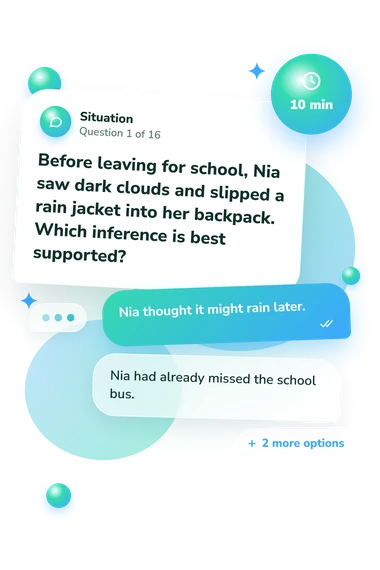
- Nia thought it might rain later.
- Nia had already missed the school bus.
- Nia disliked wearing jackets.
- Nia knew school would be canceled.
- 1 1/4 cups
- 1 1/2 cups
- 1 3/4 cups
- 2 1/4 cups
- 80 square meters
- 26 square meters
- 13 square meters
- 40 square meters
Are You Smarter Than a 5th Grader Quiz - Description and methodology of the test
Designed for readers who want a quick check of school-subject recall, the Are You Smarter Than a 5th Grader Quiz turns familiar classroom tasks into an accessible self-assessment. It suits curious adults, students, and anyone revisiting foundational knowledge. The result reflects your accuracy on the mixed question sample. This 5th grade quiz focuses on practical knowledge drawn from elementary subjects.
What This Assessment Explores
The questions sample four areas of foundational learning. Arithmetic covers fractions, area, division, and money. Reading and language examine inference, vocabulary, grammar, and usage. Science covers controls, matter, condensation, seasons, and food chains. Social studies draws on civics and American history.
The sampled content groups are:
- Arithmetic shows how accurately you apply quantitative relationships.
- Reading and language indicate how well you infer meaning and recognize standard usage.
- Science reflects your grasp of evidence, physical processes, life science, and Earth science.
- Social studies captures recall of foundational civic and historical ideas.
Together, these groups contribute to one aggregate result rather than separate subject scores. As a quiz about whether you are smarter than a fifth grader, it describes performance on this mixed sample rather than overall intelligence.
Methodology and Content Context
Each item is multiple choice: a short scenario or direct question is followed by four options, and you select the best-supported response. The mix tests recall and simple application rather than extended calculation, written explanation, or open-ended reasoning. Because it is a fifth-grade knowledge quiz, the result reflects the answers selected across the sample rather than any written explanation.
These frameworks provide content context only: the questions overlap in topic with the Next Generation Science Standards, the Common Core State Standards, and the C3 Framework for Social Studies. They do not establish reliability, validity, norms, or a standardized scoring system for this questionnaire.
Results appear on the Fifth-Grade Knowledge scale, 0-16: Foundations to revisit (0-6), Developing command (7-12), and Strong command (13-16). These bands summarize performance on this question set. Concentration, guessing, prior schooling, and topic familiarity can influence a short self-administered result, so use it as a prompt for focused review.
- NGSS Lead States. (2013). Next Generation Science Standards: For States, By States. Washington, DC: The National Academies Press. 10.17226/18290.
- National Governors Association Center for Best Practices & Council of Chief State School Officers. (2010). Common Core State Standards for English Language Arts & Literacy in History/Social Studies, Science, and Technical Subjects. Washington, DC: Authors.
- National Governors Association Center for Best Practices & Council of Chief State School Officers. (2010). Common Core State Standards for Mathematics. Washington, DC: Authors.
- Swan, Kathy; Barton, Keith C.; Buckles, Stephen; Burke, Flannery; Charkins, Jim; Grant, S. G.; Hardwick, Susan W.; Lee, John; Levine, Peter; Levinson, Meira; Marri, Anand; Monte-Sano, Chauncey; Morrill, Robert; Thomas-Brown, Karen; Tyson, Cynthia; VanSledright, Bruce; and Wiesner-Hanks, Merry. (2013). The College, Career, and Civic Life (C3) Framework for Social Studies State Standards: Guidance for Enhancing the Rigor of K-12 Civics, Economics, Geography, and History. Silver Spring, MD: National Council for the Social Studies.
Updated: