
Alignment Quiz
How the Scales are Structured
Who Usually Takes This Test?
See How You Compare
Below is a preview of how scores are typically distributed across each scale.
Example Questions From the Test
- Obeying every government law without exception
- Supporting whichever authority currently holds power
- Treating rules as more important than every living being
- Valuing consistent codes, duties, traditions, or ordered systems
- Neutral Good
- Lawful Neutral
- True Neutral
- Chaotic Neutral
- Law versus chaos and good versus evil
- Tradition versus progress and courage versus fear
- Reason versus emotion and loyalty versus independence
- Order versus disorder and honesty versus deception
Alignment Quiz - Description and methodology of the test
Players, game masters, and curious readers can use this assessment to test how the classic framework organizes fictional motives and behavior. The alignment quiz checks whether you can identify alignments and their principles through examples involving order, freedom, altruism, neutrality, and harm. This quiz about moral alignment evaluates command of a role-playing model rather than your personal ethics. The result points to concepts that may deserve review.
What This Assessment Explores
Two axes organize the framework: law versus chaos and good versus evil. Presented as a nine-cell grid, this quiz about the alignment chart asks you to connect each position with its priorities.
Questions cover three kinds of framework knowledge:
- Axis knowledge shows whether you separate law from chaos and good from evil.
- Concept comparison shows whether you distinguish neighboring alignments.
- Scenario application shows whether you match fictional conduct and use alignment as a recurring guide, not a complete personality.
This quiz about character alignment reports Alignment Knowledge (0-16): knowledge of the classic nine-alignment framework, not personal moral character. Foundations to build (0-6) means the axes and their combinations need review; Developing command (7-12) shows understanding but possible confusion between neighboring alignments or motives; Strong command (13-16) indicates that close concepts can be distinguished and applied consistently to character scenarios.
Methodology and Evidence Base
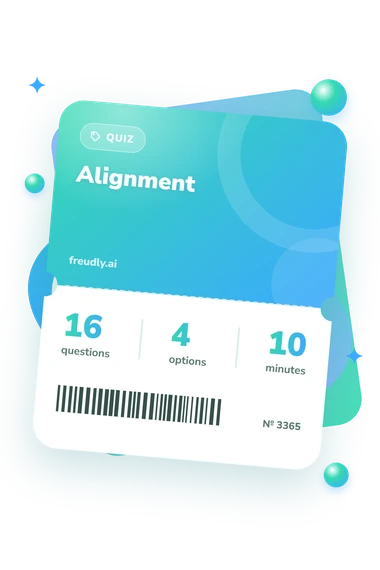
Each question uses four answer choices. Some ask for a definition or distinction; others require the best fit for a fictional scenario. The four-choice responses produce the displayed result.
Within this chaotic good quiz, scenarios in the questionnaire test the distinction between benevolent aims and a preference for personal freedom over ordered systems. This is a content-based knowledge check, not a personality measure built from self-rated traits.
The content is conceptually consistent with the Dungeons & Dragons alignment system. Gary Gygax's early formulation and handbook describe the two axes and their categories, while Miles and Hess discuss alignment as a character concept with interpretive limits. These sources clarify the model's two axes and nine categories.
The displayed bands describe framework familiarity and should not be treated as population norms. Prior role-playing experience, interpretation of motives, and current attention can affect performance. It is most useful for checking concepts, refining character analysis, and identifying topics for further study.
- Crawford, Jeremy, James Wyatt, Robert J. Schwalb, and Bruce R. Cordell. Player's Handbook: Everything a Player Needs to Create Heroic Characters for the World's Greatest Roleplaying Game. Wizards of the Coast, 2014. ISBN 978-0-7869-6560-1.
- Gygax, Gary. Players Handbook. TSR, 1978. ISBN 0-935696-01-6.
- Gygax, Gary. "The Meaning of Law and Chaos in Dungeons & Dragons and Their Relationships to Good and Evil." The Strategic Review, vol. 2, no. 1, 1976, pp. 3-5.
- Miles, J. K., and Karington Hess. "Paragons and Knaves: Does Good Character Make for a Good Character?" In Dungeons and Dragons and Philosophy: Read and Gain Advantage on All Wisdom Checks, edited by Christopher Robichaud and William Irwin, Wiley-Blackwell, 2014, pp. 23-34. 10.1002/9781118921166.ch2.