
Misinformation Susceptibility Test
How the Scales are Structured
Who Usually Takes This Test?
See How You Compare
Below is a preview of how scores are typically distributed across each scale.
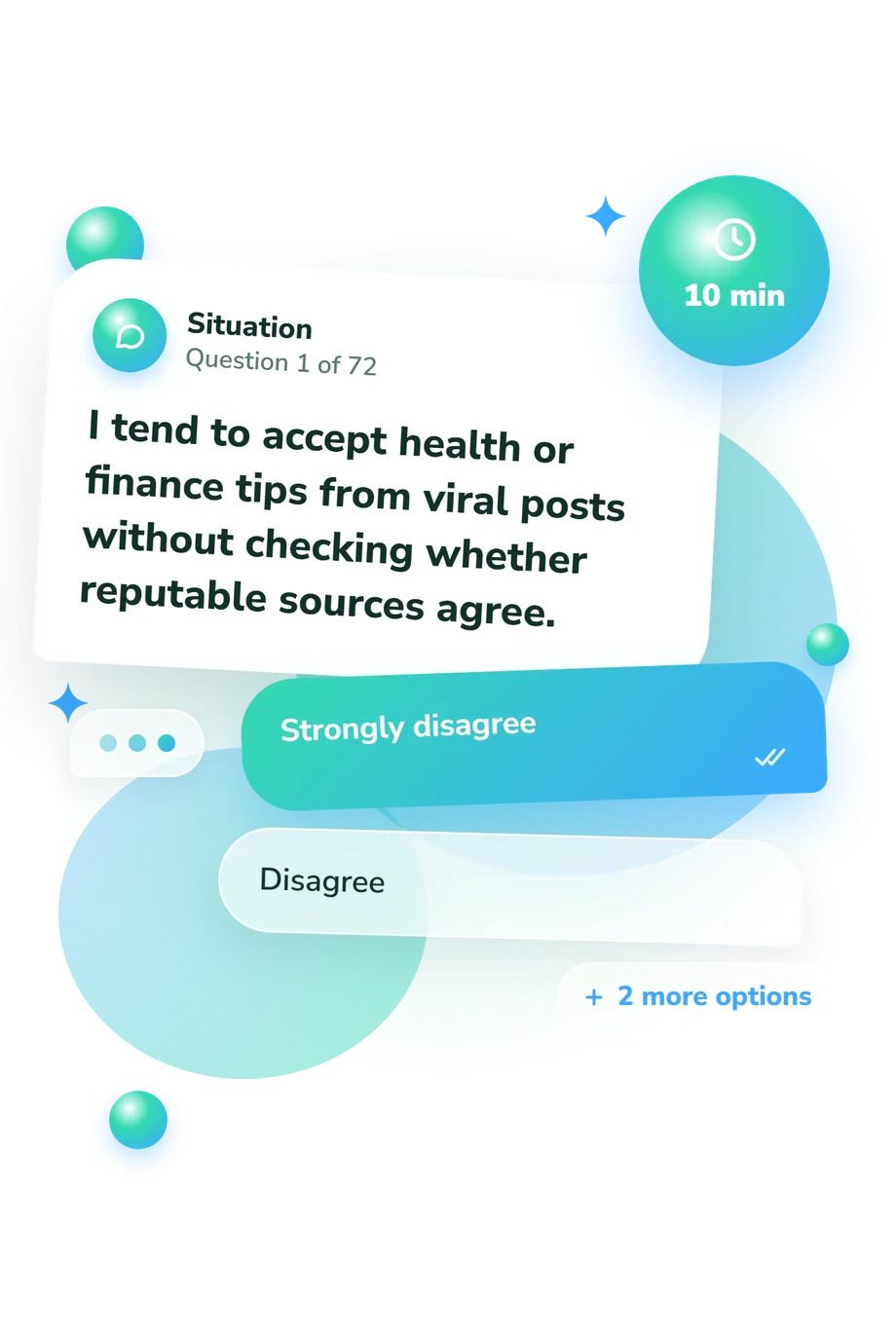
Example Questions From the Test
- Strongly disagree
- Disagree
- Not sure
- Agree
- Strongly disagree
- Disagree
- Not sure
- Agree
- Strongly disagree
- Disagree
- Not sure
- Agree
Misinformation Susceptibility Test - Description and methodology of the test
For readers who want to understand why online claims feel convincing, the misinformation susceptibility test offers a structured self-check of their evaluation habits. It is intended for people who want an assessment of misinformation susceptibility to clarify which parts of their judgment merit closer attention. The result helps them identify patterns worth examining and approach online claims more deliberately.
What This Assessment Explores
Items in this online misinformation questionnaire present viral advice, dramatic visuals, confident wording, repeated claims, and incomplete screenshots as persuasive contexts. Familiarity, identity, and presentation style remain item contexts, not separate scales.
Responses examine emotional reactions and confirmation bias, plus source checking, independent corroboration, and detail verification before belief or sharing. As a self-check, it makes these patterns practical to examine.
Three displayed scales organize the result:
- Bias & Emotion Reactivity (0-20) measures emotional reactions and confirmation bias in claim judgments: Reflective & Balanced (0-6), Mixed Reactivity (7-13), or Bias/Emotion-Driven (14-20).
- Susceptibility Score (0-40) measures influence from misleading headlines, edited visuals, or confident-sounding claims: Low susceptibility (0-13), Moderate susceptibility (14-26), or High susceptibility (27-40).
- Verification Habits (0-20) measures consistent, effective source checking, corroboration, and detail verification before believing or sharing: Infrequent verification (0-7), Sometimes verifies (8-14), or Consistent verification (15-20).
Methodology and Evidence Base
First-person statements use ordered response choices: some use four-point agreement options from Strongly disagree to Agree, while others use frequency options from Never to Almost always. This format captures reactions to claims and reported checking behavior.
The questionnaire combines responses into displayed dimensions rather than relying on one answer. Because the ranges do not reveal item weights or reverse-scoring, the output describes response patterns, not a calculated probability of believing false information.
MIST (Maertens et al., 2024) provides the closest methodological comparison: a psychometrically validated measure of judging news accuracy. This questionnaire is conceptually consistent with MIST, not a direct adaptation, so that validation cannot automatically be transferred to its exact items or result bands.
Emotion-focused content is consistent with Martel et al. (2020), whose findings connected reliance on emotion with belief in fake news. Checking and corroboration also relate to Guess et al. (2020), who studied whether digital media literacy could improve discrimination between reliable and false news.
Used as a misinformation susceptibility assessment, the output is a descriptive self-report profile. Current mood, self-awareness, and willingness to report habits accurately can affect answers; the displayed bands organize this questionnaire’s results but are not population norms.
- Maertens, R., Götz, F. M., Golino, H. F., Roozenbeek, J., Schneider, C. R., Kyrychenko, Y., Kerr, J. R., Stieger, S., McClanahan, W. P., Drabot, K., He, J., & van der Linden, S. (2024). The Misinformation Susceptibility Test (MIST): A psychometrically validated measure of news veracity discernment. Behavior Research Methods, 56(3), 1863-1899. 10.3758/s13428-023-02124-2
- Martel, C., Pennycook, G., & Rand, D. G. (2020). Reliance on emotion promotes belief in fake news. Cognitive Research: Principles and Implications, 5(1), Article 47. 10.1186/s41235-020-00252-3
- Guess, A. M., Lerner, M., Lyons, B., Montgomery, J. M., Nyhan, B., Reifler, J., & Sircar, N. (2020). A digital media literacy intervention increases discernment between mainstream and false news in the United States and India. Proceedings of the National Academy of Sciences of the United States of America, 117(27), 15536-15545. 10.1073/pnas.1920498117
Updated: