
Masochist Test
How the Scales are Structured
Who Usually Takes This Test?
See How You Compare
Below is a preview of how scores are typically distributed across each scale.
Example Questions From the Test
- Strongly disagree
- Disagree
- Not sure
- Agree
- Strongly disagree
- Disagree
- Agree
- Strongly agree
- Strongly disagree
- Disagree
- Not sure
- Agree
Masochist Test - Description and methodology of the test
People who want to understand consent, endurance, guilt, or intense experience may use this assessment for self-reflection. The masochist test presents separate tendencies involving power and boundary clarity, self-sacrifice and guilt, and attraction to intensity. This masochist quiz helps examine whether discomfort reflects chosen intensity, relational pressure, difficulty asserting limits, or a need to earn care.
What This Assessment Explores
Three separate areas-power and boundary clarity, self-sacrifice and guilt, and attraction to intensity-keep masochism from being treated as one fixed trait. This masochism test helps examine whether discomfort is chosen, pressured, or linked to self-neglect while keeping possibilities separate. The dimensions are:
- Power Dynamics & Boundary Clarity (0-30) measures comfort with negotiated control and clarity about boundaries and consent; bands are Low clarity/interest (0-10), Moderate comfort & clarity (11-20), and High comfort & clear boundaries (21-30).
- Self-Sacrifice & Guilt (0-30) measures guilt-driven endurance and reciprocity; bands are Balanced Reciprocity (0-10), Mixed Patterns (11-20), and Guilt-Driven Self-Sacrifice (21-30).
- Sensation & Discomfort Seeking (0-30) measures attraction to intense or uncomfortable experiences; bands are Comfort-Oriented (0-10), Balanced Intensity (11-20), and High Sensation-Seeking (21-30).
Read separately, the results prompt reflection on consent, limits, guilt, and attraction to intensity rather than a single judgment.
Methodology and Scientific Basis
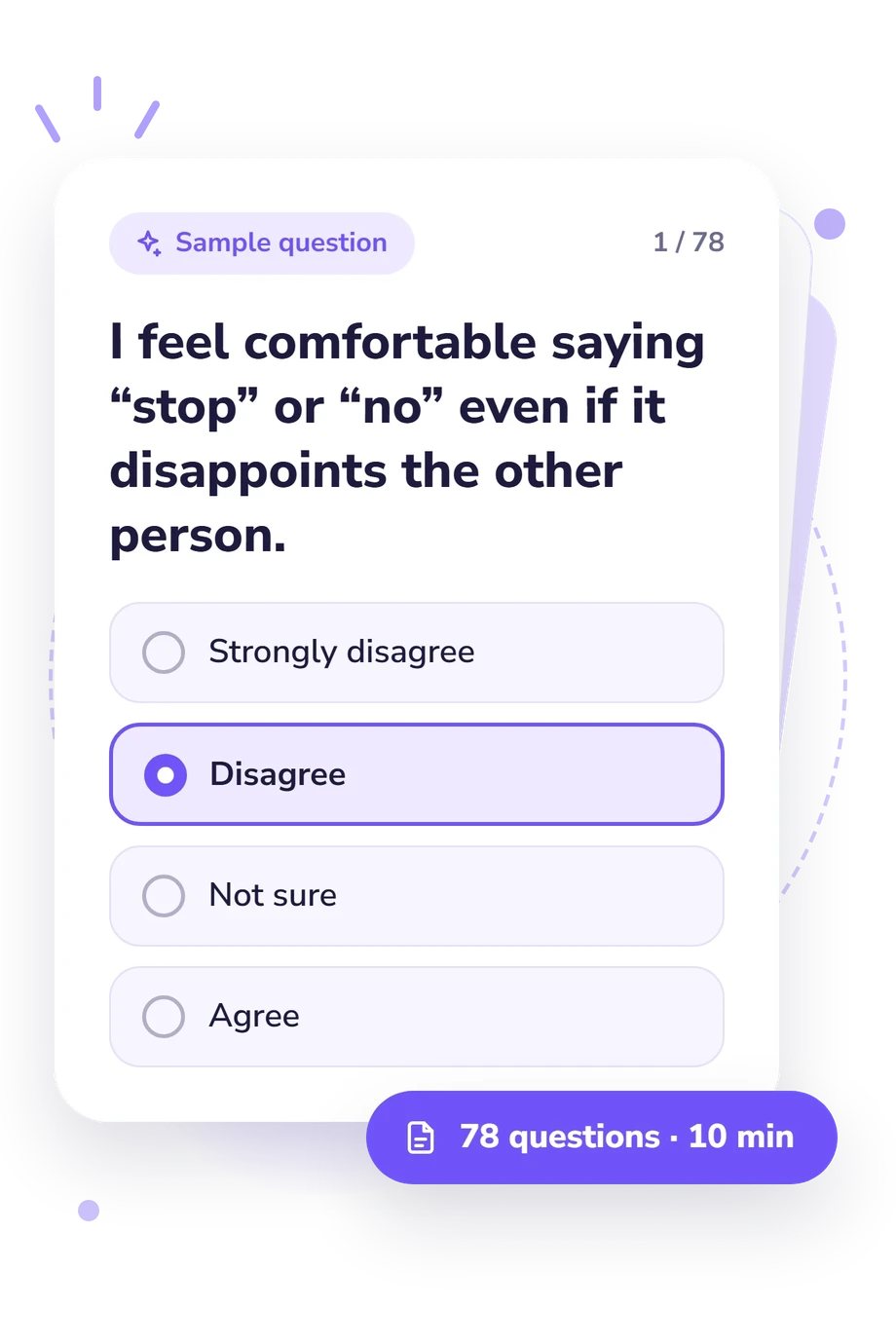
Its first-person statements address boundaries, guilt, conflict, support, power exchange, and attraction to discomfort; this masochist tendencies quiz organizes those themes into a self-report. The sample shows four response options: most use Strongly disagree, Disagree, Not sure, and Agree, while some intensity-focused items use Strongly agree instead of Not sure. Responses form three scale totals rather than one verdict, so the result is a pattern profile, not a fixed identity.
The questionnaire is conceptually consistent with Weierstall and Giebel's 2017 Sadomasochism Checklist, a related measure of sadomasochistic behavior, but is a separate questionnaire with its own scales. A 2020 study by Sagioglou and Greitemeyer links common nonsexual masochistic preferences with antisocial traits, but that association cannot be applied to an individual result. Rozin and colleagues' 2013 work describes benign masochism as voluntary engagement with unpleasant sensations that can become rewarding.
Self-report answers can reflect mood, relationships, self-awareness, and candour. Here, the displayed bands are descriptive: this questionnaire has no documented standardized norms or clinical cutoffs, so they prompt examination of consent, boundaries, guilt, and motivation rather than indicate a disorder.
- Weierstall, Roland, and Gilda Giebel. The Sadomasochism Checklist: A Tool for the Assessment of Sadomasochistic Behavior. Archives of Sexual Behavior, 46(3), 735-745 (2017). 10.1007/s10508-016-0789-0
- Sagioglou, Christina, and Tobias Greitemeyer. Common, Nonsexual Masochistic Preferences Are Positively Associated with Antisocial Personality Traits. Journal of Personality, 88(4), 780-793 (2020). 10.1111/jopy.12526
- Rozin, Paul, Lily Guillot, Katrina Fincher, Alexander Rozin, and Eli Tsukayama. Glad to Be Sad, and Other Examples of Benign Masochism. Judgment and Decision Making, 8(4), 439-447 (2013). 10.1017/S1930297500005295
Updated: