
Am I Selfish Quiz
How the Scales are Structured
Who Usually Takes This Test?
See How You Compare
Below is a preview of how scores are typically distributed across each scale.
Example Questions From the Test
- Strongly disagree
- Disagree
- Agree
- Strongly agree
- Strongly disagree
- Disagree
- Not sure
- Agree
- Strongly disagree
- Disagree
- Agree
- Strongly agree
Am I Selfish Quiz - Description and methodology of the test
People wondering whether assertiveness has become inconsiderate can use this selfishness test to examine how they handle other people’s needs. The Am I Selfish Quiz focuses on boundaries, reciprocity, empathy, and self-focus rather than reducing one difficult interaction to a character judgment. It can help readers notice recurring patterns in tension around attention, limits, and shared decisions.
What This Assessment Explores
Three dimensions separate boundary habits, responsiveness, and self-prioritization. Representative items address plans, resources, impact, listening, and expressing needs, while helping readers reflect on self-centered behavior.
The three displayed dimensions are:
- Boundary Balance (0-30) measures sustainable give-and-take, limits, compromise, fairness, and reciprocity; lower scores can mean people-pleasing or over-sacrifice, or difficulty sharing power and compromising. Bands: Unbalanced Boundaries (0-12), Mostly Balanced (13-21), Well-Balanced (22-30).
- Empathy & Responsiveness (0-30) measures noticing, validating, and responding to others’ needs; lower scores indicate frequent overlooking or minimizing them, while higher scores indicate stronger empathy and follow-through. Bands: Often Misses Others’ Needs (0-10), Inconsistent but Aware (11-20), Consistently Empathic (21-30).
- Self-Focus (0-30) measures how strongly choices and attention center on personal needs, preferences, and outcomes; higher scores suggest a more self-centered default, while lower scores suggest rarely putting oneself first. Bands: Low self-focus (0-10), Balanced self-focus (11-20), High self-focus (21-30).
Methodology and Scientific Basis
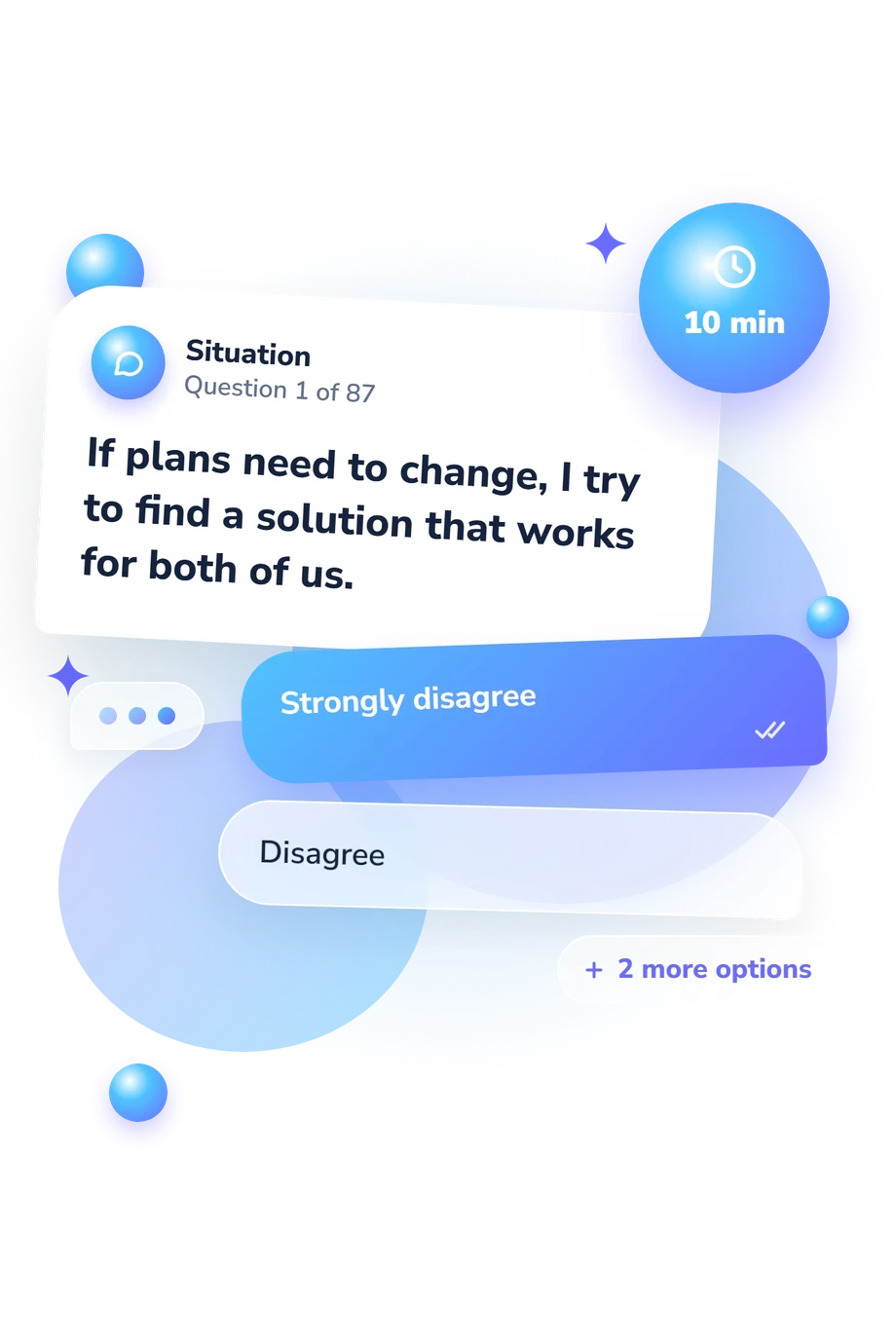
Representative items use four-choice agreement responses: depending on the statement, options run from Strongly disagree to Strongly agree, or include Not sure before Agree. These examples address motives, habits, and impact, including accommodation, guilt around saying no, listening, credit, and shared resources.
Results are organized into three separate displayed scale scores, each paired with the questionnaire’s interpretation bands. No calculation rule for item weighting or an overall total is stated, so the questionnaire reports only the three displayed scale results and their bands.
Conceptually, the structure is consistent with the Selfishness Questionnaire (Raine & Uh, 2019), which distinguishes forms of self-interest. Kaufman and Jauk (2020) frame healthy self-prioritization against harmful extremes, Carlson and colleagues (2022) treat selfishness as psychologically complex, and Davis’s (1983) multidimensional empathy model supports reading responsiveness as more than a single feeling. These works offer theoretical comparison, not evidence that this questionnaire is a validated adaptation.
As a self-reflection questionnaire, it can help identify patterns without assigning a fixed character label. Because answers are self-reported, results may shift with current circumstances, self-awareness, and the wish to appear favorable.
- Raine, Adrian, and Stepheni Uh. "The Selfishness Questionnaire: Egocentric, Adaptive, and Pathological Forms of Selfishness." Journal of Personality Assessment 101, no. 5 (2019): 503-514. 10.1080/00223891.2018.1455692
- Kaufman, Scott Barry, and Emanuel Jauk. "Healthy Selfishness and Pathological Altruism: Measuring Two Paradoxical Forms of Selfishness." Frontiers in Psychology 11 (2020): 1006. 10.3389/fpsyg.2020.01006
- Carlson, Ryan W., Chance Adkins, M. J. Crockett, and Margaret S. Clark. "Psychological Selfishness." Perspectives on Psychological Science 17, no. 5 (2022): 1359-1380. 10.1177/17456916211045692
- Davis, Mark H. "Measuring Individual Differences in Empathy: Evidence for a Multidimensional Approach." Journal of Personality and Social Psychology 44, no. 1 (1983): 113-126. 10.1037/0022-3514.44.1.113
Updated: