
Am I a People Pleaser Quiz
How the Scales are Structured
Who Usually Takes This Test?
See How You Compare
Below is a preview of how scores are typically distributed across each scale.
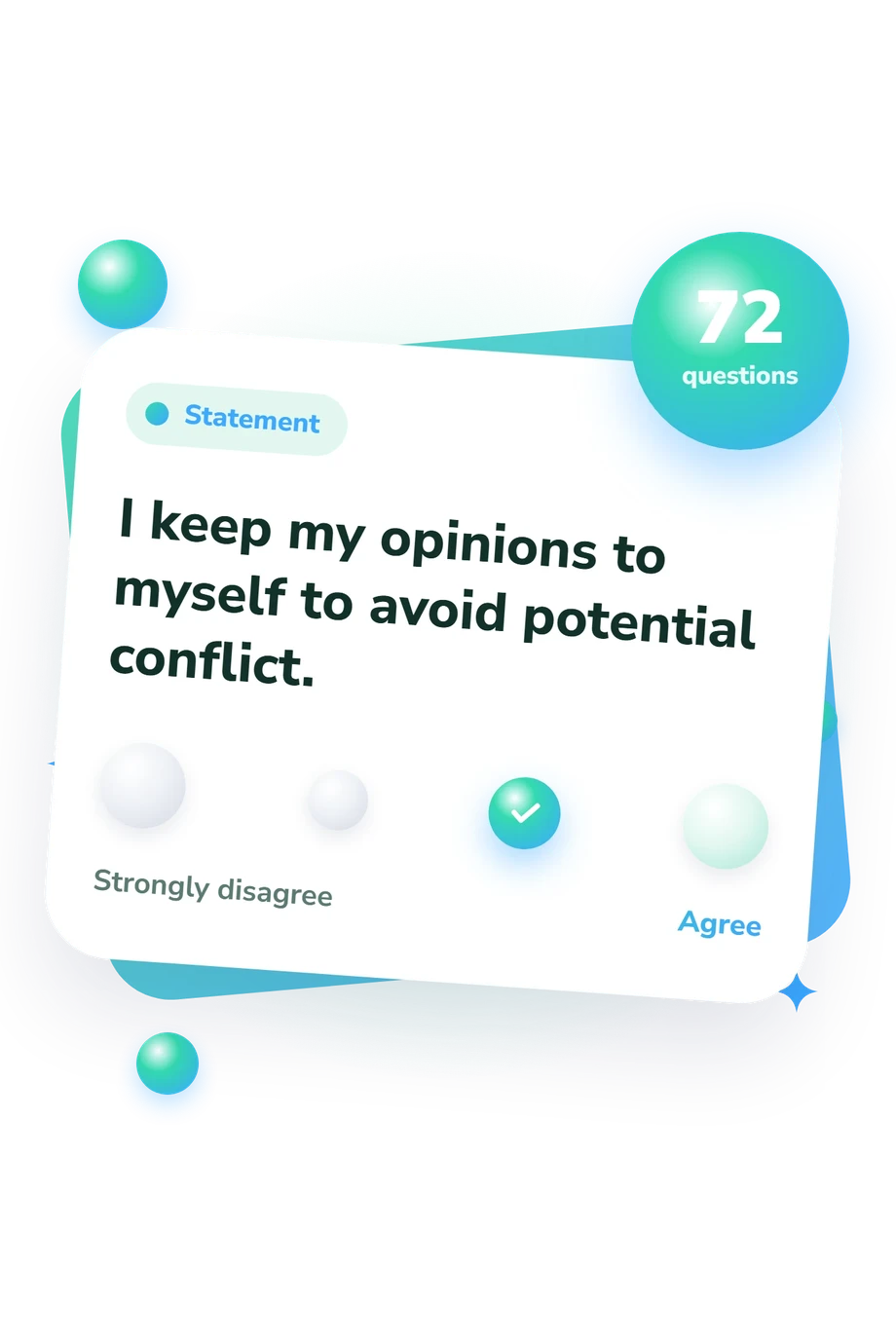
Example Questions From the Test
- Strongly disagree
- Disagree
- Not sure
- Agree
- Strongly disagree
- Disagree
- Not sure
- Agree
- Strongly disagree
- Disagree
- Not sure
- Agree
Am I a People Pleaser Quiz - Description and methodology of the test
For readers who often agree too quickly, hide disagreement, or feel responsible for keeping everyone comfortable, the Am I a People Pleaser Quiz organizes these experiences into a focused self-reflection profile. The questionnaire is useful when you want to examine whether approval-seeking shapes your choices, relationships, or energy. Its questions make this people pleaser test a focused exploration of approval, boundaries, and conflict, not a fixed identity.
What This Assessment Measures
This assessment examines approval-seeking in everyday interactions: saying yes while overloaded, hiding disagreement, tolerating interruptions, over-explaining, and assuming responsibility for others’ disappointment. It suits readers reviewing recurring patterns with family, friends, partners, or coworkers.
The dimensions distinguish limits, conflict and disappointment anxiety, and an overall tendency to put others first:
- Boundary-Setting Difficulty (0-30) shows difficulty setting, communicating, and maintaining limits: Low difficulty (0-10), Moderate difficulty (11-20), High difficulty (21-30).
- Conflict & Disappointment Anxiety (0-30) shows fear of conflict, rejection, or disappointing others, disagreement avoidance, and managing others’ emotions: Low (0-10), Moderate (11-20), High (21-30).
- People-Pleasing Level (0-40) shows approval-seeking, prioritizing others’ comfort, and guilt-driven compliance: Low (0-13), Moderate (14-26), High (27-40).
In this people pleaser quiz, the three scores show whether the result centres on boundary difficulty, conflict-related anxiety, or broader approval-seeking; bands indicate the relevant level, not a character verdict.
Methodology and Evidence Base
Items are self-statements about boundaries, emotional labor, disagreement, guilt, and others’ reactions. Four choices-Strongly disagree, Disagree, Not sure, and Agree-show how closely each situation fits the respondent’s behavior. The format favors concrete experiences over abstract labels.
Responses combine into three displayed scores with named bands. Higher scores indicate more difficulty, anxiety, or people-pleasing under the relevant definition. Item weights and reverse-scoring rules are not stated, so ranges should not become extra point rules or population norms.
Blötner’s People Pleasing Scale (2026) is the closest conceptual reference. This online questionnaire is conceptually consistent with Blötner’s scale but is not its adaptation. The Chinese People-Pleasing Questionnaire is a separate instrument with published psychometric findings (Kuang et al., 2025), and the Revised Personal Style Inventory (Bagby et al., 2001) provides a sociotropy-autonomy framework. These sources clarify the themes but do not validate or standardize this online measure.
Interpret a people-pleasing assessment with context and examples. Honest self-report and self-awareness affect the result; current stress or circumstances may shift responses and scores do not by themselves explain causes or establish a clinical condition.
- Blötner, C. (2026). Valuing others over oneself: development and validation of a people pleasing scale in two German samples. Current Psychology, 45, Article 952. 10.1007/s12144-026-09519-2
- Kuang, X., Li, H., Luo, W., Zhu, J., & Ren, F. (2025). The mental health implications of people-pleasing: Psychometric properties and latent profiles of the Chinese People-Pleasing Questionnaire. PsyCh Journal, 14(4), 500-512. 10.1002/pchj.70016
- Bagby, R. M., Gilchrist, E. J., Rector, N. A., Dickens, S. E., Joffe, R. T., Levitt, A., Levitan, R. D., & Kennedy, S. H. (2001). The stability and validity of the sociotropy and autonomy personality dimensions as measured by the Revised Personal Style Inventory. Cognitive Therapy and Research, 25(6), 765-779. 10.1023/A:1012975524455
Updated: