
What Type of Therapy Do I Need Quiz
How the Scales are Structured
Who Usually Takes This Test?
See How You Compare
Below is a preview of how scores are typically distributed across each scale.
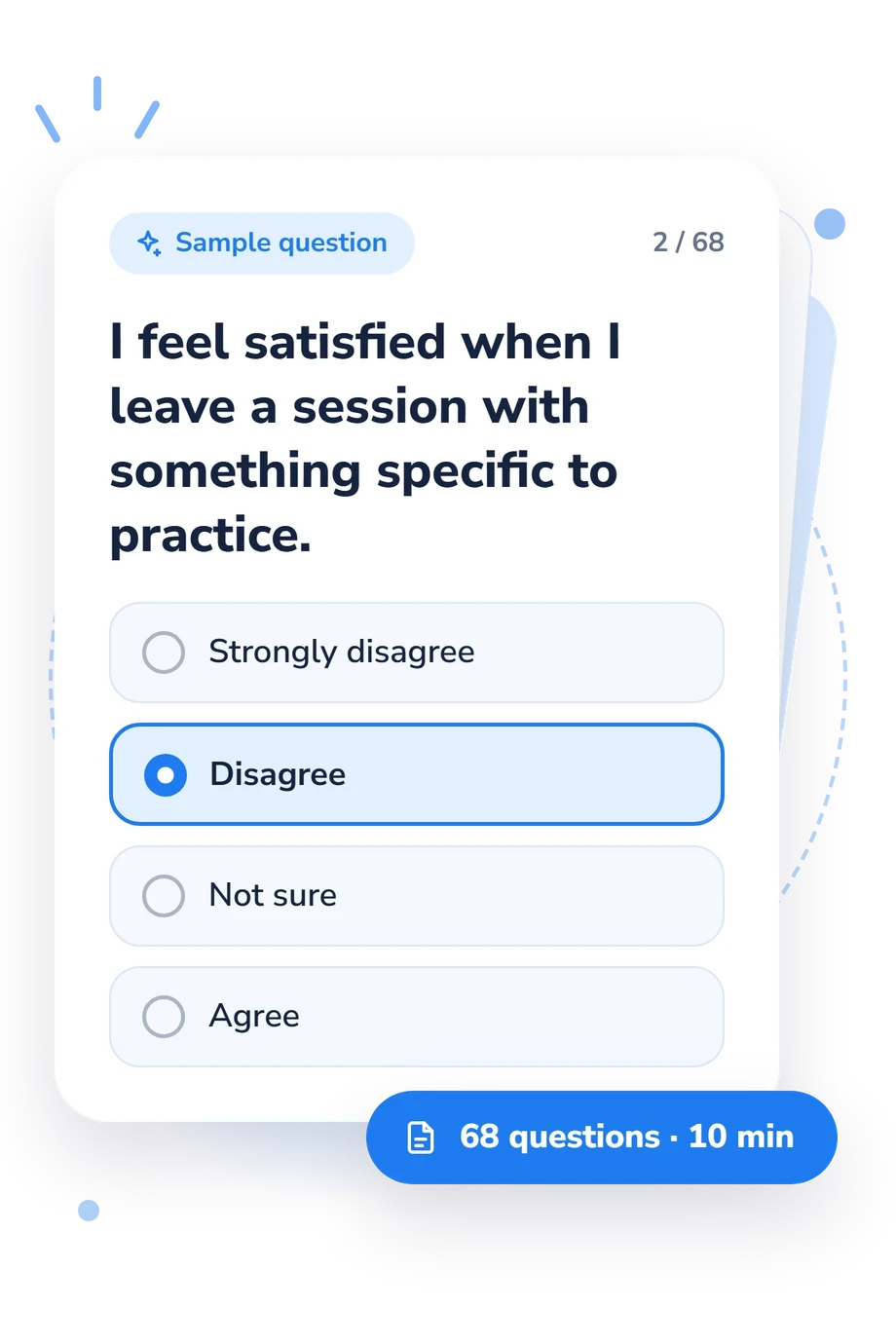
Example Questions From the Test
- Strongly disagree
- Disagree
- Not sure
- Agree
- Strongly disagree
- Disagree
- Not sure
- Agree
- Strongly disagree
- Disagree
- Not sure
- Agree
What Type of Therapy Do I Need Quiz - Description and methodology of the test
A person deciding what to seek in therapy may need to choose between practical tools, exploratory insight, structured work, or trauma-focused support. The what type of therapy do i need quiz frames that decision around preferred ways of working, desired pace, and trauma-related concerns. For someone asking how to find the right therapist, this quiz provides language for an initial consultation rather than naming a clinician.
What This Assessment Explores
Items focus on what the respondent wants therapy to do and how sessions should feel. They cover practical coping, emotion regulation, goals, homework, early relationships, trauma reminders, intrusive memories, avoidance, sleep, and alertness. The profile suits people deciding what to discuss with a therapist.
The what kind of therapy do i need quiz organizes preferences into three dimensions:
- Insight vs Tools (0-20) measures preference for practical coping and behavior change versus deeper work on patterns, emotions, and past experiences. Insight-oriented: 0-8; Balanced: 9-14; Tools-oriented: 15-20.
- Structure Preference (0-20) measures comfort with open-ended exploration versus clear agendas, skills, and measurable goals. More Exploratory: 0-6; Balanced: 7-13; More Structured: 14-20.
- Trauma/Exposure Focus (0-20) measures how central trauma-related symptoms and processing are to current goals. Low focus: 0-6; Moderate focus: 7-13; High focus: 14-20.
Methodology and Evidence Base
Each item uses four options: Strongly disagree, Disagree, Not sure, or Agree. Statements address session structure, desired pace, between-session practice, and trauma-related experiences. Responses combine into the three dimensions, but the questionnaire does not specify how many points each response contributes. Its displayed result bands describe the respondent's therapy preference levels rather than population norms or clinical cutoffs.
Conceptually, the assessment functions as a therapy preference quiz and is consistent with the C-NIP, a published framework describing desired activity, direction, and depth in therapy. The cited C-NIP research does not validate this online version. Cooper and colleagues (2022) connect activity preferences with alliance and outcomes, supporting discussion of fit without promising a particular result.
Trauma-related items reflect whether processing past events is central to current goals. Simiola and colleagues (2015) reviewed preferences in trauma treatment, while Beutler and colleagues (2016) describe treatment selection as matching client characteristics, problems, and methods. Self-report is shaped by current context, expectations, and self-awareness, so the result does not establish a diagnosis or prescribe a modality.
- Cooper, M., & Norcross, J. C. (2016). A brief, multidimensional measure of clients’ therapy preferences: The Cooper-Norcross Inventory of Preferences (C-NIP). International Journal of Clinical and Health Psychology, 16(1), 87-98. 10.1016/j.ijchp.2015.08.003
- Cooper, M., van Rijn, B., Chryssafidou, E., & Stiles, W. B. (2022). Activity preferences in psychotherapy: What do patients want and how does this relate to outcomes and alliance? Counselling Psychology Quarterly, 35(3), 503-526. 10.1080/09515070.2021.1877620
- Simiola, V., Neilson, E. C., Thompson, R., & Cook, J. M. (2015). Preferences for trauma treatment: A systematic review of the empirical literature. Psychological Trauma: Theory, Research, and Policy, 7(6), 516-524. 10.1037/tra0000038
- Beutler, L. E., Someah, K., Kimpara, S., & Miller, K. (2016). Selecting the most appropriate treatment for each patient. International Journal of Clinical and Health Psychology, 16(1), 99-108. 10.1016/j.ijchp.2015.08.001
Updated: