
What Fish Am I Quiz
How the Scales are Structured
Who Usually Takes This Test?
See How You Compare
Below is a preview of how scores are typically distributed across each scale.
Example Questions From the Test
- Strongly disagree
- Disagree
- Agree
- Strongly agree
- Strongly disagree
- Disagree
- Not sure
- Agree
- Strongly disagree
- Disagree
- Not sure
- Agree
What Fish Am I Quiz - Description and methodology of the test
People who want a playful way to reflect on how they approach novelty, challenge, and connection may find the What Fish Am I Quiz useful. Rather than assigning a fixed identity, it turns everyday preferences into a readable personality profile. The fish-personality format turns a what-fish-are-you quiz into an accessible starting point for noticing patterns in social energy, exploration, and assertiveness.
What This Assessment Explores
Three dimensions organize the profile: initiative under challenge, openness to novelty, and desire for connection. They describe tendencies rather than permanent labels, and responses may vary with mood, context, and experience. The fish personality quiz is intended for readers curious about their everyday style; its imagery makes the result memorable without claiming that anyone literally matches a species.
The result dimensions are:
- Boldness (0-20) shows how daring, assertive, and action-oriented you tend to be; Cautious (0-6), Steady (7-13), or Bold (14-20) indicates the displayed band.
- Curiosity (0-20) shows how exploratory, imaginative, and open to new ideas you tend to be; Routine-Seeking (0-7), Balanced Explorer (8-14), or Highly Curious (15-20) indicates the displayed band.
- Sociability (0-20) shows how much you seek connection, teamwork, and social stimulation; Low (0-6), Moderate (7-13), or High (14-20) indicates the displayed band.
Methodology and Evidence Base
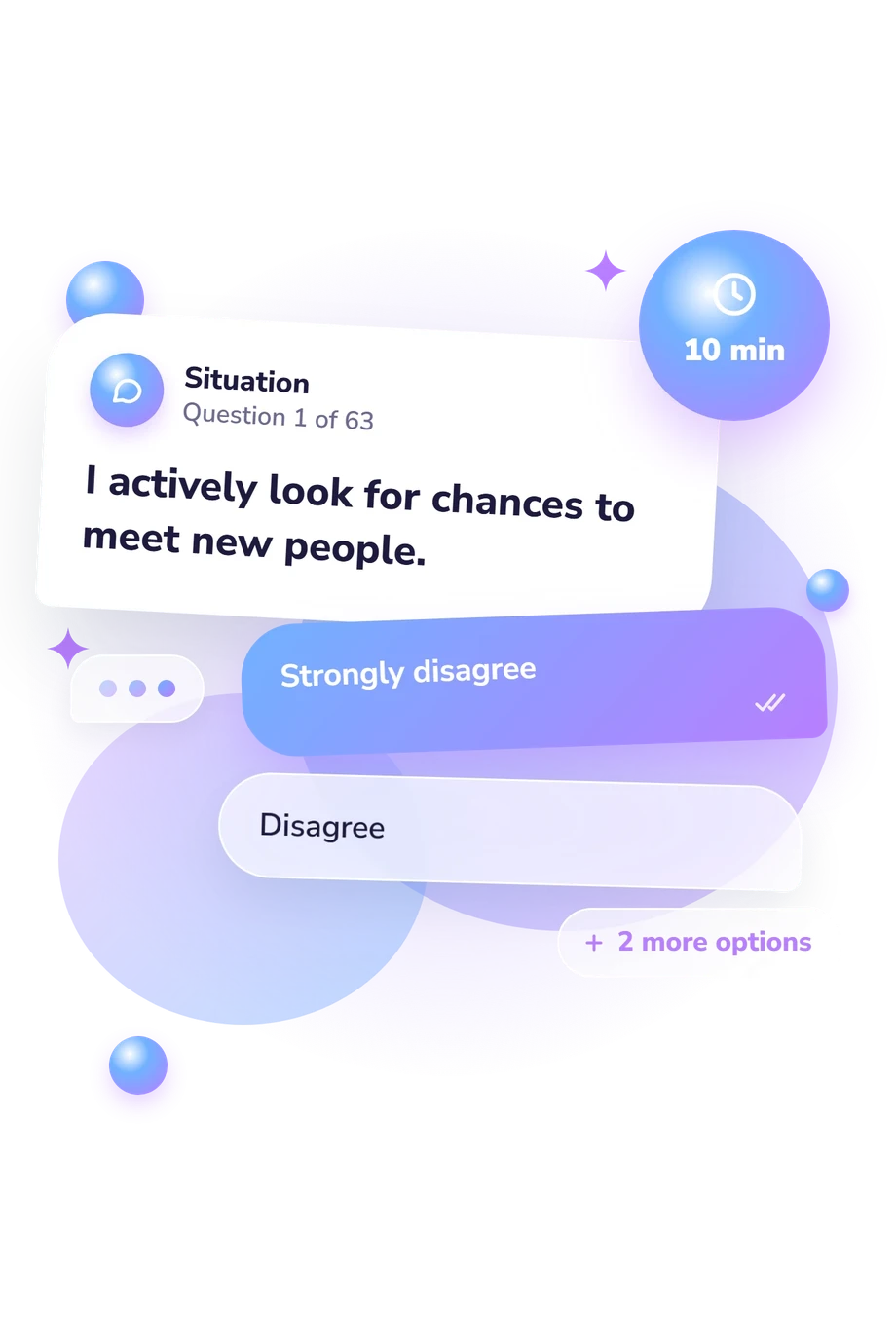
Questions cover meeting people, unfamiliar activities, uncertainty, speaking up, new ideas, and connection. Respondents choose from varying four-option agreement sets that include Strongly disagree, Disagree, and Agree; some add Not sure, while others add Strongly agree. This format captures degree rather than a simple yes-or-no response.
The questionnaire reports scores for three displayed dimensions and assigns them to the displayed bands. Results are descriptive rather than norm-referenced: this online questionnaire has no stated normative sample or independent standardization. As a what fish quiz, it organizes self-observations into a concise pattern, not a formal psychological measurement.
This questionnaire has only broad conceptual overlap with the BFI-2, which models broad personality domains alongside narrower facets, and with the Big Five aspects model described by DeYoung, Quilty, and Peterson. These models offer context for personality dimensions, not evidence that this online questionnaire is an adaptation, validated measure, or direct mapping of either instrument.
Self-report results can reflect current mood, self-presentation, memory, and self-awareness. Use the profile as a reflection prompt, especially when different situations bring out different sides of the respondent.
- Soto, C. J., & John, O. P. (2017). The next Big Five Inventory (BFI-2): Developing and assessing a hierarchical model with 15 facets to enhance bandwidth, fidelity, and predictive power. Journal of Personality and Social Psychology, 113(1), 117-143. 10.1037/pspp0000096
- DeYoung, C. G., Quilty, L. C., & Peterson, J. B. (2007). Between facets and domains: 10 aspects of the Big Five. Journal of Personality and Social Psychology, 93(5), 880-896. 10.1037/0022-3514.93.5.880
Updated: