
Verbal IQ Test
How the Scales are Structured
Who Usually Takes This Test?
See How You Compare
Below is a preview of how scores are typically distributed across each scale.
Example Questions From the Test
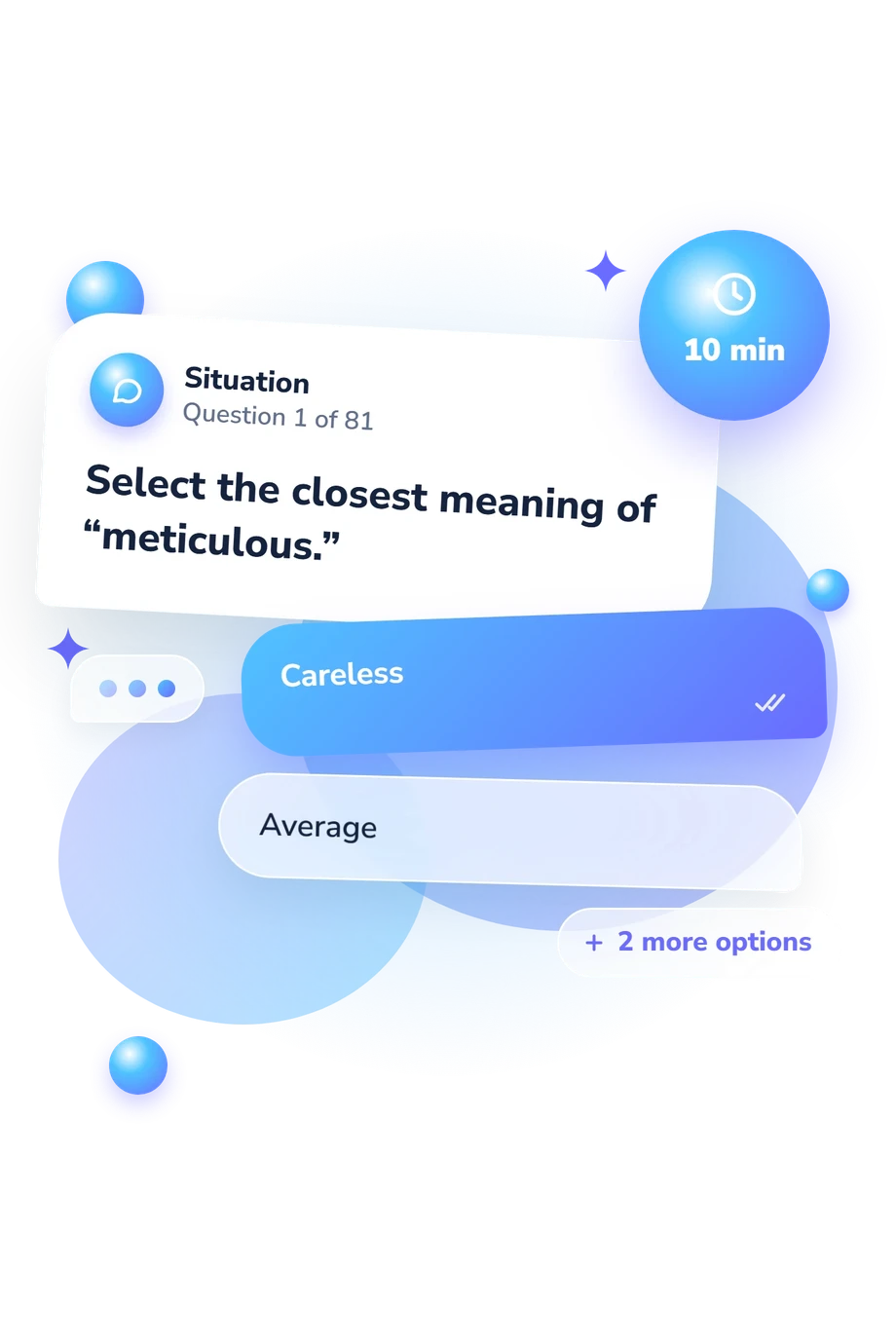
- Careless
- Average
- Very careful and precise
- Noisy
- Strongly disagree
- Disagree
- Agree
- Strongly agree
- Clear
- Obscure
- Helpful
- Fragile
Verbal IQ Test - Description and methodology of the test
People who want a clearer picture of their language-based problem solving can use this verbal iq test to examine how they handle word meaning, relationships between concepts, and reasoning from written information. It suits people who want to explore their language-based reasoning and vocabulary through a verbal intelligence test that organizes strengths and practice priorities. The result is a three-part profile rather than a single undifferentiated estimate of ability.
What This Assessment Explores
This questionnaire examines three abilities that work together in language-based problem solving. Vocabulary items test definitions, synonyms, antonyms, and contextual meaning; analogy items test relationships such as function, category, part-whole, cause, opposition, and sequence; reading items test claims, conditions, viewpoints, evidence, contradictions, and event order.
The result is divided into three dimensions:
- Analogical Reasoning (0-20) measures recognition and application of verbal relationships. Bands: Developing 0-7; Moderate 8-14; Strong 15-20.
- Reading & Verbal Logic (0-20) measures passage comprehension and inference under constraints. Bands: Developing 0-6; Moderate 7-13; Strong 14-20.
- Vocabulary (0-20) measures breadth and precision of word knowledge. Bands: Developing 0-9; Solid 10-15; Strong 16-20.
Together, these dimensions show whether your profile leans toward relational reasoning, reading inference, or precise word knowledge. As a verbal reasoning assessment, it can reveal whether practice should emphasize relationships, comprehension, or word precision.
Methodology and Scientific Basis
Two response formats are used. Vocabulary items present a word or sentence with answer choices; analogy and passage items use Strongly disagree, Disagree, Agree, or Strongly agree. This samples selected-answer knowledge and self-rated reasoning.
Results are reported across the three displayed dimensions. The profile can guide verbal aptitude practice by showing relative strengths and weaker areas; how responses are weighted is not specified.
The evidence base is conceptual. The questionnaire is conceptually consistent with relevant domains in WAIS-IV (Coalson, Wechsler, and Raiford, 2008), Duran, Enright, and Peirce’s (1987) study of reasoning in verbal analogies, and Daneman and Carpenter’s (1980) work connecting reading performance with working-memory differences; it is not an adaptation of those works or a standardized administration of the instruments associated with them.
The cited works’ own samples, norms, and psychometric findings belong to their respective studies and should not be treated as norms or validation evidence for this questionnaire.
Self-report can shift with vocabulary exposure, attention, confidence, and current context; use the profile as a snapshot for reflection and targeted practice, not a clinical classification.
- Coalson, Diane L., David Wechsler, and Susan Engi Raiford. WAIS-IV: Wechsler Adult Intelligence Scale: Technical and Interpretive Manual. Pearson, 2008.
- Duran, Richard P., Mary K. Enright, and Leslie P. Peirce. "GRE Verbal Analogy Items: Examinee Reasoning on Items." ETS Research Report Series, 1987(1), i-47. 10.1002/j.2330-8516.1987.tb00209.x
- Daneman, Meredyth, and Patricia A. Carpenter. "Individual Differences in Working Memory and Reading." Journal of Verbal Learning and Verbal Behavior, 19(4), 450-466, 1980. 10.1016/S0022-5371(80)90312-6
Updated: