
Freudly+971 508685814hello@freudly.ai
Freudly
narcissism

Is My Child a Narcissist Quiz
Is My Child a Narcissist Quiz: Childhood Behavior Test - FreudlyIs My Child a Narcissist Quiz: Evaluate concerning behavioral patterns. Free parental screening. Not diagnostic – consult child psychologist.en
Understand whether your child's behavior may reflect narcissistic-like patterns or normal stress and development. Take this Is My Child a Narcissist Quiz for a supportive summary and practical next steps to guide your support.
Start Online Test
Questions: 7510 minutes
08:30
March 25, 2026
March 25, 2026
Material has been updated
March 25, 2026
Material has been published
3,532 views
565 completions
241 likes
Share
Scale Explorer

How the Scales are Structured

example score
7/20
Context & Stress Load (C&SL)
Assesses how strongly current stressors and context factors (e.g., sleep issues, anxiety, family changes, social media pressure, peer conflict) may be amplifying challenging behavior.
Low stress load
Moderate stress load
High stress load
06: Low stress load | 713: Moderate stress load | 1420: High stress load
A score of 7 suggests a moderate level of current stressors that could be contributing to or intensifying the behaviors you’re noticing.
example score
19/30
Empathy & Accountability (E&A)
Assesses how often the child notices others’ feelings, takes responsibility, and tries to repair after conflict.
Needs Support
Developing
Strong
014: Needs Support | 1522: Developing | 2330: Strong
A score of 19 falls in the Developing range, suggesting emerging empathy and accountability with some inconsistency in perspective-taking, apologizing, or making repairs after mistakes.
example score
10/40
Narcissistic-Trait Indicators (NTI)
Measures how often a child shows patterns sometimes associated with narcissistic-trait indicators, such as entitlement, attention-seeking, blaming others, rule-bending, and strong reactions to criticism.
Low indicators
Moderate indicators
High indicators
013: Low indicators | 1426: Moderate indicators | 2740: High indicators
A score of 10 falls in the Low indicators range, suggesting these behaviors are reported as infrequent or relatively mild overall.
Start Online Test
just completed the test
DATA-BASED USER COHORTS

Who Usually Takes This Test?

Concerned parents of tweens
41%OF USERS
They’re noticing frequent entitlement, bragging, or blaming others at home or school and want to know what’s typical development versus a pattern that needs support.
Parents after big changes
34%OF USERS
Following divorce, a move, new sibling, or other stress, they’re seeing sharper reactions to criticism and more rule-bending and want guidance on next steps.
Families navigating social pressure
25%OF USERS
They suspect peer dynamics or social media is fueling attention-seeking and low empathy and want a reality check plus practical ways to respond.
BASED ON AGGREGATED, ANONYMIZED DATA FROM TENS OF THOUSANDS OF FREUDLY USERS.
Benchmarking

See How You Compare

Once you complete the test, your results are compared with real-world data from people in your country.
Below is a preview of how scores are typically distributed across each scale.
Context & Stress Load (C&SL)
Average
9.6
Normal range
6.612.7
min.
0
max.
20
This curve shows how scores are typically distributed.
Once you complete the test, your result will appear on the scale so you can see how you compare.
Empathy & Accountability (E&A)
Average
14.5
Normal range
9.219.8
min.
0
max.
30
This curve shows how scores are typically distributed.
Once you complete the test, your result will appear on the scale so you can see how you compare.
Narcissistic-Trait Indicators (NI)
Average
16.1
Normal range
10.421.8
min.
0
max.
40
This curve shows how scores are typically distributed.
Once you complete the test, your result will appear on the scale so you can see how you compare.
Featured On
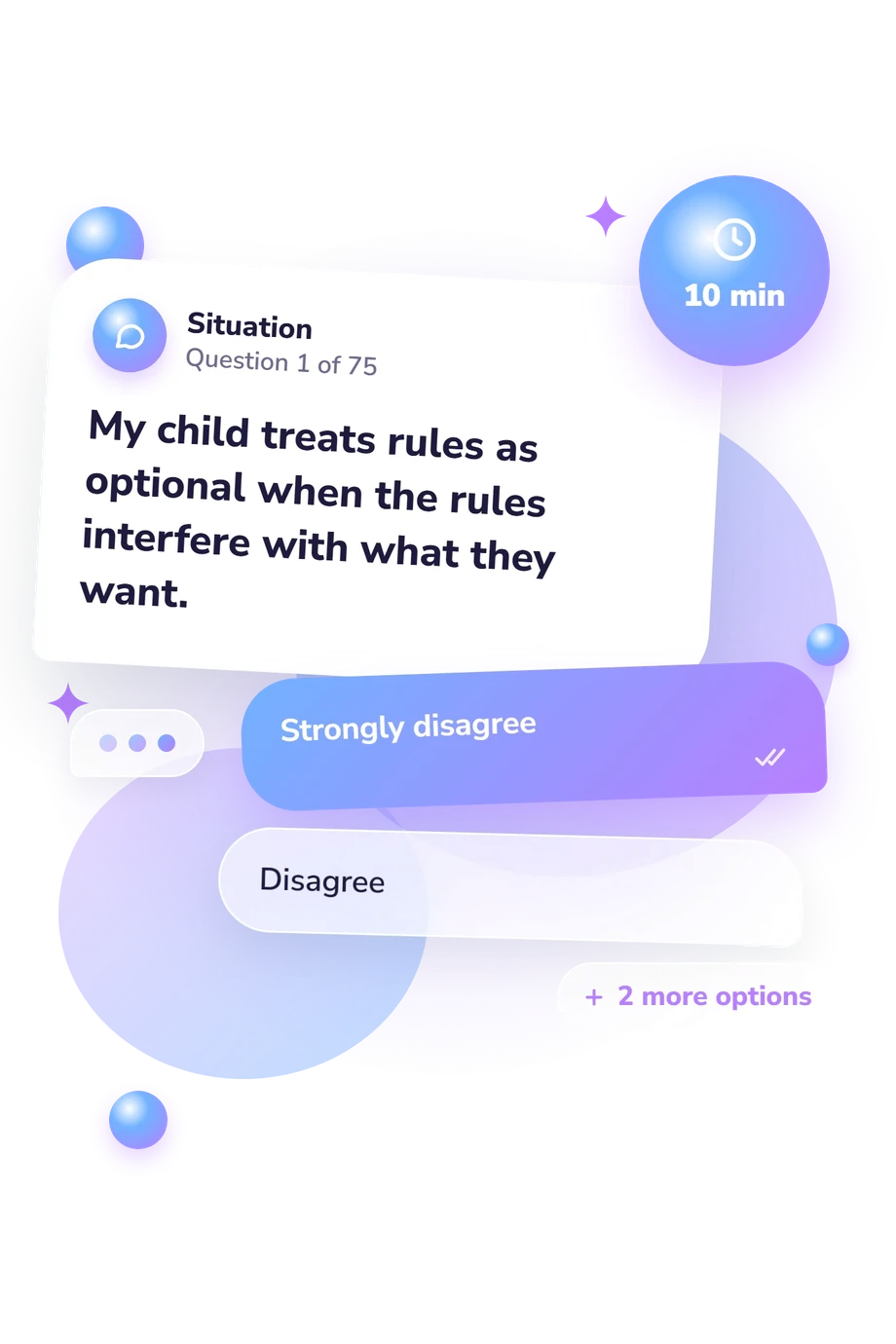
SAMPLE QUESTIONS

Example Questions From the Test

    • Strongly disagree
    • Disagree
    • Not sure
    • Agree
    • Strongly disagree
    • Disagree
    • Not sure
    • Agree
    • Never
    • Sometimes
    • Often
    • Almost always
WHAT THE TEST MEASURES
About This Assessment
narcissism
parenting

Worried your child seems unusually entitled, lacks empathy, or reacts strongly to criticism? This parent quiz helps you reflect on patterns sometimes associated with narcissistic traits — like attention-seeking, blaming others, rule-bending, and sensitivity to failure — while also considering age-appropriate behavior and stressors (sleep, anxiety, family change, social media). You'll get a gentle summary and practical next steps for support. This is not a diagnosis, and only a qualified professional can evaluate concerns.

Why Take an Is My Child a Narcissist Quiz

Entitled outbursts, difficulty apologizing, or a strong need for attention can look concerning in the moment, but these same behaviors also show up as a normal, temporary part of child and adolescent development — especially during stress, big life changes, or specific developmental stages. This is my daughter a narcissist quiz is designed to help sort through this distinction rather than jumping straight to a worrying label based on a few difficult moments.

This quiz is especially useful because it separates three genuinely important pieces of the picture — how much current stress or context (sleep issues, anxiety, family changes, social pressure) may be amplifying the behavior, how consistently your child shows empathy and takes responsibility after conflict, and how often specific narcissistic-trait patterns like entitlement or blame-shifting actually show up. A child under high stress load can show elevated difficult behaviors that say more about the situation than about an enduring trait.

This assessment is especially useful for concerned parents of tweens noticing frequent entitlement, bragging, or blaming others who want to know what's typical development versus a pattern needing support, parents navigating a big change like divorce or a new sibling who are seeing sharper reactions to criticism, and families wondering whether peer dynamics or social media may be fueling attention-seeking and low empathy.

What the Assessment Measures

The quiz explores your child's patterns across three core dimensions:

  • Context & Stress Load — how strongly current stressors and context factors, such as sleep issues, anxiety, family changes, social media pressure, and peer conflict, may be amplifying challenging behavior
  • Empathy & Accountability — how often the child notices others' feelings, takes responsibility, and tries to repair after conflict
  • Narcissistic-Trait Indicators — how often a child shows patterns sometimes associated with narcissistic traits, such as entitlement, attention-seeking, blaming others, rule-bending, and strong reactions to criticism

Results provide a brief summary and practical support steps, including when to seek professional input. Elevated results suggest monitoring and follow-up rather than labeling or punishment.

Who This Assessment Is For

This Is My Child a Narcissist Quiz is intended for a parent or primary caregiver who observes the child in daily settings across home, school, and peers. It's especially relevant for concerned parents of tweens, parents navigating a recent family change, and families wondering how peer dynamics or social media may be affecting their child's behavior.

How to Use This Assessment

A parent or primary caregiver who observes the child in daily settings should complete the quiz. If more than one caregiver is involved, responses may be compared to identify consistent patterns. Answer based on typical behavior over the past several months rather than isolated incidents. This is not a diagnosis — only a qualified mental health professional can evaluate symptoms, rule out other causes, and provide a diagnosis if appropriate. A child psychologist is best placed to help interpret patterns within a child's specific developmental stage.

Popular tests
Comments
Leave a Comment