
Gen Z Quiz
How the Scales are Structured
Who Usually Takes This Test?
See How You Compare
Below is a preview of how scores are typically distributed across each scale.
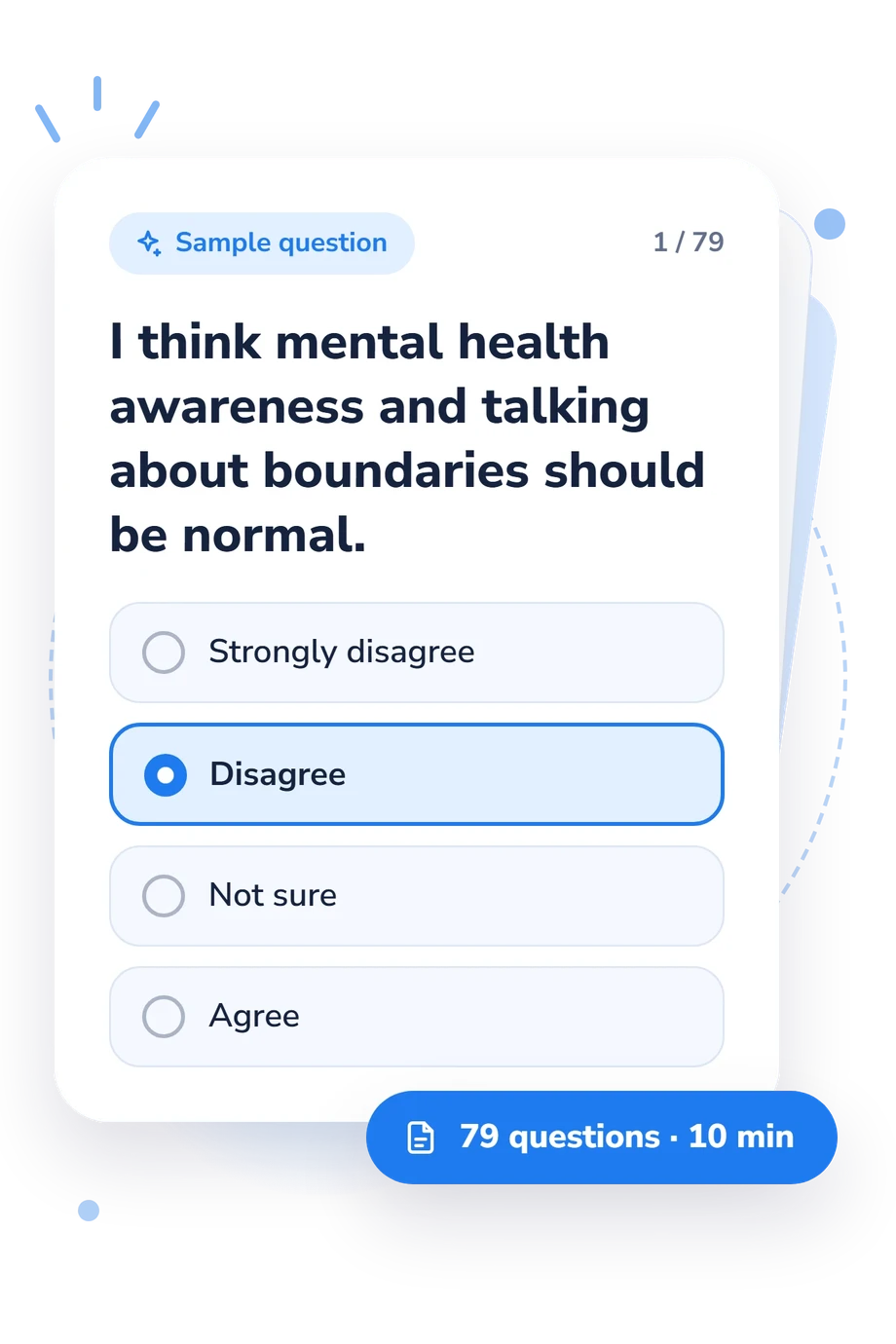
Example Questions From the Test
- Strongly disagree
- Disagree
- Not sure
- Agree
- Not at all
- A little
- Pretty well
- Very well
- Not at all
- Somewhat
- Mostly
- Completely
Gen Z Quiz - Description and methodology of the test
Readers might take the Gen Z Quiz when they want to compare their self-perception with a playful profile of generational style and digital confidence. The result can help someone reflect on which parts of that profile feel familiar, emerging, or less relevant to them. This Gen Z test suits anyone interested in understanding their relationship with rapidly changing online culture.
What This Assessment Explores
Questions link attitudes, communication habits, internet references, and platform awareness with patterns associated with Gen Z. They cover boundaries, digital identity, mood-based media, memes, creator formats, engagement cues, and slang. In this Gen Z slang quiz, questions about slang and memes form one part of the broader profile.
The result separates three dimensions, each describing a different part of the profile:
- Gen Z Alignment (0-40) measures attitude, preference, and habit fit with Gen Z norms/aesthetics: Light Gen Z vibe (0-13), Moderate Gen Z vibe (14-26), Strong Gen Z vibe (27-40).
- Slang & Meme Literacy (0-30) measures slang, meme, and online-humor fluency: Still Learning (0-10), Pretty Fluent (11-20), Meme-Savvy (21-30).
- Trend & Platform Fluency (0-30) measures platform, content, trend, and creator-culture fluency: Low fluency (0-10), Moderate fluency (11-20), High fluency (21-30).
Together, these dimensions show where your profile is more or less pronounced.
Methodology and Evidence Base
The sampled questions use self-report statements and recognition prompts. Response choices vary: agreement, frequency from “Never” to “Almost always,” or graded confidence and knowledge. This format captures preferences and fluency while allowing uncertainty; the slang quiz element sits alongside behavior and platform items.
Responses are grouped into three dimensions, with higher scores indicating stronger alignment or fluency within each definition. Displayed ranges and bands describe result categories, but the answer-to-score calculation is not documented; response contributions should not be inferred.
Hu and colleagues’ study of platform use and gratification offers context for the questionnaire’s overlap with platform-use themes. That overlap does not make the questionnaire an adaptation. Seemiller and Grace add context for Gen Z preferences; Shifman adds context for meme participation. These references offer context, not provenance, norms, or validation for this questionnaire. It is an unstandardized online self-reflection assessment without published norms or validation.
Interpret the result as a time-sensitive snapshot: exposure, community familiarity, self-awareness, and response style can shape answers, while slang and platform conventions change. It reveals patterns without defining a fixed generational identity.
- Hu, Qingqing, Xue Hu, and Pan Hou. "One Social Media, Distinct Habitus: Generation Z's Social Media Uses and Gratifications and the Moderation Effect of Economic Capital." Frontiers in Psychology, vol. 13, 2022, article 939128. 10.3389/fpsyg.2022.939128
- Seemiller, Corey, and Meghan Grace. Generation Z Goes to College. Jossey-Bass, 2016. ISBN 9781119143451
- Shifman, Limor. Memes in Digital Culture. The MIT Press, 2013. ISBN 9780262525435
Updated: