
Does My Boyfriend Love Me Quiz
How the Scales are Structured
Who Usually Takes This Test?
See How You Compare
Below is a preview of how scores are typically distributed across each scale.
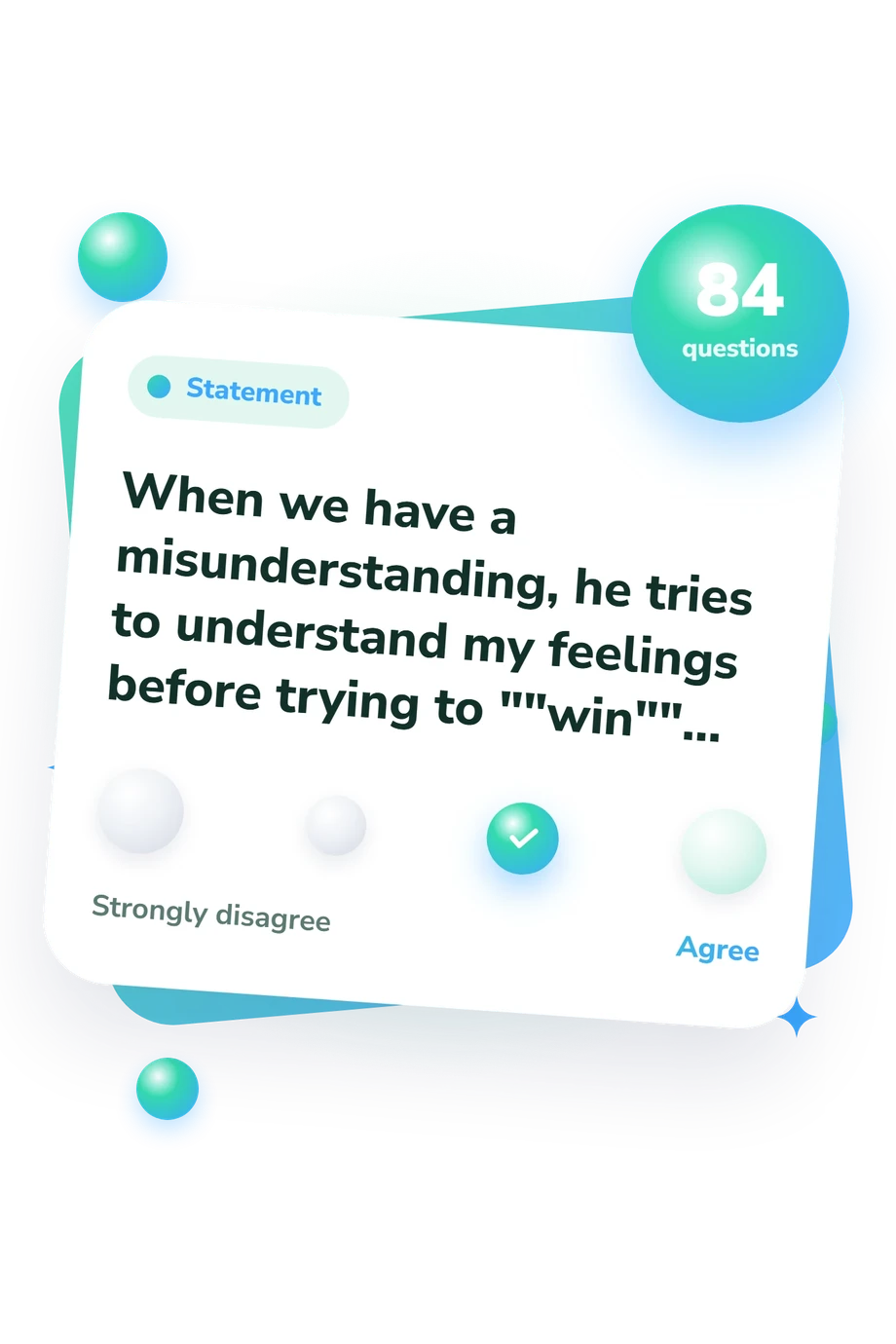
Example Questions From the Test
- Strongly disagree
- Disagree
- Not sure
- Agree
- Strongly disagree
- Disagree
- Not sure
- Agree
- Strongly disagree
- Disagree
- Not sure
- Agree
Does My Boyfriend Love Me Quiz - Description and methodology of the test
People who are uncertain whether a partner’s affection is reflected in everyday conduct may use the Does My Boyfriend Love Me Quiz to examine recurring patterns. It works as a boyfriend love quiz with a broader focus, considering effort, emotional responsiveness, communication, boundaries, and safety across the relationship rather than isolated moments.
What This Assessment Explores
The questionnaire looks at whether affection appears in dependable action, emotional presence, and respectful treatment. Statements address planning, follow-through, listening in conflict, emotional sharing, responses to distress, acceptance of space, and boundaries. The result from this boyfriend relationship quiz summarizes recurring relationship behavior across these situations, rather than treating one reassuring moment as decisive.
The three displayed dimensions are:
- Care & Commitment (0-30) measures care, prioritization, time, effort, and reliability: Inconsistent (0-10), Mixed signals (11-20), or Consistent commitment (21-30).
- Emotional Availability (0-30) measures openness, empathy, and engagement with feelings: Low availability (0-14), Moderate availability (15-22), or High availability (23-30).
- Respect & Safety (0-30) measures boundaries, fairness, and supportive versus controlling treatment: Red Flags (0-14), Mixed/Watchouts (15-23), or Respectful & Safe (24-30).
Methodology and Scientific Basis
The statements shown are concrete descriptions of observable behavior, answered with Strongly disagree, Disagree, Not sure, or Agree. This format asks the respondent to judge recurring interactions rather than make a binary decision about love. Answers from this relationship patterns quiz are most informative when they reflect typical relationship patterns and repeated interactions rather than one unusually good or difficult week.
Responses are combined into the three dimensions. Because no point-by-point scoring formula is stated, interpret each result through its definition and displayed band rather than reverse-engineering the answer choices.
Conceptually, the questionnaire is consistent with work by Crasta et al. (2021), which examines responsiveness and insensitivity in close relationships. Its attention to harmful interaction patterns also relates to Murphy and Hoover (1999). These links do not make this questionnaire an adaptation of those instruments.
The displayed bands are descriptive, and the cited published instruments do not establish norms or clinical thresholds for this online questionnaire; scores may also shift with mood, recent conflict, memory, expectations, or openness. Use the profile to discuss needs, boundaries, and repair, especially when dimensions diverge.
- Crasta, D., Rogge, R. D., Maniaci, M. R., & Reis, H. T. (2021). Toward an optimized measure of perceived partner responsiveness: Development and validation of the perceived responsiveness and insensitivity scale. Psychological Assessment, 33(4), 338-355. 10.1037/pas0000986
- Murphy, C. M., & Hoover, S. A. (1999). Measuring emotional abuse in dating relationships as a multifactorial construct. Violence and Victims, 14(1), 39-53. 10.1891/0886-6708.14.1.39
- Hendrick, S. S. (1988). A generic measure of relationship satisfaction. Journal of Marriage and the Family, 50(1), 93-98. 10.2307/352430
Updated: