
Body Language Test
How the Scales are Structured
Who Usually Takes This Test?
See How You Compare
Below is a preview of how scores are typically distributed across each scale.
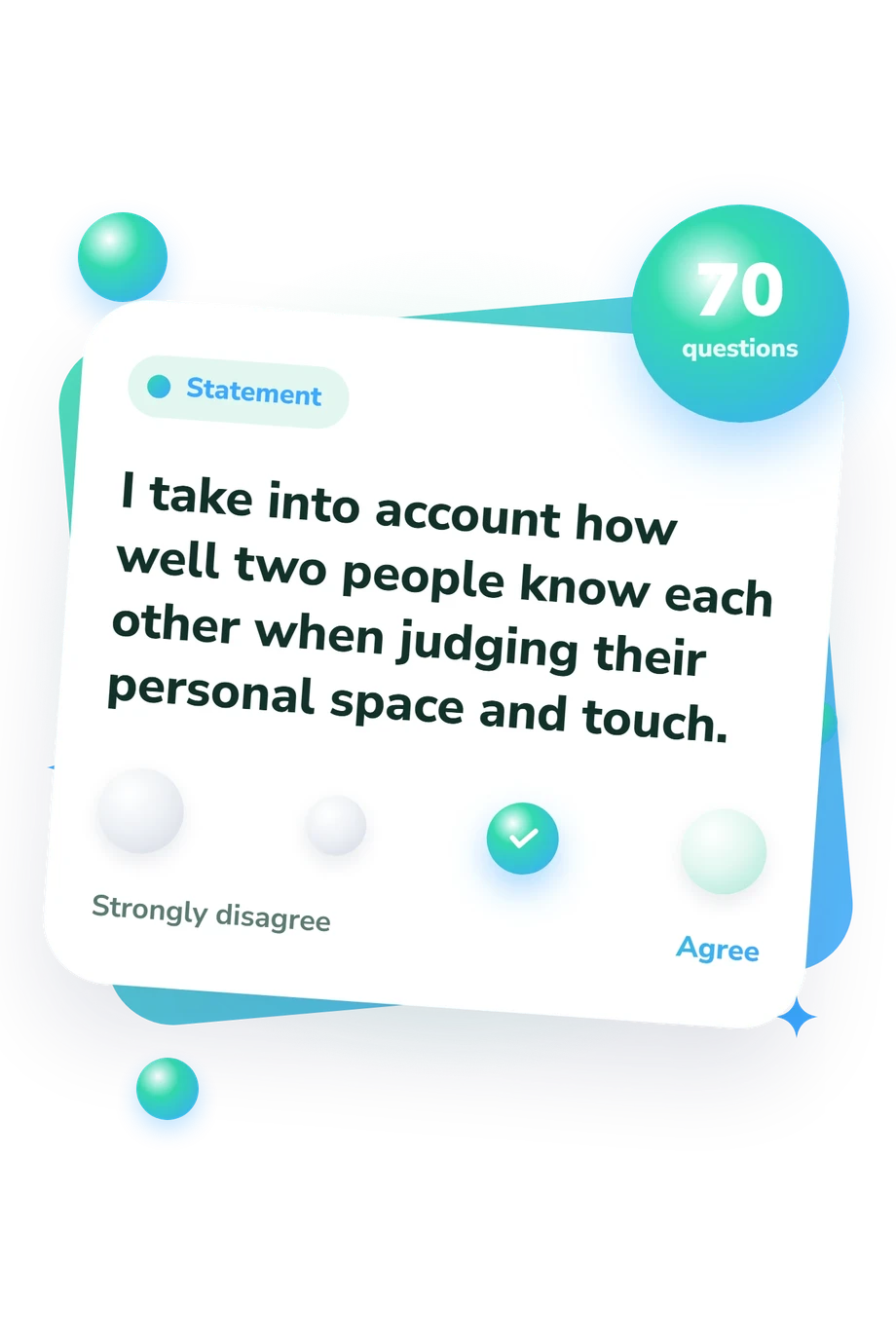
Example Questions From the Test
- Strongly disagree
- Disagree
- Not sure
- Agree
- Strongly disagree
- Disagree
- Not sure
- Agree
- Strongly disagree
- Disagree
- Not sure
- Agree
Body Language Test - Description and methodology of the test
People who want to understand their own approach to nonverbal interpretation can use this self-report questionnaire as a starting point. Taking a body language test gives you a separate result on each of three dimensions, so the profile can show where your reading habits fall without claiming to reveal another person’s inner state. It works as a body language quiz for everyday self-reflection and produces a structured profile.
What This Assessment Explores
Items ask whether you combine signals with the situation before deciding what behavior means. They cover relationships, power differences, cultural norms, spoken tone, distractions, stress, and habits that can resemble discomfort or deception. This body language assessment describes interpretation tendencies across contextual reasoning, caution about inferences, and cue accuracy.
The three result dimensions describe these areas:
- Context Sensitivity (0-20) measures how well you incorporate relationship, setting, culture, and tone-of-voice context; bands: Limited Context Use 0-8, Moderate Context Awareness 9-14, High Context Sensitivity 15-20.
- Inference Caution (0-20) measures your tendency to avoid snap conclusions, consider alternative explanations, and resist mind-reading from single signals; bands: Low caution 0-6, Moderate caution 7-13, High caution 14-20.
- Nonverbal Cue Accuracy (0-30) measures how accurately you interpret posture, gestures, facial expressions, eye contact, and personal space across scenarios; bands: Developing 0-14, Proficient 15-23, Strong 24-30.
Methodology and Evidence Base
The questionnaire uses self-report statements with four options: Strongly disagree, Disagree, Not sure, and Agree. Items ask about noticing cues, checking context, considering alternatives, and revising first impressions. Answers produce results on the three displayed dimensions. The questionnaire does not state a point-by-point formula or an overall profile rule, so each dimension should be interpreted as reported rather than combined through an invented calculation.
Methodologically, the questionnaire is conceptually consistent with CAST, the PONS test, and Sporer and Schwandt’s research on deception cues; it is not a standardized administration or adaptation of CAST or PONS. That evidence supports caution because cue meaning varies with moderators, so one signal cannot reliably reveal lying.
For this body language skills test, each dimension should be read separately: higher results indicate more of the tendency that dimension measures, while lower or middle bands indicate different reported levels. As a self-report format, results may reflect response bias, self-perception, and the respondent’s current context. Use the result to examine habits and seek multiple cues before drawing conclusions.
- Trimboli, Antonietta, and Michael Walker. "The Cast Test of Nonverbal Sensitivity." Journal of Language and Social Psychology 12(1-2) (1993): 49-65. 10.1177/0261927X93121004
- Rosenthal, Robert, Judith A. Hall, M. Robin DiMatteo, Peter L. Rogers, and Dane Archer. Sensitivity to Nonverbal Communication: The PONS Test. Baltimore: The Johns Hopkins University Press, 1979.
- Sporer, Siegfried L., and Barbara Schwandt. "Moderators of Nonverbal Indicators of Deception: A Meta-Analytic Synthesis." Psychology, Public Policy, and Law 13(1) (2007): 1-34. 10.1037/1076-8971.13.1.1
Updated: