
Are We Just Friends, or Does He Like Me? Quiz
How the Scales are Structured
Who Usually Takes This Test?
See How You Compare
Below is a preview of how scores are typically distributed across each scale.
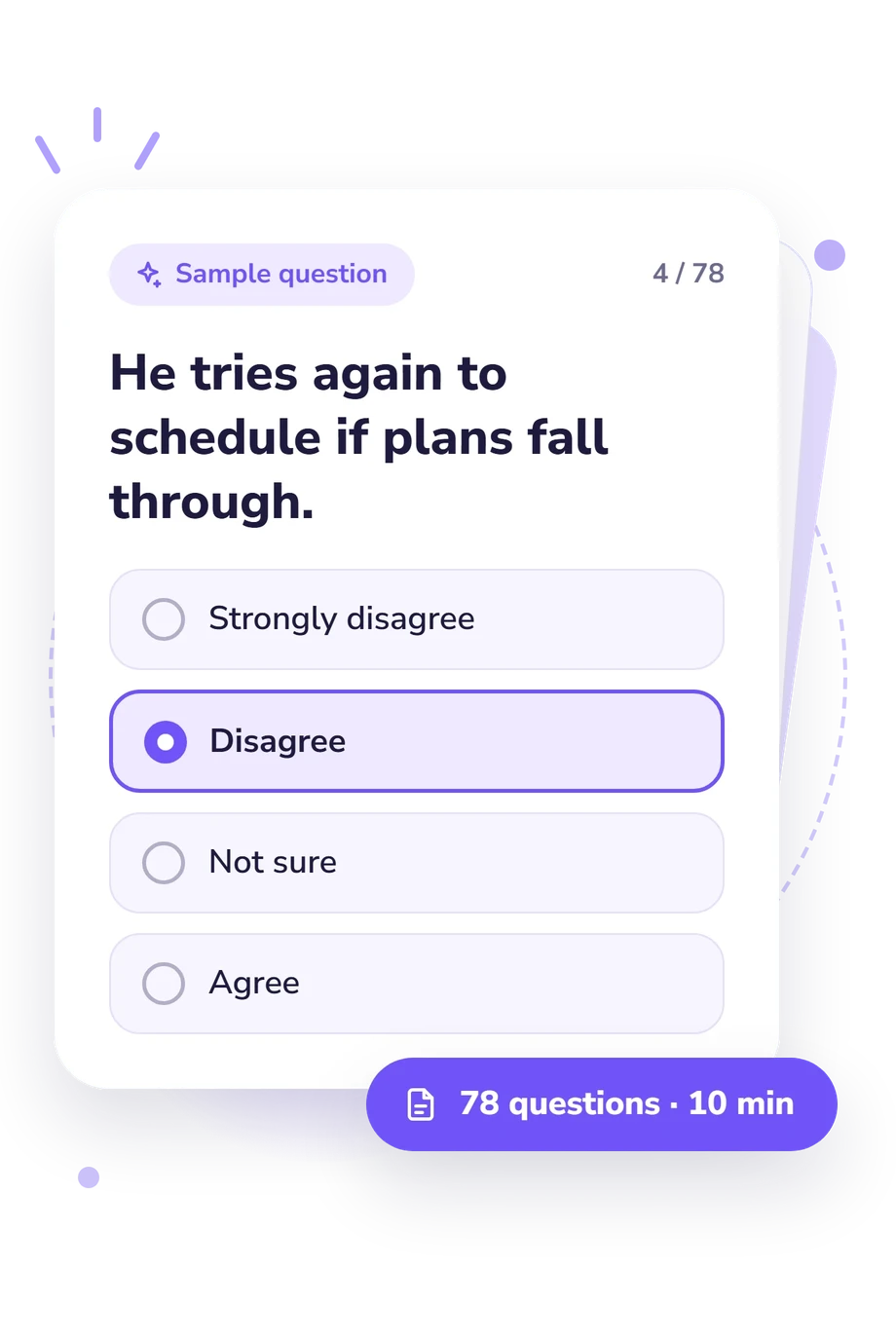
Example Questions From the Test
- Strongly disagree
- Disagree
- Not sure
- Agree
- Strongly disagree
- Disagree
- Not sure
- Agree
- Strongly disagree
- Disagree
- Not sure
- Agree
Are We Just Friends, or Does He Like Me? Quiz - Description and methodology of the test
People trying to understand an ambiguous connection can use the Does He Like Me or Are We Just Friends Quiz to organize repeated observations rather than overread one message or encounter. It is intended for someone reflecting on another person’s communication, consistency, warmth, and boundaries. Looking at signs of romantic interest can make the contrast between platonic patterns and possible attraction easier to examine.
What This Test Measures
The items focus on observable behavior: one-on-one plans, flirtatious banter, personal compliments, physical closeness, attention, group language, and reactions to romantic hints. Neutral replies, casual distance, and practical-only contact provide contrasting cues.
When someone is wondering whether he likes them romantically, the profile separates platonic patterns, reliability of effort, and romantic signals. It summarizes behavior rather than claiming access to private feelings.
The displayed profile contains three dimensions:
- Friend-Vibe Indicators (0-30) show how strongly platonic-only patterns appear; Low friend-vibe cues (0-10), Mixed/unclear vibe (11-20), and Strong friend vibes (21-30) mark the displayed bands.
- Initiation & Consistency (0-30) shows whether contact and follow-through are Sporadic (0-10), Inconsistent (11-20), or Steady (21-30).
- Romantic Interest Signals (0-40) show the strength of romantic cues, with Mostly Friend Vibes (0-13), Mixed Signals (14-26), and Likely Interested (27-40) as the displayed bands.
Methodology and Evidence Base
The representative statements use four options: Strongly disagree, Disagree, Not sure, or Agree. The sample items cover platonic cues, initiation, follow-through, and attraction. Because some items ask about presence and others about absence, answer from the overall pattern rather than one isolated event.
The results provide scores for the three dimensions, interpreted through the displayed bands, but per-answer weights are not specified; the ranges should not be used to reverse-engineer a scoring formula.
Conceptually, the questionnaire is consistent with Muehlenhard et al. (1986), whose research examined verbal and nonverbal signals of dating interest. Montoya, Kershaw, and Prosser (2018) connect attraction with enacted behavior, while Stinson, Cameron, and Hoplock (2022) describe friendship as a common route into romance. These sources support the themes, not authorship or validation of this online version.
As a quiz about signs he likes you more than a friend, it groups the result around context and behavior over time. Self-report may be shaped by memory, hope, current circumstances, and communication style; the displayed categories describe the response profile and are best read alongside the surrounding context.
- Muehlenhard, C. L., Koralewski, M. A., Andrews, S. L., & Burdick, C. A. (1986). Verbal and nonverbal cues that convey interest in dating: Two studies. Behavior Therapy, 17(4), 404-419. 10.1016/S0005-7894(86)80071-5
- Montoya, R. M., Kershaw, C., & Prosser, J. L. (2018). A meta-analytic investigation of the relation between interpersonal attraction and enacted behavior. Psychological Bulletin, 144(7), 673-709. 10.1037/bul0000148
- Stinson, D. A., Cameron, J. J., & Hoplock, L. B. (2022). The friends-to-lovers pathway to romance: Prevalent, preferred, and overlooked by science. Social Psychological and Personality Science, 13(2), 562-571. 10.1177/19485506211026992
Updated: