
When Will I Get a Boyfriend Quiz
How the Scales are Structured
Who Usually Takes This Test?
See How You Compare
Below is a preview of how scores are typically distributed across each scale.
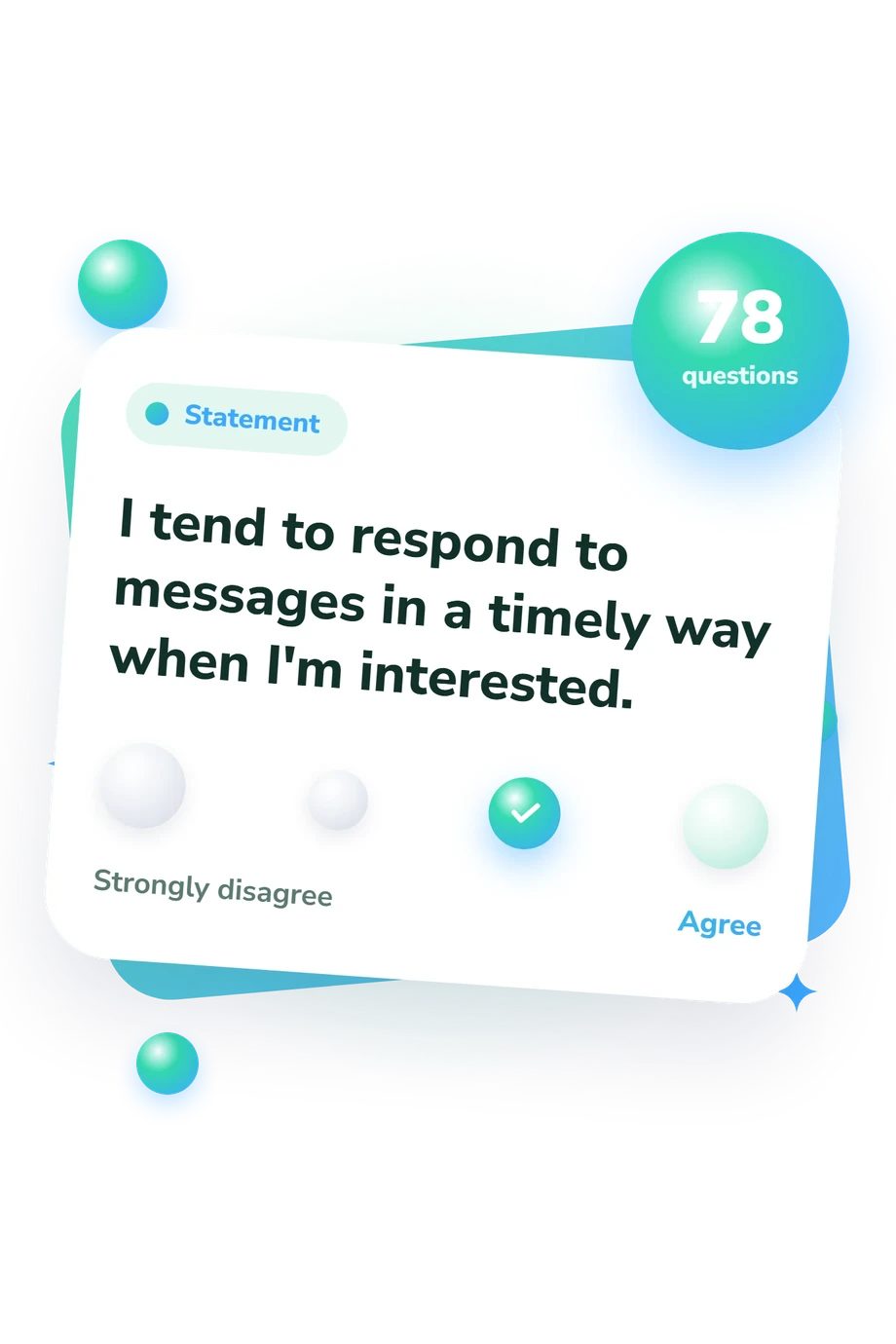
Example Questions From the Test
- Strongly disagree
- Disagree
- Not sure
- Agree
- Strongly disagree
- Disagree
- Not sure
- Agree
- Strongly disagree
- Disagree
- Not sure
- Agree
When Will I Get a Boyfriend Quiz - Description and methodology of the test
People seeking a clearer dating picture can use the When Will I Get a Boyfriend Quiz to examine conditions surrounding new relationship opportunities. It suits readers reflecting on current habits, availability, confidence, and relationship goals. Rather than naming a guaranteed date, the result turns concern into signals about what may help or slow progress. The Will I Get a Boyfriend Quiz keeps this reflection structured.
What This Assessment Explores
The items examine whether routines create chances to meet someone and whether you can act. They cover exposure, initiative, availability, confidence, clarity, and dating.
The timing estimate addresses one practical question: how soon will I get a boyfriend? Availability, activity, and readiness combine; momentum creates opportunities, while confidence and clarity shape follow-through.
The dimensions are:
- Dating Momentum (0-30) measures action and opportunity for meeting people; Low momentum (0-10), Moderate momentum (11-20), and High momentum (21-30) are its displayed bands.
- Readiness & Confidence (0-20) assesses emotional readiness, self-confidence, and relationship-goal clarity; Hesitant (0-8), Building (9-14), and Ready (15-20) show the levels.
- Timeline Window (1-5) estimates how soon a potential boyfriend may be met from availability, activity, and readiness; Longer window (1-2), Moderate window (3), and Sooner window (4-5) are the timing bands.
Together, they show whether progress may require contact, readiness, or time.
Methodology and Scientific Basis
The shown items use ordered self-report choices, including Strongly disagree to Agree and, for one openness item, Not at all open to Very open. The result presents three scales with their ranges and descriptive bands, which organize the profile. The displayed bands are descriptive categories for distinguishing levels of momentum, readiness, and timing.
Conceptually, readiness content is consistent with research on commitment readiness, confidence themes relate to research on relationship confidence, and online meeting content connects with work by McKenna et al. (2002) on online relationship formation. These sources provide relevant constructs; this questionnaire is not a direct adaptation of any one of them.
The result works as a boyfriend timing quiz by estimating current availability, activity, and readiness. Read the categories as a way to compare these dimensions within your profile.
Current mood, recent dating experiences, self-confidence, and personal interpretation can shift self-report results. Use the profile to choose a practical next step, while remembering that relationship outcomes also depend on other people and circumstances.
- Hadden, Benjamin W., Christopher R. Agnew, and Kenneth Tan. "Commitment Readiness and Relationship Formation." Personality and Social Psychology Bulletin, 44(8), 2018, 1242-1257. 10.1177/0146167218764668
- Rosenfeld, Michael J., and Reuben J. Thomas. "Searching for a Mate: The Rise of the Internet as a Social Intermediary." American Sociological Review, 77(4), 2012, 523-547. 10.1177/0003122412448050
- Riggio, Heidi R., Dana Weiser, Ann Valenzuela, Priscilla Lui, Robert Montes, and Julie Heuer. "Initial validation of a measure of self-efficacy in romantic relationships." Personality and Individual Differences, 51(5), 2011, 601-606. 10.1016/j.paid.2011.05.026
Updated: