
What Book Should I Read Quiz
How the Scales are Structured
Who Usually Takes This Test?
See How You Compare
Below is a preview of how scores are typically distributed across each scale.
Example Questions From the Test
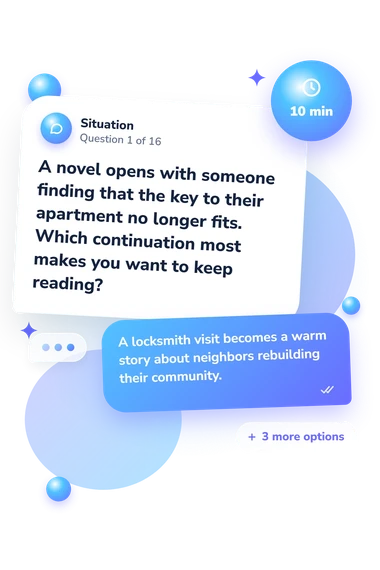
- A locksmith visit becomes a warm story about neighbors rebuilding their community.
- The key opens a door in the building that did not exist yesterday.
- The incident exposes a long-buried secret within the resident’s family.
- Someone has entered the apartment, moved one object, and left a deadline on the table.
- A sudden external event that immediately redirects the story
- A useful clue about a larger secret or mystery
- A sharp confrontation that finally makes the conflict explicit
- Small gestures and carefully chosen words that reveal the hidden tensions
- A recognizable story about work, family, or friendship
- A realistic adventure in a place I have never visited
- A familiar world changed by one impossible twist
- A sweeping journey through a world unlike my own
What Book Should I Read Quiz - Description and methodology of the test
Readers who feel pulled between genres, moods, and formats can use the What Book Should I Read Quiz to turn broad preferences into a practical reading profile. Readers seeking a book recommendations quiz can use this assessment as a more considered starting point than a random title. The result connects choices about plot, language, atmosphere, ideas, and emotional involvement with likely reading directions.
What This Assessment Explores
Reading taste is a pattern, not identity. Scenarios test tension, prose, setting, evidence, and emotional complexity. Several genres can therefore shape the answer in this quiz about what book I should read next.
The result dimensions are:
- Character-Driven Literary Fiction (0-12) measures interest in nuanced relationships, layered prose, moral complexity, and interior change; bands: Plot-or-Concept Led (0-4), Emotionally Open (5-8), Human-Nature Reader (9-12).
- Immersive Fantasy & Speculative Adventure (0-12) measures interest in inventive settings, impossible possibilities, quests, and discoveries; bands: Reality-Anchored Reader (0-4), Selective Explorer (5-8), World Wanderer (9-12).
- Narrative Nonfiction & Big Ideas (0-12) measures interest in true stories, evidence, history, science, and social ideas; bands: Fiction-First Curiosity (0-4), Topic-Driven Learner (5-8), Curious Investigator (9-12).
- Pulse-Racing Mystery & Thriller (0-12) measures interest in suspense, danger, clue-solving, secrets, and meaningful reveals; bands: Different Kind of Momentum (0-4), Mystery-Curious (5-8), Suspense Seeker (9-12).
Methodology and Scientific Basis
Each item presents a reading situation or book premise with four response options. As a self-report questionnaire, it distinguishes emotional subtext, external hooks, world-building, factual depth, stylistic pleasure, and mystery-solving. The result reports four scale scores, and interpretation uses their relative profile rather than one global reading score. As a quiz about what to read next, it helps you choose a book without reducing taste to a single genre.
Liu's 2024 study of literature reading preferences offers a comparable framework for organizing literary preferences. Thums, Artelt, and Wolter (2021) distinguish entertainment- and information-oriented preferences, while Miall and Kuiken (1995) examine emotional, interpretive, and stylistic responses. This questionnaire is conceptually consistent with those works, not an adaptation or validation of them.
The displayed bands are descriptive labels for relative affinities, not population comparisons or clinical thresholds. Results can shift with mood, recent reading, genre familiarity, and how honestly someone imagines each situation. The profile offers a next-reading direction; book descriptions, sample pages, and current curiosity still shape the final choice.
- Yamei Liu (2024). Multilayer perceptron-based literature reading preferences predict anxiety and depression in university students. Frontiers in Psychology, 15, Article 1425471. 10.3389/fpsyg.2024.1425471
- Kathrin Thums, Cordula Artelt, and Ilka Wolter (2021). Reading for entertainment or information reception? Gender differences in reading preferences and their impact on text-type-specific reading competences in adult readers. European Journal of Psychology of Education, 36(2), 339-357. 10.1007/s10212-020-00486-1
- David S. Miall and Don Kuiken (1995). Aspects of Literary Response: A New Questionnaire. Research in the Teaching of English, 29(1), 37-58. 10.58680/rte199515356
Updated: