
Pi Quiz
How the Scales are Structured
Who Usually Takes This Test?
See How You Compare
Below is a preview of how scores are typically distributed across each scale.
Example Questions From the Test
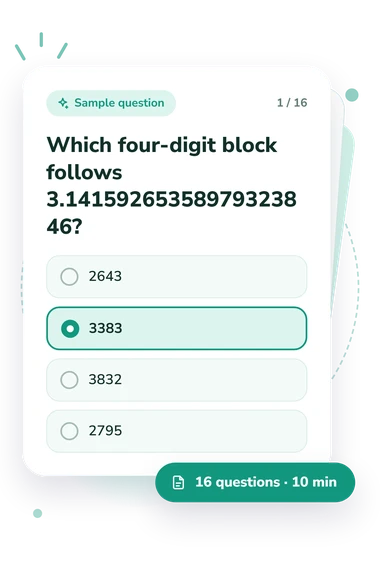
- 2643
- 3383
- 3832
- 2795
- 9π square units
- 12π square units
- 6π square units
- 36π square units
- It remains the same
- It becomes four times as large
- It triples
- It doubles
Pi Quiz - Description and methodology of the test
For learners deciding whether a short mathematics refresher fits their goals, the Pi Quiz offers a focused way to gauge readiness for further practice. It suits students and curious adults who want a clear overall result before revisiting circle geometry or digit recall. As a quiz about digits of pi, it also offers a practical choice for informal self-checking.
What This Test Measures
Questions combine decimal recall with application. They ask about sequences, place value, irrationality, circle formulas, and radians, so the result reflects both memory and usable understanding. This balance makes it useful for circle formula practice and informal Pi Day revision.
One displayed scale, Pi Knowledge (0-16), places performance in three bands: Beginning (0-6) signals core material to review; Developing (7-12) shows useful knowledge with room to strengthen recall or application; Strong (13-16) reflects accurate recall and command of standard pi mathematics.
These are the main areas represented in the result:
- Digit recall and place value show how accurately you continue decimal expansions and read notation.
- Circle geometry shows how well you connect radius, diameter, circumference, and area.
- Meaning and application show whether you understand irrationality, pi’s geometric definition, and radian measure.
Methodology and Evidence Base
Each item uses a short prompt and four answer choices. Some require decimal retrieval; others ask for a definition or one-step calculation. Results are presented as one overall score, with no separate subscores shown, so the outcome is a broad knowledge summary.
Its emphasis on decimal retrieval makes it useful for pi digit recall practice as well as geometry application. Its content is conceptually consistent with mathematical treatments of pi by Berggren, Borwein, and Borwein and with classical circle work associated with Archimedes. The digit-retrieval study by Raz and colleagues provides context for memory demands, but it does not validate this questionnaire or supply its scoring manual. The questionnaire is an online educational knowledge check.
Interpretation depends on prior teaching, notation familiarity, attention, and guessing. The same test can support Pi Day practice, although time pressure may change the result, while a lower band points to material for practice rather than broader mathematical ability. Because the questions sample narrow knowledge and depend on the respondent’s own answers, they cannot explain individual errors or establish general mathematical skill.
- Amir Raz, Mark G. Packard, Gerianne M. Alexander, Jason T. Buhle, Hongtu Zhu, Shan Yu, and Bradley S. Peterson. A slice of pi: An exploratory neuroimaging study of digit encoding and retrieval in a superior memorist. Neurocase, 15(5), 361-372, 2009. 10.1080/13554790902776896
- Lennart Berggren, Jonathan Borwein, and Peter Borwein, editors. Pi: A Source Book. 3rd ed. Springer, 2004. 10.1007/978-1-4757-4217-6
- Archimedes. The Works of Archimedes, edited by Thomas Little Heath. Cambridge University Press, 1897.