
Godly Parent Quiz
How the Scales are Structured
Who Usually Takes This Test?
See How You Compare
Below is a preview of how scores are typically distributed across each scale.
Example Questions From the Test
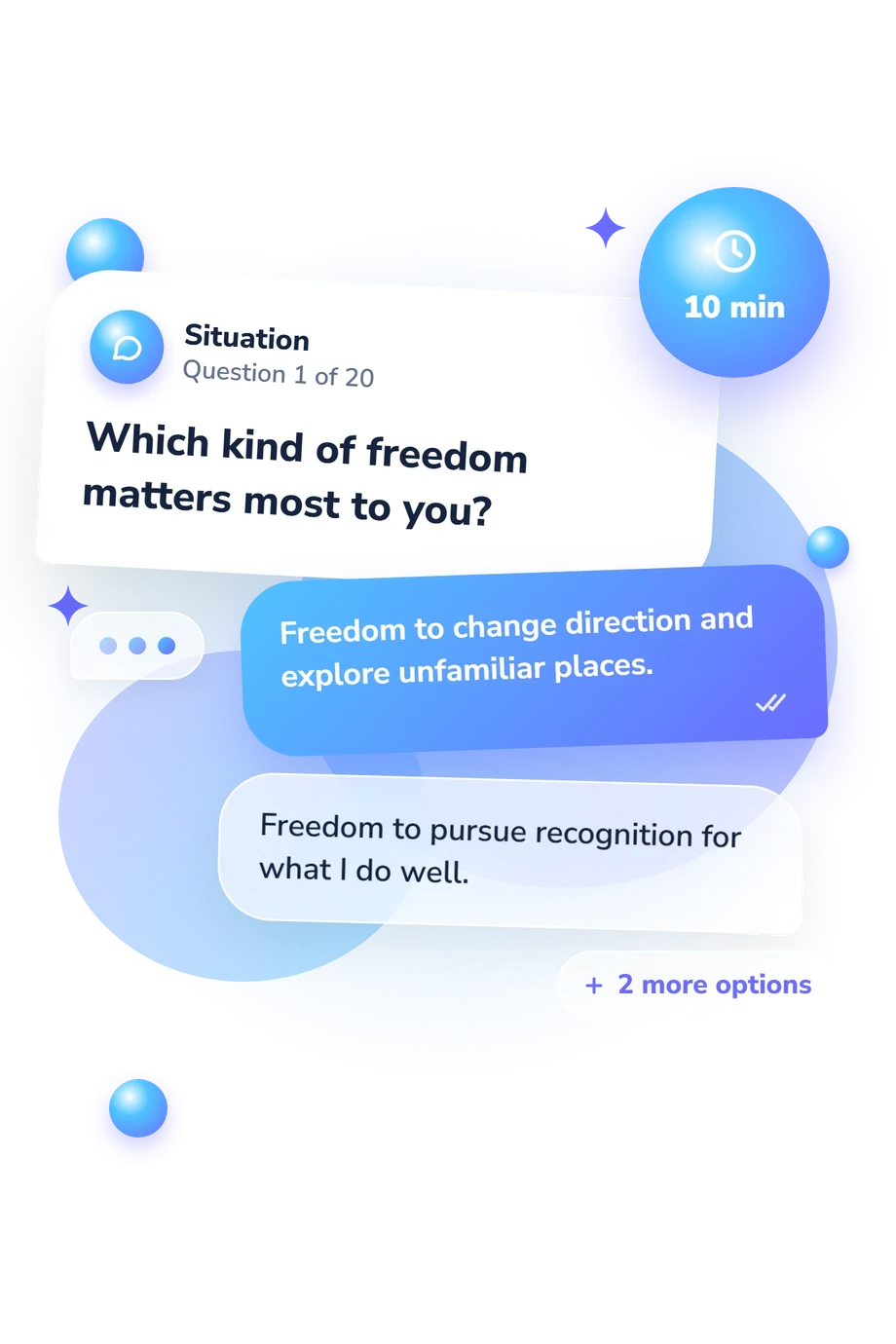
- Freedom to change direction and explore unfamiliar places.
- Freedom to pursue recognition for what I do well.
- Freedom to protect my inner world and choose my own course.
- Freedom to build a stable routine around my priorities.
- Share it immediately and build energy around it.
- Make a quick note and return to it when there is time.
- Consider whether it solves a practical problem before keeping it.
- Let it develop privately until I understand what it could become.
- Stay nearby without pressing and let them speak when ready.
- Suggest an activity that might lift their mood.
- Ask a few gentle questions to help them organize their thoughts.
- Give them space now and check back at a specific time.
Godly Parent Quiz - Description and methodology of the test
People drawn to Greek mythology, archetypes, or Percy Jackson-style identity play can use the godly parent quiz to consider which symbolic qualities resemble their everyday responses. For readers who enjoy mythic identity play, this Greek god parent quiz can make those themes approachable. It suits anyone wanting an imaginative self-reflection exercise rather than a fixed identity.
What This Assessment Explores
Rather than claiming literal ancestry, this quiz about who is my godly parent maps choices onto five mythic affinities. It suits readers exploring personality symbolism and responses to challenge, creativity, planning, novelty, and emotion.
The highest score indicates the strongest affinity; scores within one point can form a blend.
The five displayed dimensions are:
- Apollo - Radiant Creator (0-12) shows expression and artistry: Distant Echo (0-4), Mixed Resonance (5-8), Strong Affinity (9-12).
- Ares - Courageous Competitor (0-12) shows courage and directness: Distant Echo (0-4), Mixed Resonance (5-8), Strong Affinity (9-12).
- Athena - Strategic Mind (0-12) shows planning and problem-solving: Distant Echo (0-4), Mixed Resonance (5-8), Strong Affinity (9-12).
- Hermes - Clever Explorer (0-12) shows wit and flexibility: Distant Echo (0-4), Mixed Resonance (5-8), Strong Affinity (9-12).
- Poseidon - Ocean Spirit (0-12) shows feeling, loyalty, and independence: Distant Echo (0-4), Mixed Resonance (5-8), Strong Affinity (9-12).
Methodology and Scientific Basis
Situational self-report prompts ask how a person might respond to freedom, conflict, creativity, teamwork, travel, emotion, competition, and problem-solving. Four contrasting answers make the task about best-fit tendencies, not mythology knowledge or observed behavior.
The five displayed scale scores are compared: the highest scale is the strongest affinity, and any scale within one point may form part of a blend. For readers approaching it as a who-is-your-godly-parent quiz in the Percy Jackson style, the result is a symbolic affinity pattern, not divine ancestry.
Its conceptual reference is the Gods in Everyman model, which treats Greek gods as metaphors for personality and life orientation. Apollo, Ares, Hermes, and Poseidon are conceptually consistent with Bolen’s model; Athena relates to Bolen’s goddess framework and Hashemi and Tahmasebi’s Athena analysis. This questionnaire is conceptually consistent with these works, not a direct adaptation or validated reproduction.
The three displayed bands are descriptive affinity labels indicating lower, mixed, or stronger resonance with each theme. Self-report may shift with mood, self-awareness, and the situation in mind, so results work best as reflection prompts rather than fixed classifications.
- Bolen, Jean Shinoda. Gods in Everyman: A New Psychology of Men's Lives and Loves. Harper & Row, 1989.
- Bolen, Jean Shinoda. Goddesses in Everywoman: A New Psychology of Women. Harper & Row, 1984.
- Hashemi, Seyed Eissa, and Maryam Tahmasebi. The Unreachable Beloved; How Can Athena Remain as the Prime Emotion? Procedia - Social and Behavioral Sciences, vol. 30, 2011, pp. 1091-1095. 10.1016/j.sbspro.2011.10.213
Updated: