
Credit Card Quiz
How the Scales are Structured
Who Usually Takes This Test?
See How You Compare
Below is a preview of how scores are typically distributed across each scale.
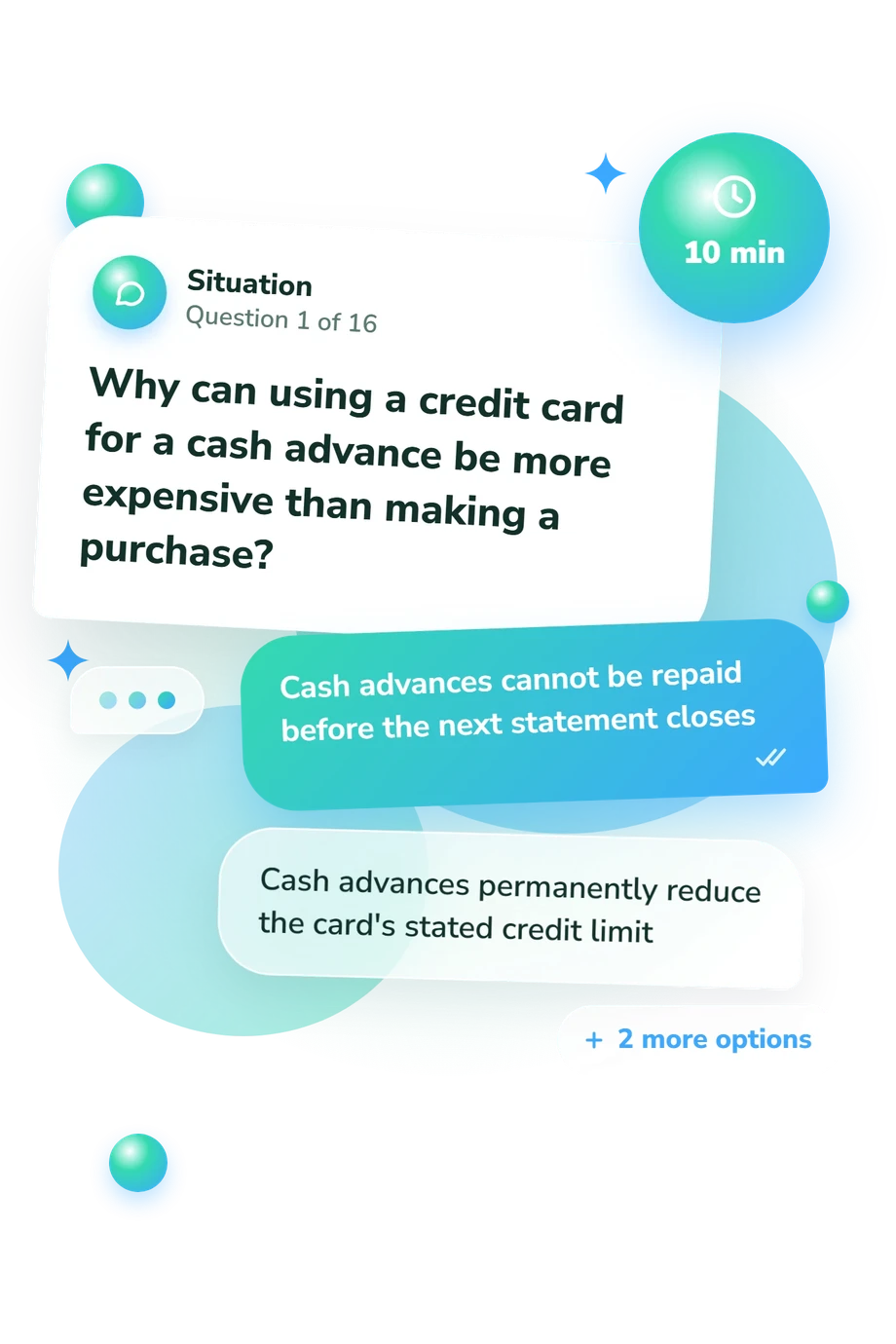
Example Questions From the Test
- $30
- $60
- $900
- $90
- 5%
- 20%
- 50%
- 80%
- The issuer automatically lowers the APR each month
- The remaining balance stops accruing interest
- The debt is paid off almost as quickly as with full payments
- Repayment usually takes longer and costs more in interest
Credit Card Quiz - Description and methodology of the test
Readers who want to check whether everyday card decisions make sense can use this credit card quiz as a focused knowledge exercise. It suits people who are learning how cards work, reviewing their own financial habits, or checking their grasp of credit card interest before managing borrowing more confidently. Taking it can reveal how comfortably a reader handles common credit-card questions and provide a starting point for further learning.
What This Assessment Explores
This questionnaire measures practical credit-card knowledge rather than personality, preference, or issuer fit. Its situations cover APRs, balances, utilization, fees, rewards, cash advances, due dates, pending authorizations, fraud responses, and issuer-network roles. Readers can review credit card fees and account features among these concepts, while the overall result summarizes performance across the questions.
One Credit Card Knowledge scale (0-16) reports the result in three bands:
- Foundations to build (0-6) signals that statement terms, borrowing costs, fees, and repayment basics need review.
- Developing knowledge (7-12) signals familiarity with essentials but possible gaps in calculations or account features.
- Strong knowledge (13-16) signals a solid grasp of common concepts and practical trade-offs.
The bands describe questionnaire performance, not borrowing suitability.
Methodology and Evidence Base
Methodologically, this is an educational multiple-choice assessment of credit-card knowledge, with financial-literacy studies serving only as conceptual context. Each item presents a concrete situation with four answer choices. Some require calculations involving fees, utilization, interest, rewards, or remaining credit; others test account rules, repayment choices, and safer responses to unfamiliar transactions. The displayed score summarizes performance, but the questionnaire does not state how each answer contributes to the total.
Evidence is conceptually consistent with Limbu (2017), which connects credit-card knowledge with credit behavior, and with Disney and Gathergood (2013) and Allgood and Walstad (2013), which examine financial literacy and credit use. This questionnaire is not an adaptation of those studies, so their findings provide context without establishing norms, reliability, or validity for this online form.
In practice, the total comes from this credit card assessment's questions about interest, fees, balances, payments, and account security. Results can reflect prior exposure, guessing, attention, and current understanding. The score has no stated normative reference group, so it is best read as educational feedback rather than a standardized measure of financial capability.
- Limbu, Yam B. (2017). Credit card knowledge, social motivation, and credit card misuse among college students: Examining the information-motivation-behavioral skills model. International Journal of Bank Marketing, 35(5), 842-856. 10.1108/IJBM-04-2016-0045
- Disney, Richard, and John Gathergood. (2013). Financial literacy and consumer credit portfolios. Journal of Banking & Finance, 37(7), 2246-2254. 10.1016/j.jbankfin.2013.01.013
- Allgood, Sam, and William Walstad. (2013). Financial Literacy and Credit Card Behaviors: A Cross-Sectional Analysis by Age. Numeracy, 6(2), Article 3. 10.5038/1936-4660.6.2.3
Updated: