
World Capitals Quiz
How the Scales are Structured
Who Usually Takes This Test?
See How You Compare
Below is a preview of how scores are typically distributed across each scale.
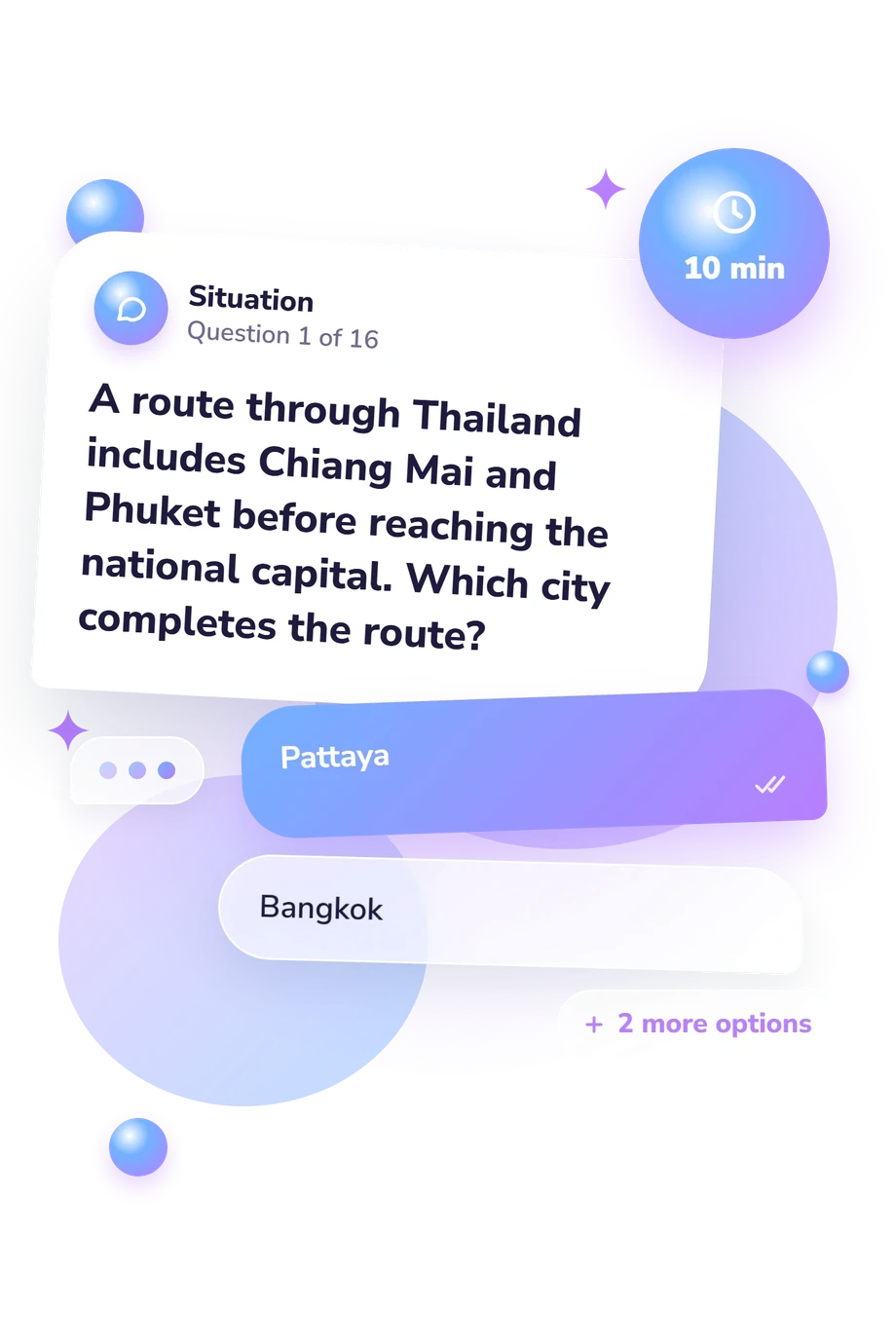
Example Questions From the Test
- Pattaya
- Bangkok
- Ayutthaya
- Krabi
- Mumbai
- Bengaluru
- Kolkata
- New Delhi
- Kano
- Port Harcourt
- Ibadan
- Abuja
World Capitals Quiz - Description and methodology of the test
People who want to strengthen practical geography knowledge can use the world capitals quiz to check how reliably they connect countries with their national seats of government. For learners, travelers, and curious people, this country capitals quiz tests recall rather than detailed map skills. The result reflects current command of capital-city facts without identifying specific regional gaps.
What This Assessment Measures
Questions ask you to identify a national capital when a country’s largest or most famous city could cause confusion. Political and geographic clues make this capital cities quiz a test of factual capital knowledge, not map drawing or speed.
One overall result measures this knowledge. The question themes include:
- World Capitals Knowledge (0-16) records correct answers: Foundation building (0-6) indicates partial recognition; Developing knowledge (7-12) reflects a broad base; Strong command (13-16) indicates accurate identification across a wide geographic range.
- Regional coverage is represented by countries and capitals from different parts of the world, but it has no separate regional score.
- City-versus-capital recognition tests whether prominent commercial cities distract from the national seat of government; institutional and historical clues support recall of political roles and capital changes.
These themes describe sampled content; the band reflects overall performance.
Methodology and Evidence Base
Each item presents a country clue and four choices, with one national capital among them. One point is awarded for each correct answer, producing the overall total. In this capitals of the world quiz, the total records accurate country-capital associations; unfamiliar names and confusion with larger cities can lower the result.
The relevant research is conceptual, not evidence that this online questionnaire reproduces a published scale. Nolan’s geographic-literacy work treats usable knowledge of the world as relevant to capital recognition. This relationship does not validate the questionnaire or establish it as Nolan’s instrument or adaptation; it provides a conceptual frame for the factual recall sampled here.
Interpret the bands as descriptive guides for this item set, not population norms. Results can reflect schooling, language familiarity, recent study, guessing, and recognition of familiar names. Because this is a fixed-choice, self-administered countries and capitals quiz, the score is best used to guide general practice and motivate further study; it cannot by itself identify which topics need review.
- Nolan, Robert E. 2002. “Geo-Literacy: How Well Adults Understand the World in Which They Live.” Adult Basic Education 12(3): 134-144.
- Saarinen, Thomas F., and Charles L. MacCabe. 1995. “World Patterns of Geographic Literacy Based on Sketch Map Quality.” The Professional Geographer 47(2): 196-204. 10.1111/j.0033-0124.1995.00196.x
- Montello, Daniel R. 2009. “Cognitive Research in GIScience: Recent Achievements and Future Prospects.” Geography Compass 3(5): 1824-1840. 10.1111/j.1749-8198.2009.00273.x
Updated: