
When Will I Get Married Quiz
How the Scales are Structured
Who Usually Takes This Test?
See How You Compare
Below is a preview of how scores are typically distributed across each scale.
Example Questions From the Test
- Strongly disagree
- Disagree
- Not sure
- Agree
- Strongly disagree
- Disagree
- Not sure
- Agree
- Strongly disagree
- Disagree
- Not sure
- Agree
When Will I Get Married Quiz - Description and methodology of the test
For someone weighing whether a relationship can move toward marriage, results from the when will i get married quiz help compare readiness with surrounding conditions and identify which obstacles deserve attention first. The assessment organizes questions about timing, compatibility, and practical circumstances so relationship concerns can be distinguished from planning concerns. As a marriage readiness quiz, it gives a structured basis for deciding whether to clarify goals, address barriers, or allow more time.
What This Assessment Explores
The questions look beyond a wish to marry. They examine emotional readiness, practical feasibility, shared goals, communication, support, and movement toward marriage. The result suits people dating or partnered who want to understand how circumstances may shape timing.
The scales organize the result:
- Commitment Readiness (0-30) measures emotional and practical commitment readiness; its bands are Not Ready Yet (0-10), Emerging Readiness (11-20), and Commitment-Ready (21-30).
- Marriage Timeline Estimate (0-20) indicates a sooner or later expected timeline; its bands are Sooner (0-6), A Few Years (7-13), and Later (14-20).
- Relationship Momentum (0-30) captures conditions supporting movement toward engagement; its bands are Low momentum (0-12), Moderate momentum (13-22), and High momentum (23-30).
A useful distinction emerges: viewed as a marriage timeline quiz, the result separates willingness from conditions, so readiness may be strong even when practical barriers limit momentum.
Methodology and Scientific Basis
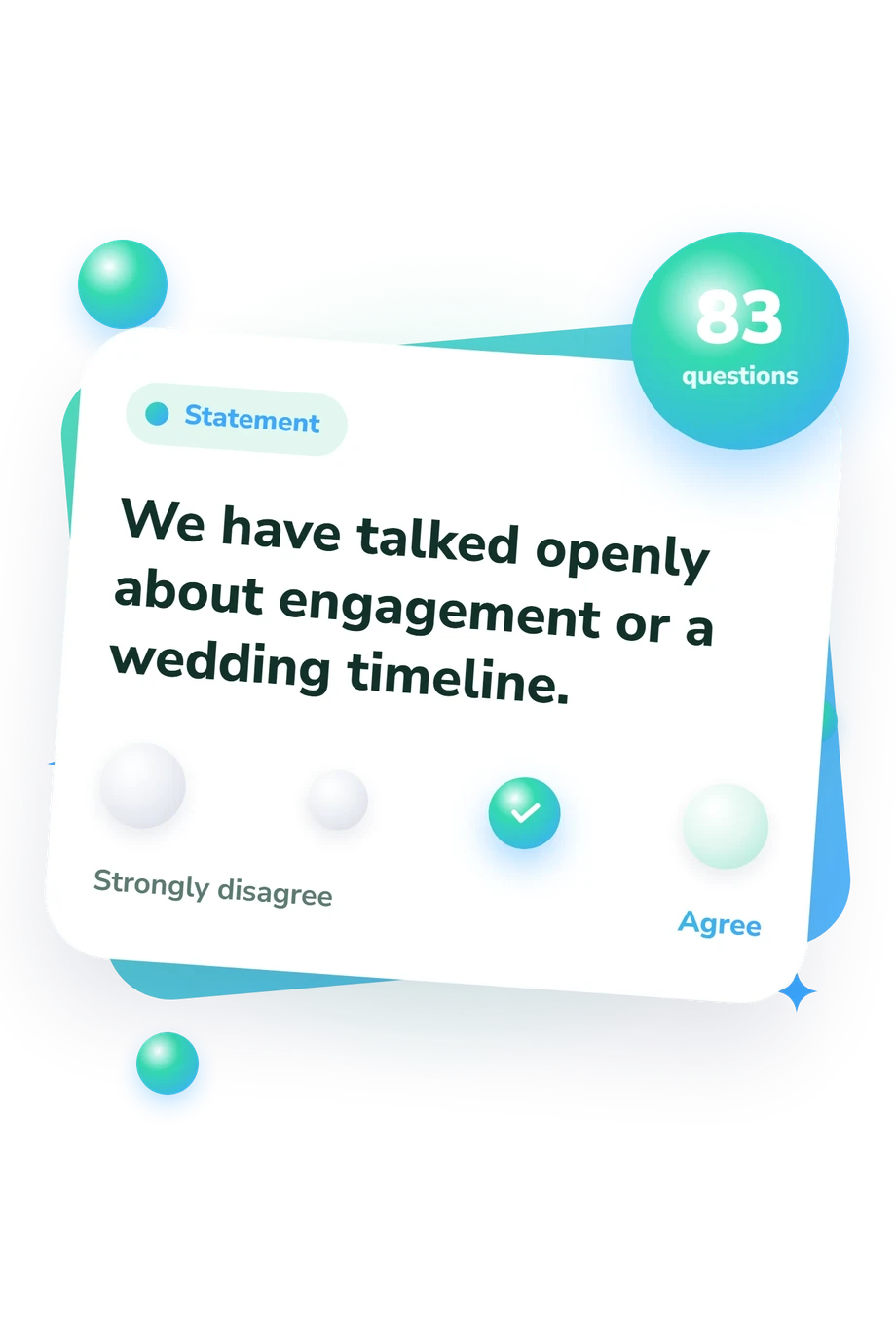
Questions use statements about conversations, preferences, finances, life stage, compatibility, and follow-through. The four response options are Strongly disagree, Disagree, Not sure, and Agree; some statements are reverse-keyed. The questionnaire addresses the question behind a will I get married quiz by assessing relationship situations that bear on timing.
Responses are aggregated into the displayed scale results, whose bands are descriptive categories shown for each result. Because the questionnaire does not specify how many points each answer contributes, no extra weighting rule should be inferred.
Conceptually, readiness is closest to the Commitment Readiness Scale. This questionnaire is conceptually consistent with that work and is not an adaptation of it. Willoughby and Hall’s research addresses marital expectations, while Stanley, Rhoades, and Markman’s work helps explain deliberate decisions versus relationship inertia. These sources support thematic interpretation, not a claim that this questionnaire has their norms or validation.
The displayed bands function as descriptive categories for this online self-report profile; they help readers compare readiness with momentum, notice mismatches, and discuss goals or obstacles. Current context, self-awareness, and response bias can affect results.
- Hadden, Benjamin W., Christopher R. Agnew, and Kenneth Tan. Commitment Readiness and Relationship Formation. Personality and Social Psychology Bulletin, 44(8), 1242-1257 (2018). 10.1177/0146167218764668
- Willoughby, Brian J., and Scott S. Hall. Enthusiasts, Delayers, and the Ambiguous Middle: Marital Paradigms Among Emerging Adults. Emerging Adulthood, 3(2), 123-135 (2015). 10.1177/2167696814548478
- Stanley, Scott M., Galena K. Rhoades, and Howard J. Markman. Sliding Versus Deciding: Inertia and the Premarital Cohabitation Effect. Family Relations, 55(4), 499-509 (2006). 10.1111/j.1741-3729.2006.00418.x
Updated: