
WW2 Quiz
How the Scales are Structured
Who Usually Takes This Test?
See How You Compare
Below is a preview of how scores are typically distributed across each scale.
Example Questions From the Test
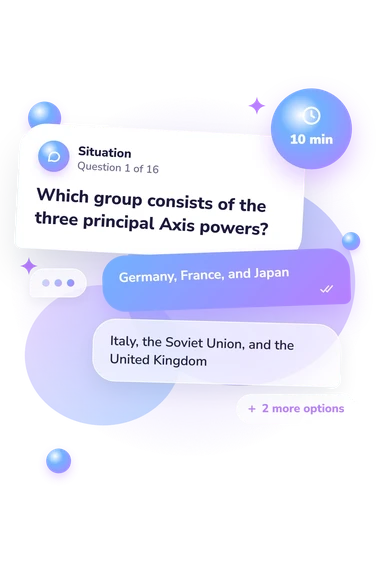
- Germany, France, and Japan
- Italy, the Soviet Union, and the United Kingdom
- Japan, China, and Germany
- Germany, Italy, and Japan
- Sicily
- Brittany
- Normandy
- The Netherlands
- The Soviet Union
- Belgium
- Norway
- Poland
WW2 Quiz - Description and methodology of the test
People who want to check their grasp of the Second World War can use the WW2 Quiz as a focused knowledge assessment, whether they are revising, teaching, or returning to the subject after time away. It moves from alliances and campaigns to intelligence, occupation, civilian life, and genocide. A world war 2 quiz of this kind can reveal both confident areas and topics worth revisiting.
What This Assessment Explores
The questions test historical knowledge rather than personality or opinion. They cover powers, invasions, operations, turning points, policies, strategy, and civilian consequences. The result reflects breadth across chronology and geography, plus recognition of why events mattered.
As a wwii quiz, it suits learners revising the subject, checking classroom knowledge, or returning to history after time away. Each item asks for the answer that best fits a documented event.
The World War II Knowledge scale runs from 0-16 and is interpreted through these bands:
- Foundations to build (0-6) indicates recognition of core elements and a need to review the timeline, theaters, and turning points.
- Developing knowledge (7-12) indicates a solid grasp of central events, with gaps in connecting strategies and consequences.
- Strong knowledge (13-16) indicates broad understanding across chronology, fronts, political decisions, and human impact.
Methodology and Evidence Base
Each item presents one historical prompt with four answer choices. The format relies on recognition and recall: the respondent compares alternatives, selects one, and receives a combined knowledge result rather than separate personality or attitude scores. Scoring is reported as one overall knowledge result on the displayed scale; no separate trait profile is presented.
As a world war ii quiz, this questionnaire is conceptually consistent with the broad historical coverage discussed by Piehler and Grant (2023), Overy (2023), and Geyer and Tooze (2015). Those works support the inclusion of military operations, political decisions, economic pressures, social experience, and human consequences; they do not make this online questionnaire an adaptation of their books or a validated reproduction of a published test.
The questionnaire is presented as an online knowledge check, not a standardized instrument with published norms. Interpret the result as an indicator of current knowledge and recall. For someone taking a ww2 history quiz, performance may vary with prior exposure, memory, guessing, and testing context, so the score cannot capture every interpretive or ethical dimension of the subject.
- Piehler, G. Kurt, and Jonathan A. Grant, eds. The Oxford Handbook of World War II. Oxford University Press, 2023. 10.1093/oxfordhb/9780199341795.001.0001
- Overy, Richard, ed. The Oxford History of World War II. Oxford University Press, 2023. 10.1093/oso/9780192884084.001.0001
- Geyer, Michael, and Adam Tooze, eds. The Cambridge History of the Second World War: Volume III: Total War: Economy, Society and Culture. Cambridge University Press, 2015. 10.1017/CHO9781139626859