
States and Capitals Quiz
How the Scales are Structured
Who Usually Takes This Test?
See How You Compare
Below is a preview of how scores are typically distributed across each scale.
Example Questions From the Test
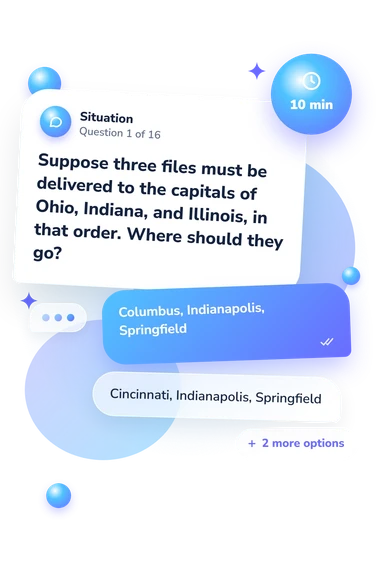
- Columbus, Indianapolis, Springfield
- Cincinnati, Indianapolis, Springfield
- Columbus, Springfield, Indianapolis
- Cleveland, Fort Wayne, Chicago
- Maine — Augusta; New Hampshire — Montpelier; Vermont — Concord
- Maine — Portland; New Hampshire — Concord; Vermont — Burlington
- Maine — Augusta; New Hampshire — Concord; Vermont — Montpelier
- Maine — Bangor; New Hampshire — Manchester; Vermont — Augusta
- New Orleans, Dallas, Tulsa
- Baton Rouge, Austin, Oklahoma City
- Baton Rouge, Houston, Oklahoma City
- Shreveport, Austin, Norman
States and Capitals Quiz - Description and methodology of the test
Students, travelers, and curious adults may use this state capitals quiz when deciding whether to refresh U.S. geography for class, travel, map study, or civic learning. The States and Capitals Quiz turns that choice into a focused exercise, so the result can indicate whether a short review session or a broader study plan would be more useful.
What This Assessment Explores
Rather than testing broad knowledge of each state, this assessment focuses on recalling capital pairings. Its items move across regions, preserve the order of several matches, and use familiar non-capital cities as distractors. Questions span different parts of the country, so this capitals quiz can point to focused review after missed pairings.
The item themes are:
- Regional recall shows whether you connect states with capitals across the country.
- Distractor discrimination shows whether you reject prominent cities that are not seats of state government.
- Ordered matching checks whether several pairings stay accurate in a specified sequence.
The States and Capitals Knowledge scale runs from 0-16. Foundations to build covers 0-6, Developing recall 7-12, and Strong command 13-16; these bands describe current mastery of the tested relationships.
Methodology and Scientific Basis
Methodologically, this is a multiple-choice knowledge check: each item presents grouped state-capital options, and the reader selects one complete grouping. Each fully correct group earns one point, so the result reflects accurate matches rather than a fixed trait estimate.
Official place-name questions ask readers to distinguish major cities from official seats of state government. Its structure also rewards exact matching, attention to order, and recognition of official place names, making focused review more targeted.
Grouped questions in the US capitals quiz draw on several regions, so a learner can use an incorrect pairing to choose a concrete topic for review.
The quiz uses factual and conceptual background rather than a published scale. Such background can establish correct place names, but it does not validate the scale, bands, or one-point model. The questionnaire is a content-focused online quiz, not a reproduction or adaptation of a published instrument.
Because the bands summarize performance on these 16 pairings, they offer descriptive feedback on this task rather than a general measure of geographic ability. Results may also shift with recent study, map familiarity, and guessing.
- Mason, Mary T., and Glen Blankenship. (1988). "Where in the World? The Status of Place-Name Geography Instruction." The Journal of Social Studies Research, 12(1), 1-7. 10.1177/235227981988012001001
- Montès, Christian. (2014). American Capitals: A Historical Geography. University of Chicago Press. 10.7208/chicago/9780226080512.001.0001
- U.S. Geological Survey. (1990). The National Gazetteer of the United States of America; United States concise 1990. U.S. Government Printing Office, Professional Paper 1200-US. 10.3133/pp1200US