
Sex Quiz
How the Scales are Structured
Who Usually Takes This Test?
See How You Compare
Below is a preview of how scores are typically distributed across each scale.
Example Questions From the Test
- If pregnancy is possible, consider emergency contraception promptly and contact a healthcare or sexual-health service for STI and HIV guidance
- Wait for symptoms before doing anything, since testing is inaccurate without them
- Use two condoms together next time; no action is useful after the break
- Douche or wash internally as soon as possible to prevent pregnancy and infection
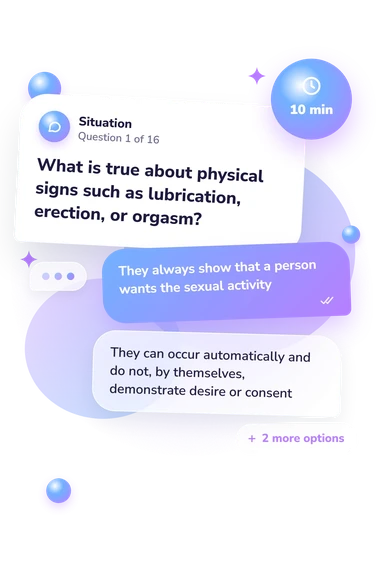
- They always show that a person wants the sexual activity
- They can occur automatically and do not, by themselves, demonstrate desire or consent
- They prove emotional readiness even when the person expresses uncertainty
- They indicate consent reliably, but only in an established relationship
- It is useful only after a person develops visible genital warts
- It cures all existing HPV infections and removes the need for screening
- It prevents every sexually transmitted infection except HIV
- It helps prevent infection from HPV types responsible for many cancers and genital warts, but does not treat an existing infection
Sex Quiz - Description and methodology of the test
Anyone who wants to check practical sexual-health knowledge can use this assessment to examine choices involving consent, protection, testing, communication, and pleasure. It is suited to people reflecting on their own understanding, including someone using a sex quiz as a starting point for a more informed conversation. The result works like a sexual health knowledge test: it shows which foundations appear secure and which topics deserve review.
What This Assessment Explores
The questions focus on practical knowledge rather than sexual identity, preference, or experience. They ask respondents to recognize safer responses when contraception fails, understand what barriers and vaccination can prevent, notice unclear consent, and identify communication that supports comfort and pleasure. The consent quiz presents these themes through situations involving intoxication, silence, changing willingness, and pausing.
The result uses Safer, More Pleasurable Sex Knowledge (0-16), with one point per correct answer. The displayed bands are:
- Foundations to build (0-6) means core topics need review before relying on this knowledge.
- Developing knowledge (7-12) means many essentials are understood, though gaps may affect safer or more pleasurable choices.
- Strong knowledge (13-16) reflects broad understanding of consent, sexual-health protection, and pleasure-supporting communication.
As a free quiz about sexual health, this assessment is most useful as a prompt for targeted learning.
Methodology and Evidence Base
Each item presents a sexual-health situation or claim with four response options, requiring selection of the best answer rather than a rating of personal behavior. The scoring shown assigns one point for each correct response, producing the single knowledge score above; no additional scoring rule should be inferred from the range.
Its content is conceptually consistent with SexContraKnow-Instrument (Sanz-Martos et al., 2019), a published knowledge measure using item-level analysis, and aligns with later work on acquired sexual-health knowledge and STI knowledge questionnaires, including Mainella et al. (2026) and Jaworski and Carey (2007). This relationship is evidential rather than genealogical: the online questionnaire is not a direct adaptation or standardized administration of those instruments.
The items combine consent literacy, contraception, barrier use, vaccination, HIV prevention, testing windows, symptom-free transmission, and pleasure-supporting communication. Within this STI prevention quiz, the result can identify a learning priority.
Because responses are self-reported, performance can be shaped by guessing, attention, and current knowledge; the score cannot establish personal infection status, contraceptive suitability, or legal consent, and the educational bands have no clinical or legal cutoffs.
- Sanz-Martos, Sebastián, Isabel M. López-Medina, Cristina Álvarez-García, and Carmen Álvarez-Nieto. "Sexuality and contraceptive knowledge in university students: instrument development and psychometric analysis using item response theory." Reproductive Health, 16(1), 127 (2019). 10.1186/s12978-019-0791-9
- Mainella, Alexandra Kriofske, Craig Miller, Bianca Tocci, and Callie Koziol. "Development and Evaluation of the Acquired Sexual Knowledge Questionnaire: A Pilot of a New Measure of Sexual Health Knowledge." American Journal of Sexuality Education, 21(1), 34-50 (2026). 10.1080/15546128.2024.2429425
- Jaworski, Beth C., and Michael P. Carey. "Development and psychometric evaluation of a self-administered questionnaire to measure knowledge of sexually transmitted diseases." AIDS and Behavior, 11(4), 557-574 (2007). 10.1007/s10461-006-9168-5