
Overthinking Test
How the Scales are Structured
Who Usually Takes This Test?
See How You Compare
Below is a preview of how scores are typically distributed across each scale.
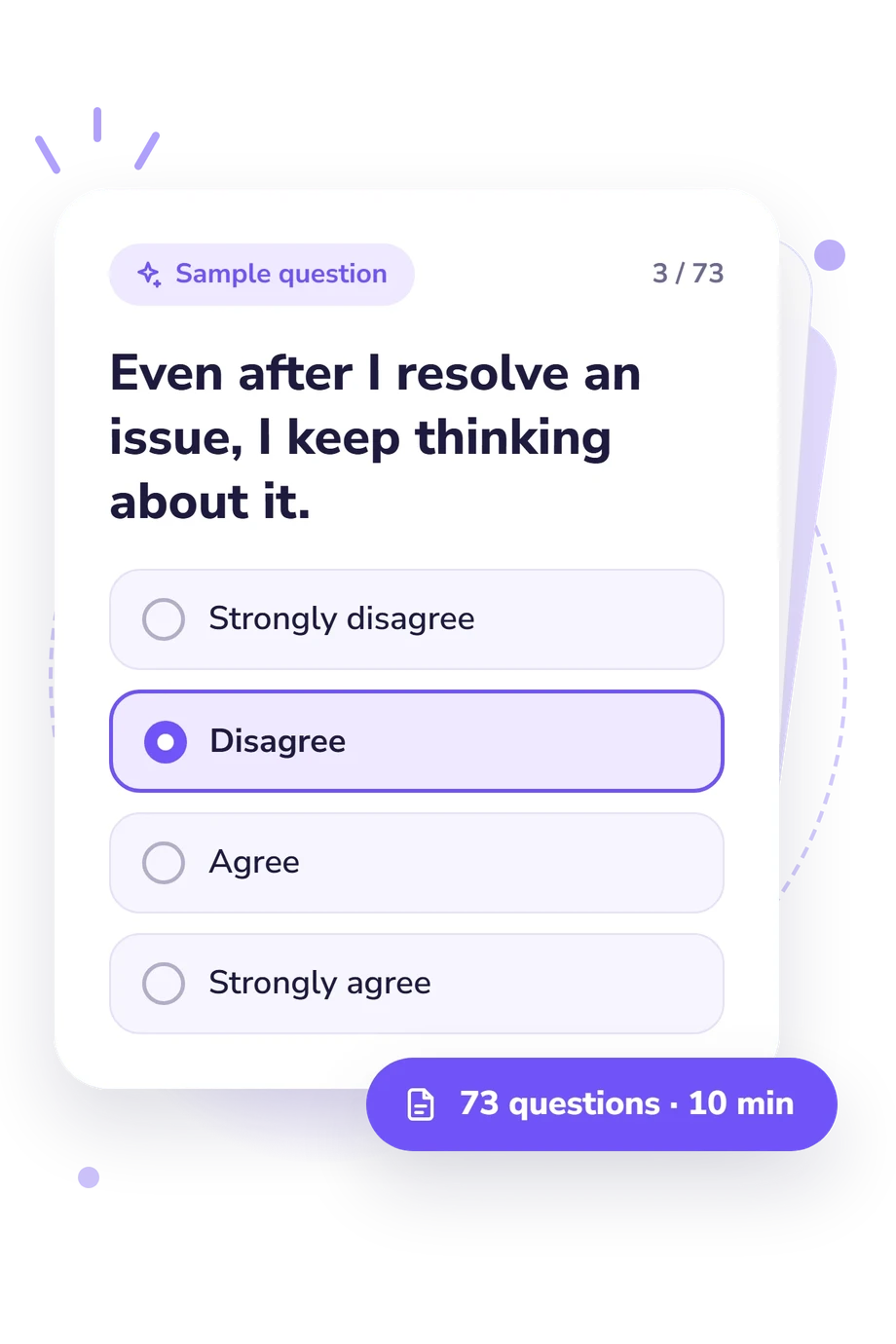
Example Questions From the Test
- Strongly disagree
- Disagree
- Agree
- Strongly agree
- Strongly disagree
- Disagree
- Agree
- Strongly agree
- Strongly disagree
- Disagree
- Agree
- Strongly agree
Overthinking Test - Description and methodology of the test
Anyone who loses time replaying conversations, scanning for danger, or struggling to settle can use this assessment to describe their thinking patterns. Readers asking whether they are overthinkers can use this overthinking quiz as a structured prompt rather than a label. The result describes patterns in switching off, past-focused replay, and future-focused worry. The overthinking test is intended for readers who want patterns described clearly.
What This Assessment Explores
Repetitive negative thinking is central: the items cover thoughts that persist after resolution, replay past events or mistakes, shift toward imagined threats, and interfere with rest or decisions. This suits readers distinguishing ordinary reflection from sticky, time-consuming loops and gives overthinking symptoms a more specific structure.
The result is organized into three dimensions:
- Mental Switch-Off Difficulty (0-20) shows difficulty disengaging and returning attention to the present; bands are Easy to switch off (0-6), Sometimes stuck in loops (7-13), and Hard to wind down (14-20).
- Rumination Intensity (0-30) shows repetitive replay of past events, conversations, or mistakes; bands are Low (0-10), Moderate (11-20), and High (21-30).
- Worry & What-If Thinking (0-30) shows future-focused “what if” scenarios and catastrophic thinking; bands are Low (0-10), Moderate (11-20), and High (21-30).
Together, these dimensions separate past-focused replay, future-focused worry, and difficulty settling.
Methodology and Scientific Basis
The sampled statements ask for agreement, with response options ranging from disagreement to agreement and Not sure included in some sets. The sampled prompts cover replayed conversations, mistakes, imagined dangers, difficult choices, unfinished concerns, and trouble settling at night. This format samples recurring thought patterns rather than one isolated event.
Answers combine into three displayed scores, whose bands describe the intensity or difficulty represented by each score. The displayed bands are descriptive categories attached to the three score ranges. Recent stress, sleep, concentration, and situations that amplify a loop should shape interpretation.
The methodology is conceptually consistent with the Perseverative Thinking Questionnaire (Ehring et al., 2011), while future-focused items overlap with the Penn State Worry Questionnaire (Meyer et al., 1990). Past-focused rumination also connects conceptually with Treynor et al. (2003). These works are reference points, not evidence that this questionnaire is an adaptation or validated equivalent.
In practice, this overthinking questionnaire remains a self-report snapshot: answers can shift with current mood, memory, self-awareness, and the wish to appear favorable. Use the result to examine recurring tendencies and possible triggers, not to treat one occasion as a fixed description of the person.
- Thomas Ehring, Ulrike Zetsche, Kathrin Weidacker, Karina Wahl, Sabine Schönfeld, and Anke Ehlers. The Perseverative Thinking Questionnaire (PTQ): Validation of a content-independent measure of repetitive negative thinking. Journal of Behavior Therapy and Experimental Psychiatry, 42(2), 225-232, 2011. 10.1016/j.jbtep.2010.12.003
- Thomas J. Meyer, Mark L. Miller, R. L. Metzger, and Thomas D. Borkovec. Development and validation of the Penn State Worry Questionnaire. Behaviour Research and Therapy, 28(6), 487-495, 1990. 10.1016/0005-7967(90)90135-6
- Wendy Treynor, Richard Gonzalez, and Susan Nolen-Hoeksema. Rumination Reconsidered: A Psychometric Analysis. Cognitive Therapy and Research, 27(3), 247-259, 2003. 10.1023/A:1023910315561
Updated: