
Am I Smart Quiz
How the Scales are Structured
Who Usually Takes This Test?
See How You Compare
Below is a preview of how scores are typically distributed across each scale.
Example Questions From the Test
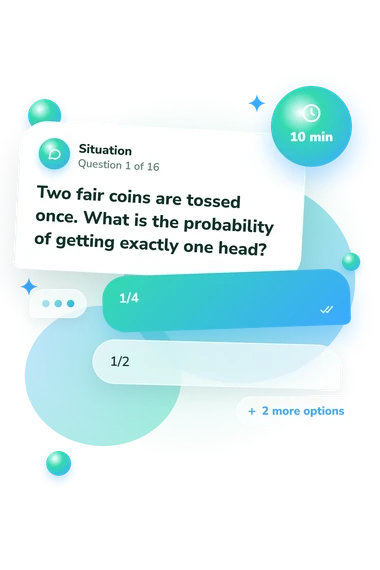
- 1/4
- 1/2
- 3/4
- 1
- 80
- 78
- 75
- 85
- Cuneiform writing
- Linear perspective
- Stained-glass leading
- Movable-type printing
Am I Smart Quiz - Description and methodology of the test
People who want a quick snapshot of broad knowledge can use the Am I Smart Quiz to explore performance across science, mathematics, history, civics, and reasoning. Its smart quiz format asks for applied knowledge across a mixed set, while the result gives an overall summary rather than separate topic scores. It offers a prompt for self-reflection about the breadth of this performance.
What This Assessment Explores
Viewed as a how smart are you quiz, the questionnaire samples general knowledge through problems and factual decisions rather than defining intelligence as one trait. Items span quantitative reasoning, science, health, history, civics, economics, language, art, and ecology, making it suitable for visitors who want a broad academic self-check.
Some questions test recall; others require calculation, explanation, or distinguishing correlation from causation. The overall result answers the practical question of how smart you are on this mixed set, rather than making a claim about every form of thinking.
The result types are:
- General Knowledge Knowledge (0-16) reports performance on this quiz: Building Foundations (0-6) marks areas for further learning; Developing Breadth (7-12) indicates knowledge across a meaningful portion of the material; Strong General Knowledge (13-16) indicates at least 80% correct and strong command of this set. It does not measure creativity, wisdom, practical ability, or overall capacity to learn.
Methodology and Scientific Basis
The format is a self-administered multiple-choice knowledge quiz: each item presents four answer choices, and the respondent selects the best answer. The mix spans calculation, probability, science, history, civics, language, and causal reasoning, so performance reflects knowledge plus simple application. The displayed result is a quiz score on this questionnaire’s scale, not a validated intelligence or IQ measure; it cannot answer whether you are smart in every setting.
The content is conceptually consistent with Russian General-Knowledge Questions (Martín-Luengo et al., 2020), a reference for broad knowledge assessment. Nelson and Narens (1980) and Tauber et al. (2013) offer norms for general-information questions, highlighting item difficulty and familiarity. This questionnaire is not presented as an adaptation or standardized administration of those instruments, so these studies provide context rather than validation of this online version.
When a visitor uses this how smart am I quiz, the score can guide review without turning a mixed result into a broad judgment. Responses can shift with schooling, language, culture, guessing, attention, and current context. The result describes this bounded sample, not overall learning capacity.
- Beatriz Martín-Luengo, Oksana Zinchenko, Maria Alekseeva, and Yury Shtyrov (2020). Russian Norms for 500 General-Knowledge Questions. Frontiers in Psychology, 11, 545304. 10.3389/fpsyg.2020.545304
- Thomas O. Nelson and Louis Narens (1980). Norms of 300 General-Information Questions: Accuracy of Recall, Latency of Recall, and Feeling-of-Knowing Ratings. Journal of Verbal Learning and Verbal Behavior, 19(3), 338-368. 10.1016/S0022-5371(80)90266-2
- Shannon K. Tauber, John Dunlosky, Katherine A. Rawson, Matthew G. Rhodes, and Daniel M. Sitzman (2013). General Knowledge Norms: Updated and Expanded from the Nelson and Narens (1980) Norms. Behavior Research Methods, 45(4), 1115-1143. 10.3758/s13428-012-0307-9
Updated: