
History Quiz
How the Scales are Structured
Who Usually Takes This Test?
See How You Compare
Below is a preview of how scores are typically distributed across each scale.
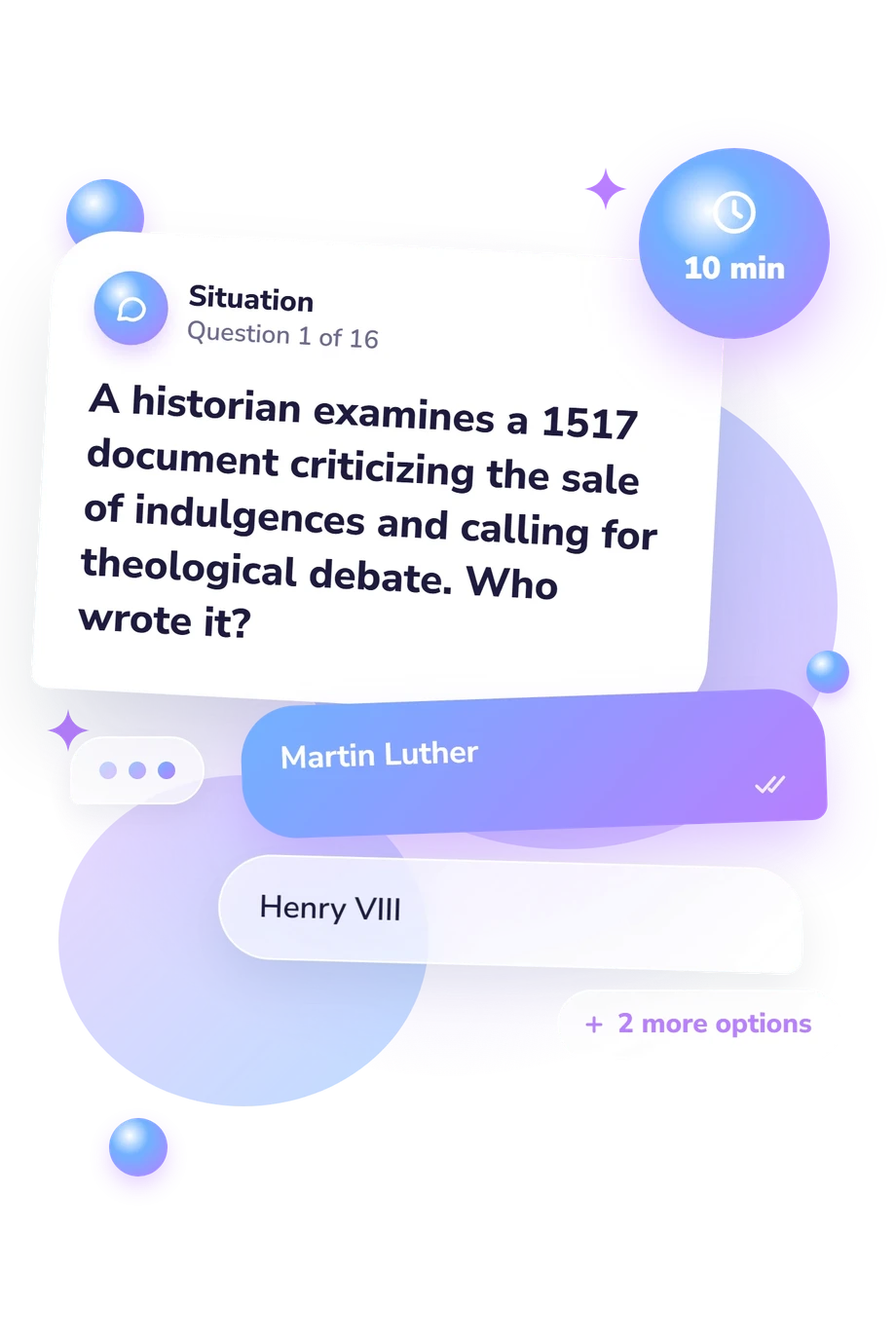
Example Questions From the Test
- Martin Luther
- Henry VIII
- John Calvin
- Ignatius of Loyola
- Egyptian hieroglyphs
- Cuneiform
- Chinese oracle-bone script
- Linear B
- Eligible male citizens could vote directly on public decisions
- Government offices were inherited within a royal family
- All adult residents had equal political rights
- Provincial governors were appointed by an emperor
History Quiz - Description and methodology of the test
People seeking a clear starting point for studying the past can use this history quiz to check broad knowledge rather than memorize one period. It suits learners, curious adults, and anyone comparing strengths across eras, regions, and themes. As a quiz covering world history, it can show where further reading, revision, or a more focused topic review may be useful.
What This Assessment Explores
Across chronology, geography, ideas, religion, exchange, and social change, the assessment tests whether facts can be placed in context. Items identify people, documents, systems, and events, while others focus on purpose, cause, consequence, or significance. A quiz covering general history can reveal which areas feel secure and which need reinforcement.
The item themes can be grouped as follows:
- Early societies and institutions show whether you recognize cultures, writing systems, laws, and political arrangements.
- Exchange and encounter connect trade, migration, crops, and religious ideas with change.
- Revolution and modernization cover upheaval, industrial growth, empire, and state-building.
- Leaders and ideas link people and movements to decisions, institutions, and consequences.
Together they form History Knowledge, reported on a 0-16 scale. The bands are Foundations to build (0-6), Developing knowledge (7-12), and Strong knowledge (13-16). These labels describe a snapshot, not complete expertise.
Methodology and Historical Thinking Framework
Each item presents a historical prompt with four answer choices. Some ask you to identify a person, document, writing system, movement, or event; others ask why a development mattered. A quiz built around historical trivia therefore tests factual recognition alongside chronology, setting, evidence, and cause.
Selected responses are combined into one overall result. The questionnaire does not state separate weighting or subscale calculations, so the score is best read as a single snapshot of performance across the represented topics. Familiarity with particular examples, education, language, memory, and current attention can affect performance.
The design is conceptually consistent with Reich (2013) on multiple-choice history testing, Reich (2009) on question design and student reasoning, and Seixas and Morton’s historical-thinking concepts, including evidence, significance, cause and consequence, and historical perspectives. It is not presented as a direct adaptation of those works. Because the questionnaire has no stated population norms or independent reliability estimate, its broad item mix may feel like a quiz about random history topics, but it should be read as a focused profile rather than a measure of every historical period or the full complexity of historical expertise.
- Reich, Gabriel A. (2013). Imperfect Models, Imperfect Conclusions: An Exploratory Study of Multiple-Choice Tests and Historical Knowledge. The Journal of Social Studies Research, 37(1), 3-16. 10.1016/j.jssr.2012.12.004
- Reich, Gabriel A. (2009). Testing Historical Knowledge: Standards, Multiple-Choice Questions and Student Reasoning. Theory & Research in Social Education, 37(3), 325-360. 10.1080/00933104.2009.10473401
- Seixas, Peter, and Tom Morton. (2013). The Big Six: Historical Thinking Concepts. Toronto: Nelson Education.
Updated: