
Europe Capitals Quiz
How the Scales are Structured
Who Usually Takes This Test?
See How You Compare
Below is a preview of how scores are typically distributed across each scale.
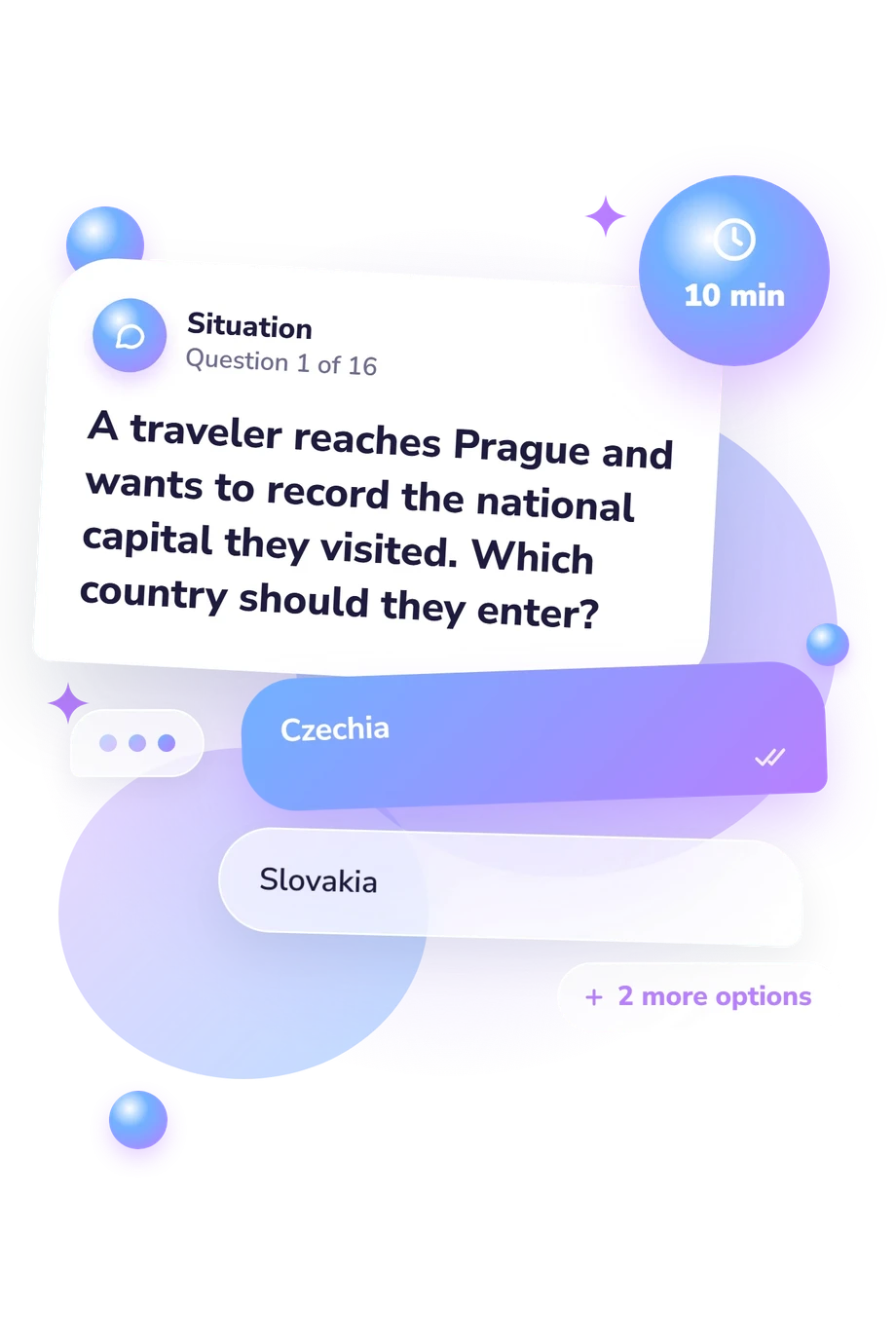
Example Questions From the Test
- Czechia
- Slovakia
- Poland
- Hungary
- Belgrade
- Bratislava
- Bucharest
- Budapest
- Belfast
- Cork
- Cardiff
- Dublin
Europe Capitals Quiz - Description and methodology of the test
People who want to strengthen place knowledge can use this assessment to check how reliably they connect European countries with their national capitals. The Europe Capitals Quiz suits travelers, students, and curious adults who want a focused measure of factual geography rather than a test of cultural familiarity. As a quiz about the capitals of Europe, it can reveal which pairings feel secure and which deserve targeted review.
What This Quiz Measures
The items assess declarative geography knowledge: they ask you to connect a capital with its country, identify the correct city from alternatives, or recognize a pairing in a travel setting. This quiz about European countries and capitals measures recall and discrimination, not route planning or cultural familiarity.
The questions separate these practical aspects:
- Country-capital recall shows how securely you remember each pairing.
- Distractor discrimination shows whether you reject a familiar-looking city from another country.
- Applied recognition shows how accurately you use capital knowledge in travel or regional contexts.
The displayed Europe Capitals Knowledge scale spans 0-16. Foundations (0-6) indicates some familiar capitals; Developing (7-12) indicates useful knowledge with possible confusion around neighboring or less familiar capitals; Strong (13-16) indicates consistent identification in geographic and travel contexts. It suits travelers, students, and curious adults refreshing capital knowledge.
Methodology and Evidence Base
Each item presents a short travel or geography scenario with four answer choices. You select the capital-country relationship that fits, while plausible alternatives test precise recognition rather than familiarity with a city name. As a quiz about European capitals, it returns one overall result and no regional subscores.
The display summarizes performance, but exact points assigned to options are not specified. Read the result as a snapshot of recall, not a complete measure of European geography; schooling, travel exposure, language familiarity, attention, and current context may affect it. The result can guide review of uncertain pairings.
De Witte et al. (2024) offers broad conceptual context for factual learning involving cognitive load and spatial abilities; this questionnaire is conceptually consistent with that work, not an adaptation of it. Watrin et al. (2023) and Goecke et al. (2022) offer similarly broad context on declarative knowledge and multiple-choice formats, not validation of this questionnaire. The 2012 United Nations list supplies the country-and-capital naming reference.
No norm-referenced standing, reliability estimate, or formal standardization is stated for this online questionnaire. Use the result to plan study and monitor recall.
- De Witte, Benjamin, Vincent Reynaert, Jerome Hutain, Danny Kieken, Joseph Jabbour, and Jalal Possik. (2024). Immersive learning of factual knowledge while assessing the influence of cognitive load and spatial abilities. Computers & Education: X Reality, 5, 100085. 10.1016/j.cexr.2024.100085
- Watrin, Luc, Ulrich Schroeders, and Oliver Wilhelm. (2023). Gc at its boundaries: A cross-national investigation of declarative knowledge. Learning and Individual Differences, 102, Article 102267. 10.1016/j.lindif.2023.102267
- Goecke, Benjamin, Marlena Staab, Catherine Schittenhelm, and Oliver Wilhelm. (2022). Stop Worrying about Multiple-Choice: Fact Knowledge Does Not Change with Response Format. Journal of Intelligence, 10(4), 102. 10.3390/jintelligence10040102
- Cyprus Permanent Committee for the Standardization of Geographical Names. (2012). List of Country Names and Capitals. United Nations, E/CONF.101/97.
Updated: