
Interior Design Style Quiz
How the Scales are Structured
Who Usually Takes This Test?
See How You Compare
Below is a preview of how scores are typically distributed across each scale.
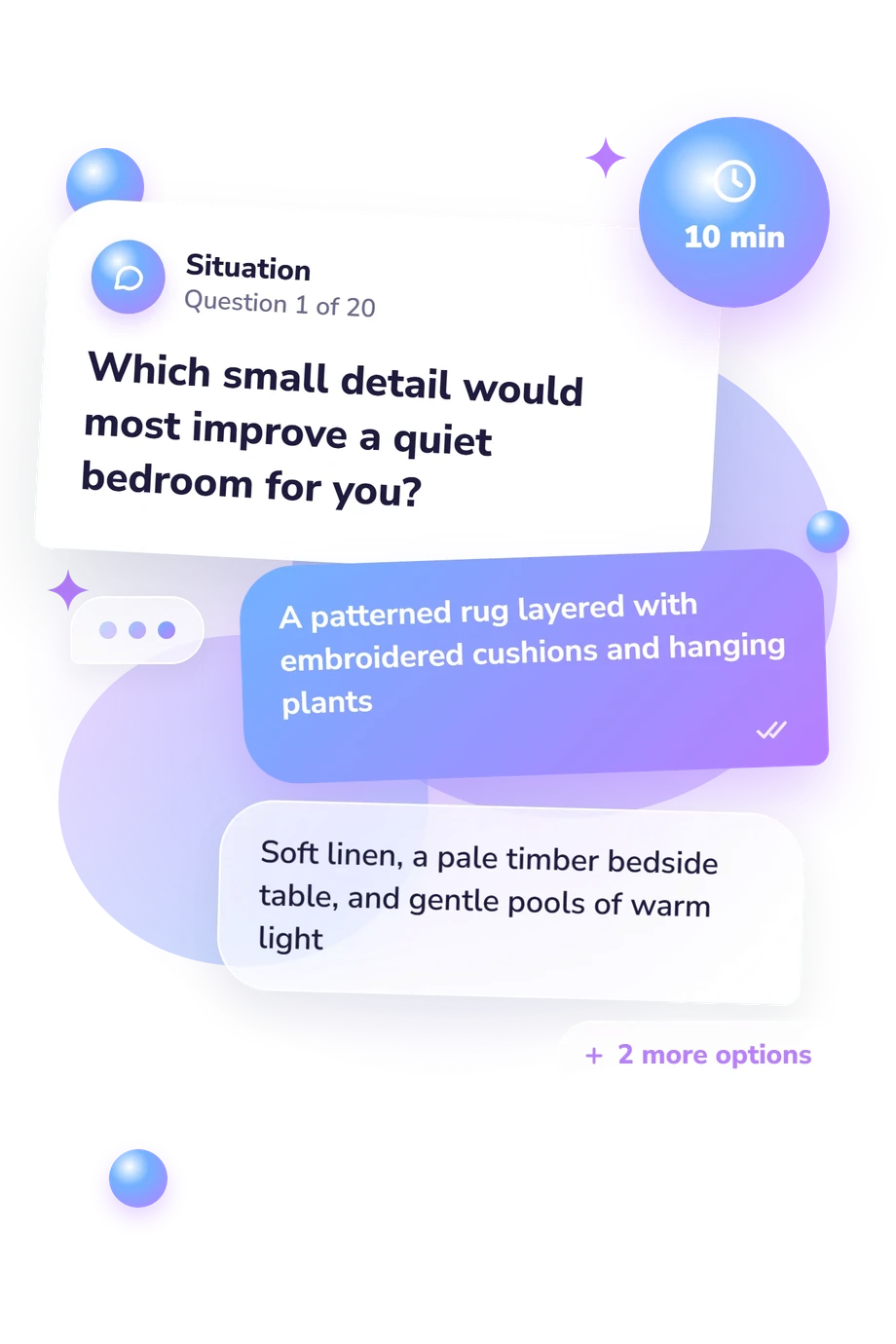
Example Questions From the Test
- A patterned rug layered with embroidered cushions and hanging plants
- Soft linen, a pale timber bedside table, and gentle pools of warm light
- Matching lamps, framed artwork, and classic trim around the room
- An uncluttered platform bed with concealed storage and a single tonal artwork
- Group them into symmetrical displays with coordinated frames or containers
- Keep most of the collection visible because the variety gives the room life
- Rotate a small selection while storing the rest out of sight
- Edit the collection down to only the pieces I value or use most
- A carved wood cabinet with paneled doors and traditional hardware
- A low, handle-free unit with a simple geometric profile
- A slim wood console with tapered legs and visible grain
- An open shelving unit styled with baskets and handmade objects
Interior Design Style Quiz - Description and methodology of the test
People choosing furniture, colors, and room arrangements may find this interior design style quiz useful when several styles appeal at once and a decision feels diffuse. For someone comparing alternatives, the home decor style quiz organizes competing directions into a usable profile for choosing a palette, layout, or shortlist. It can show where two approaches work together, helping planners refine a room without forcing a single label.
What This Assessment Explores
The interior design quiz maps preferences in color, texture, furniture shape, lighting, storage, ornament, and room arrangement. Its profile helps people name the visual language that feels natural.
The five result dimensions are:
- Bohemian (0-12) shows affinity for layered individuality: More edited preference (0-4); Bohemian influence (5-8); Strong Bohemian affinity (9-12).
- Mid-Century Modern (0-12) shows affinity for retro warmth and organic form: Different design language (0-4); Mid-Century influence (5-8); Strong Mid-Century Modern (9-12).
- Minimalist (0-12) shows affinity for open space and edited simplicity: Selective contrast (0-4); Minimalist influence (5-8); Strong Minimalist affinity (9-12).
- Scandinavian (0-12) shows affinity for light, soft, practical comfort: Different atmosphere (0-4); Scandinavian influence (5-8); Strong Scandinavian affinity (9-12).
- Traditional (0-12) shows affinity for symmetry, classic forms, and refined materials: Contemporary contrast (0-4); Traditional influence (5-8); Strong Traditional affinity (9-12).
Methodology and Evidence Base
Each item presents four concrete alternatives involving rooms, furniture, materials, or color, so the respondent chooses a direction rather than demonstrating technical knowledge. The design quiz turns those selections into a pattern across atmosphere, form, order, and layering.
Scores are reported separately rather than collapsed into one winner. The result gives five separate scale totals, applies the displayed one-point blending rule, and uses interpretive bands; it does not establish population norms or specify each answer's contribution.
Conceptually, the questionnaire is consistent with Vartanian et al. (2021), which studied individual differences in responses to architectural interiors. Coburn et al. (2020) adds evidence about psychological and neural responses to interior environments, while Dazkir and Read (2012) supports attention to furniture form and emotional response. The questionnaire is conceptually consistent with these studies' attention to interior preference and form, but it is a separate online profile rather than a direct adaptation of their instruments.
Self-report is the main limitation: current mood, possessions, cultural associations, and design familiarity can influence answers. The design style quiz works best as a flexible starting profile for decorating decisions.
- Vartanian, Oshin, Gorka Navarrete, Letizia Palumbo, and Anjan Chatterjee. “Individual differences in preference for architectural interiors.” Journal of Environmental Psychology, vol. 77, 2021, article 101668. 10.1016/j.jenvp.2021.101668
- Coburn, Alexander, Oshin Vartanian, Yoed N. Kenett, Marcos Nadal, Franziska Hartung, Gregor U. Hayn-Leichsenring, Gorka Navarrete, José Luis González-Mora, and Anjan Chatterjee. “Psychological and neural responses to architectural interiors.” Cortex, vol. 126, 2020, pp. 217-241. 10.1016/j.cortex.2020.01.009
- Dazkir, Sibel S., and Marilyn A. Read. “Furniture Forms and Their Influence on Our Emotional Responses Toward Interior Environments.” Environment and Behavior, vol. 44, no. 5, 2012, pp. 722-732. 10.1177/0013916511402063
Updated: