
Cutie Mark Quiz
How the Scales are Structured
Who Usually Takes This Test?
See How You Compare
Below is a preview of how scores are typically distributed across each scale.
Example Questions From the Test
- Strongly disagree
- Disagree
- Agree
- Strongly agree
- Strongly disagree
- Disagree
- Agree
- Strongly agree
- Strongly disagree
- Disagree
- Agree
- Strongly agree
Cutie Mark Quiz - Description and methodology of the test
People can use this profile to organize self-reflection around the choices that energize them, the activities they approach imaginatively, and the ways they relate to others. The cutie mark quiz turns those everyday patterns into a symbolic profile, helping a reader sort recurring preferences without treating them as a fixed identity. Someone wondering which mark fits them can use this what-is-my-cutie-mark quiz for personal interpretation.
What This Assessment Explores
The questionnaire treats a cutie mark as a symbolic summary of interests and preferences. The cutie-mark concept supplies the fictional frame, while the items connect challenge-seeking, creativity, helping, and friendship with recognizable motivations rather than fixed destiny.
Across everyday choices, the profile organizes the symbolic themes explored by this cutie-mark assessment into three dimensions:
- Adventure & Drive: 0-40. Steady & Grounded (0-13), Balanced Explorer (14-26), or Bold & Driven (27-40) reflects your preference for excitement, exploration, risk-taking, and ambitious goal pursuit.
- Creativity & Expression: 0-40. Practical Focus (0-13), Balanced Expression (14-26), or Highly Creative (27-40) reflects your motivation for imagination, art, performance, and self-expression.
- Helping & Friendship: 0-40. Independent Focus (0-13), Balanced Helper (14-26), or Connector & Caretaker (27-40) reflects your orientation toward support, empathy, teamwork, and community-building.
Methodology and Evidence Base
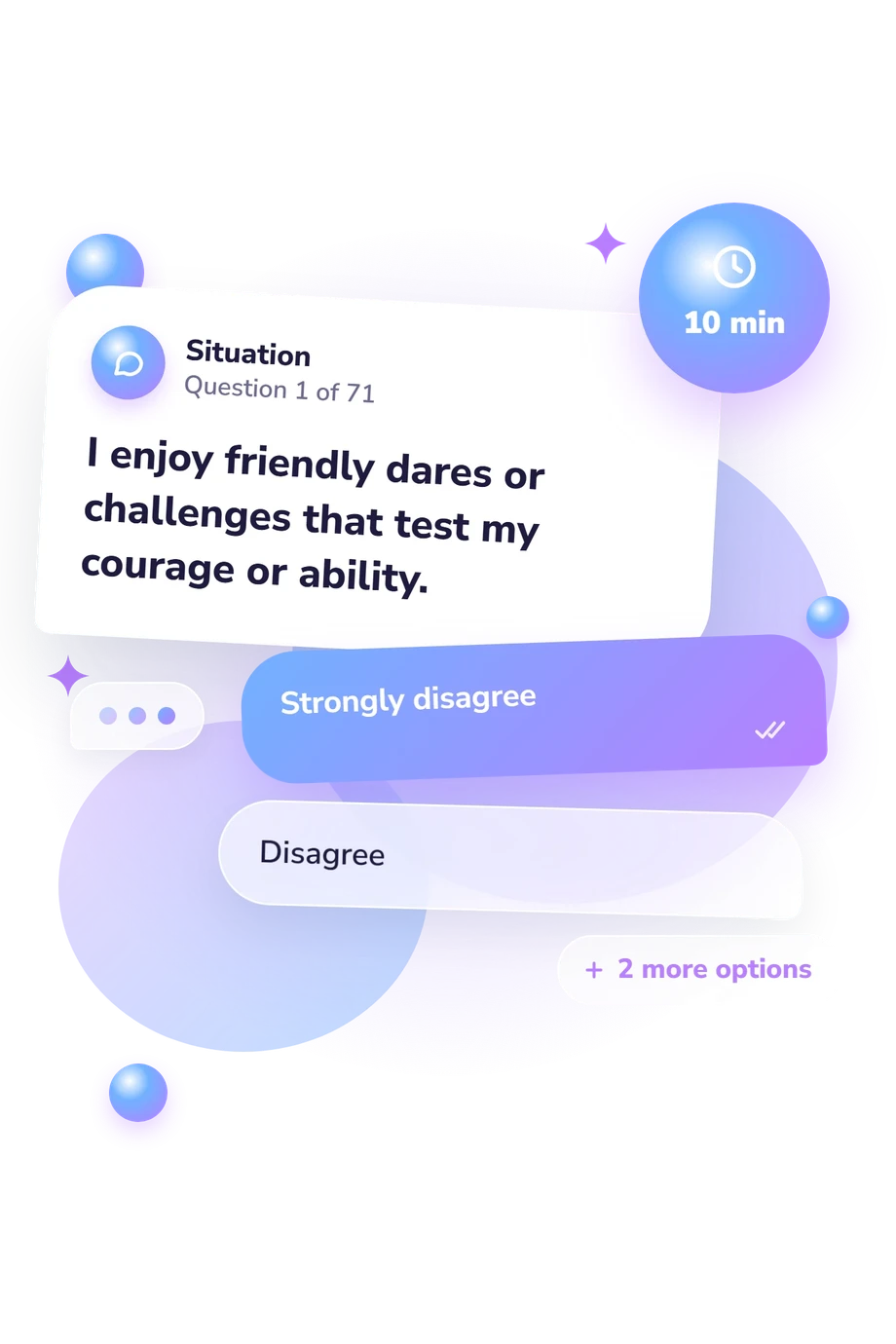
In the sampled items, self-report statements use an agreement scale, usually from Strongly disagree to Strongly agree; some statements include Not sure. The examples cover challenges, novelty, goals, creative expression, and noticing or supporting other people, so the questionnaire addresses everyday preferences rather than specialist knowledge.
Each dimension receives a displayed score and result band. The questionnaire does not specify how individual responses are converted into those scores, so the categories are best read as an organized profile rather than as a label attached to any one answer.
The questionnaire presents a cutie mark personality profile with conceptual parallels to McCrae’s 1992 Five-Factor Model account and Ryan and Deci’s 2000 self-determination theory. These sources offer comparison points for recurring tendencies, intrinsic interest, autonomy, competence, and social connection, but this questionnaire is not an adaptation, standardized measure, or validation of either work.
Self-report responses can vary with mood, circumstances, self-awareness, and favorable self-presentation, so the profile is best used as structured reflection rather than a diagnosis.
- Faust, Lauren (creator). My Little Pony: Friendship Is Magic. The Hub/Hasbro Studios, 2010-2019.
- McCrae, Robert R. “An Introduction to the Five-Factor Model and Its Applications.” Journal of Personality, vol. 60, no. 2, 1992, pp. 175-215. 10.1111/j.1467-6494.1992.tb00970.x
- Ryan, Richard M., and Edward L. Deci. “Self-determination theory and the facilitation of intrinsic motivation, social development, and well-being.” American Psychologist, vol. 55, no. 1, 2000, pp. 68-78. 10.1037/0003-066X.55.1.68
Updated: