
Does My Child Have Anxiety Quiz
How the Scales are Structured
Who Usually Takes This Test?
See How You Compare
Below is a preview of how scores are typically distributed across each scale.
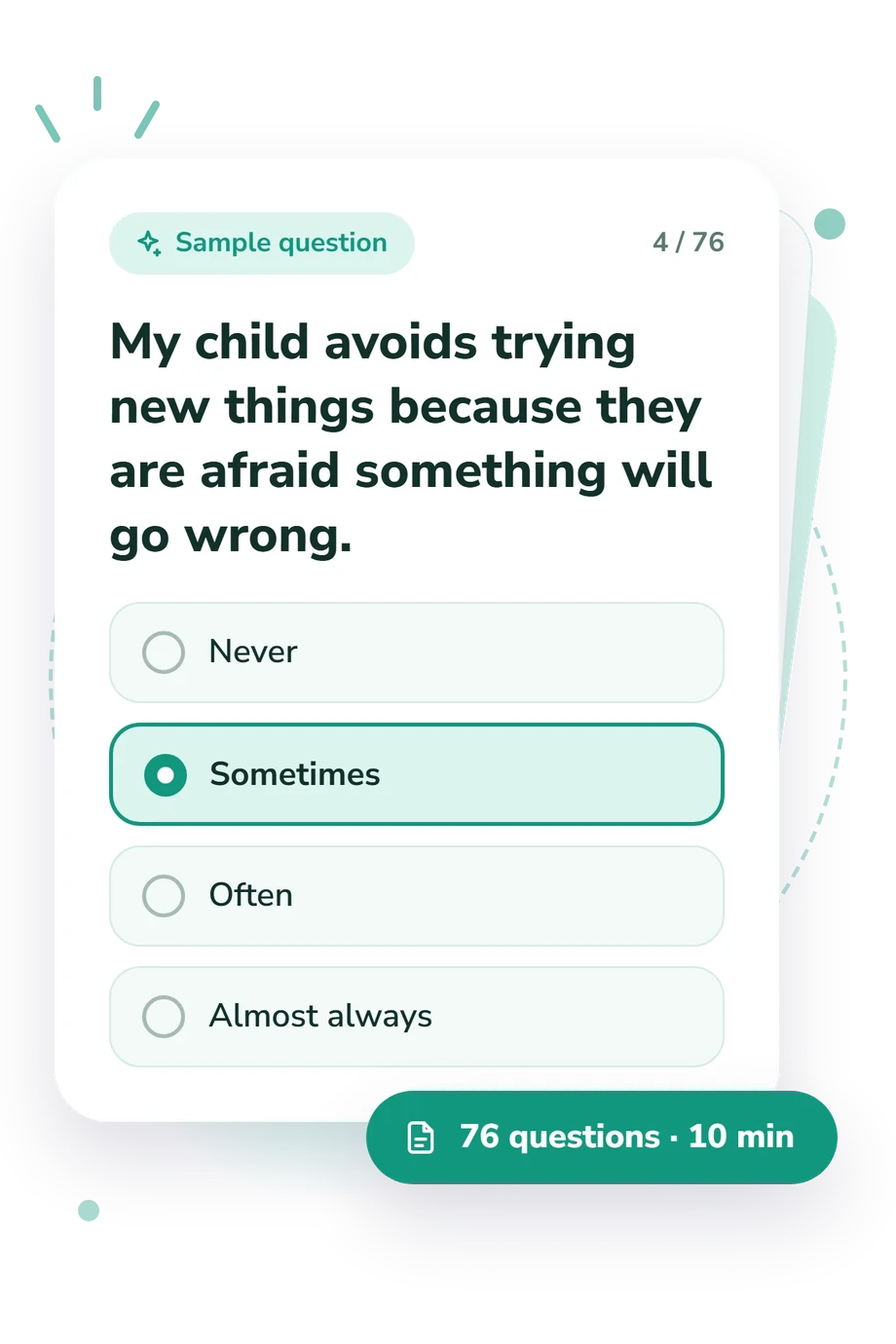
Example Questions From the Test
- Never
- Sometimes
- Often
- Almost always
- Never
- Sometimes
- Often
- Almost always
- Never
- Sometimes
- Often
- Almost always
Does My Child Have Anxiety Quiz - Description and methodology of the test
Parents noticing persistent worry, avoidance, or distress in everyday situations can use the Does My Child Have Anxiety Quiz to consider whether anxiety is affecting school participation, sleep, independence, routines, social activities, or separation. This questionnaire serves as an anxiety test for kids, focusing a caregiver’s attention on the situations that may warrant closer observation. It is intended for adults answering about a child, not for children completing it themselves.
What This Assessment Explores
Rather than focusing on one fear, the questions cover separation, school, unfamiliar activities, mistakes, social performance, reassurance, irritability, bodily complaints, and sleep. As a child anxiety test, the questionnaire provides a profile across these contexts, showing where patterns may interfere with ordinary routines.
The result contains three displayed dimensions:
- Avoidance & Separation Distress (0-20) measures avoidance and separation distress affecting activities or transitions; Low 0-6, Moderate 7-13, High 14-20.
- Overall Anxiety Signs (0-30) measures frequency and intensity of worry, avoidance, sleep trouble, irritability, physical complaints, and school or separation distress; Low 0-10, Moderate 11-20, High 21-30.
- Physical & Sleep Symptoms (0-20) captures bodily complaints and sleep disruption; Low 0-6, Moderate 7-13, High 14-20.
Meanings differ by dimension: higher avoidance scores indicate interference with functioning and transitions; higher overall scores reflect consistent or impactful anxiety signs; physical-and-sleep scores suggest bodily and sleep manifestations.
Methodology and Evidence Base
Each statement asks the caregiver to choose Never, Sometimes, Often, or Almost always. The prompts cover separation and independence, unfamiliar or evaluative situations, worry and reassurance, body sensations, sleep, and emotional reactions. Scoring is not specified beyond three displayed scores, which use the Low, Moderate, and High bands listed above; higher values carry the catalogue’s domain-specific meanings.
Social-evaluative fears are one part of the broader assessment: it can function as a does my child have social anxiety quiz while also covering separation, school reluctance, physical symptoms, sleep disruption, and general worry.
Methodologically, the questionnaire is conceptually consistent with SCAS-P (Nauta et al., 2004), a parent-report measure, and with the symptom framework of the Spence Children’s Anxiety Scale (Spence, 1998). It is not the published instrument or a direct adaptation. Arendt et al. (2014) provide later psychometric context for SCAS versions, but those findings do not standardize this online scoring system. Caregiver recall, current circumstances, and response bias can affect scores, so results are best read as a structured profile for discussion, not a definitive clinical classification.
- Nauta, M. H., Scholing, A., Rapee, R. M., Abbott, M., Spence, S. H., & Waters, A. (2004). A parent-report measure of children's anxiety: Psychometric properties and comparison with child-report in a clinic and normal sample. Behaviour Research and Therapy, 42(7), 813-839. 10.1016/S0005-7967(03)00200-6
- Spence, S. H. (1998). A measure of anxiety symptoms among children. Behaviour Research and Therapy, 36(5), 545-566. 10.1016/S0005-7967(98)00034-5
- Arendt, K., Hougaard, E., & Thastum, M. (2014). Psychometric properties of the child and parent versions of Spence Children's Anxiety Scale in a Danish community and clinical sample. Journal of Anxiety Disorders, 28(8), 947-956. 10.1016/j.janxdis.2014.09.021
Updated: