Two Dismissive Avoidants in a Relationship: Why It Feels Distant and What Can Help
Emotional distance can be confusing, especially when a relationship looks stable on the surface but feels empty underneath. Many couples don’t fight often, don’t experience dramatic breakups, and still feel profoundly disconnected from one another. When two dismissive avoidants in a relationship come together, this quiet disconnection is not accidental — it’s built into how both partners learned to manage closeness.
In these relationships, independence is prioritized, emotions are minimized, and vulnerability often feels unnecessary or even unsafe. That can create a sense of calm and self-sufficiency early on, while slowly eroding emotional intimacy over time. Partners may coexist peacefully yet struggle to feel deeply seen or emotionally needed.
This article explains what happens when both partners have a dismissive avoidant attachment style, why intimacy tends to stall despite low conflict, and what patterns commonly emerge over time. You’ll also learn whether these relationships can grow, what change realistically requires, and when professional support can make a meaningful difference — without pathologizing either partner or oversimplifying the dynamic.

What happens when two dismissive avoidants are in a relationship?
When two people with a dismissive avoidant attachment style form a relationship, it often looks unusually calm from the outside. There may be little overt conflict, few emotional confrontations, and a strong emphasis on independence. This dynamic can feel functional and even refreshing at first, especially for partners who value autonomy and low emotional pressure.
In a dismissive–dismissive pairing, both individuals have learned to downplay emotional needs and rely primarily on themselves. Closeness is tolerated as long as it does not require vulnerability, dependency, or emotional exposure. Because neither partner pushes for reassurance or deep emotional engagement, the relationship rarely triggers dramatic attachment anxiety. Instead, it settles into a pattern of mutual distance.
Early on, this can feel comfortable. Both partners respect each other’s space, maintain separate routines, and avoid intense emotional demands. There is often a shared, unspoken agreement: “You don’t need much from me, and I won’t need much from you.” For people who associate closeness with loss of control or emotional overwhelm, this arrangement can feel safe.
Over time, however, the same qualities that reduce conflict can also limit intimacy. Emotional conversations are brief or avoided. Support during stress may be practical rather than emotional. Expressions of longing, fear, or dependency tend to be minimized or internalized rather than shared. As a result, the relationship may function smoothly while lacking emotional depth.
A common experience in these couples is delayed loneliness. One or both partners may suddenly realize that, despite being in a committed relationship, they feel emotionally alone. This realization often comes during life transitions, illness, grief, or moments when emotional support becomes harder to avoid. Because both partners are skilled at self-reliance, the absence of closeness can remain invisible for a long time.
Importantly, this dynamic does not mean the relationship is doomed or inherently unhealthy. It does mean that emotional connection does not develop automatically. Without intentional effort, two dismissive avoidants can maintain a stable partnership that meets practical needs while quietly bypassing emotional intimacy.
Why do two dismissive avoidants struggle with emotional closeness?
When both partners have a dismissive avoidant attachment style, emotional distance is not a coincidence — it is the result of two attachment systems working in the same direction. Each person has learned, often early in life, that relying on others feels unsafe or unnecessary. As a result, closeness is managed through emotional control rather than emotional exchange.
In these relationships, intimacy does not usually fail because of conflict. It stalls because neither partner is practiced in expressing emotional needs, and neither feels comfortable responding to them. The relationship becomes organized around self-sufficiency instead of mutual regulation.
How attachment deactivation works in this dynamic
Dismissive avoidant attachment is characterized by deactivation strategies. These are unconscious ways of turning down emotional signals when closeness increases. In a dismissive–dismissive relationship, both partners use these strategies simultaneously.
Common deactivation behaviors include:
- minimizing the importance of emotional needs;
- intellectualizing feelings instead of expressing them;
- focusing on tasks, work, or routines during emotional moments;
- withdrawing internally when vulnerability arises.
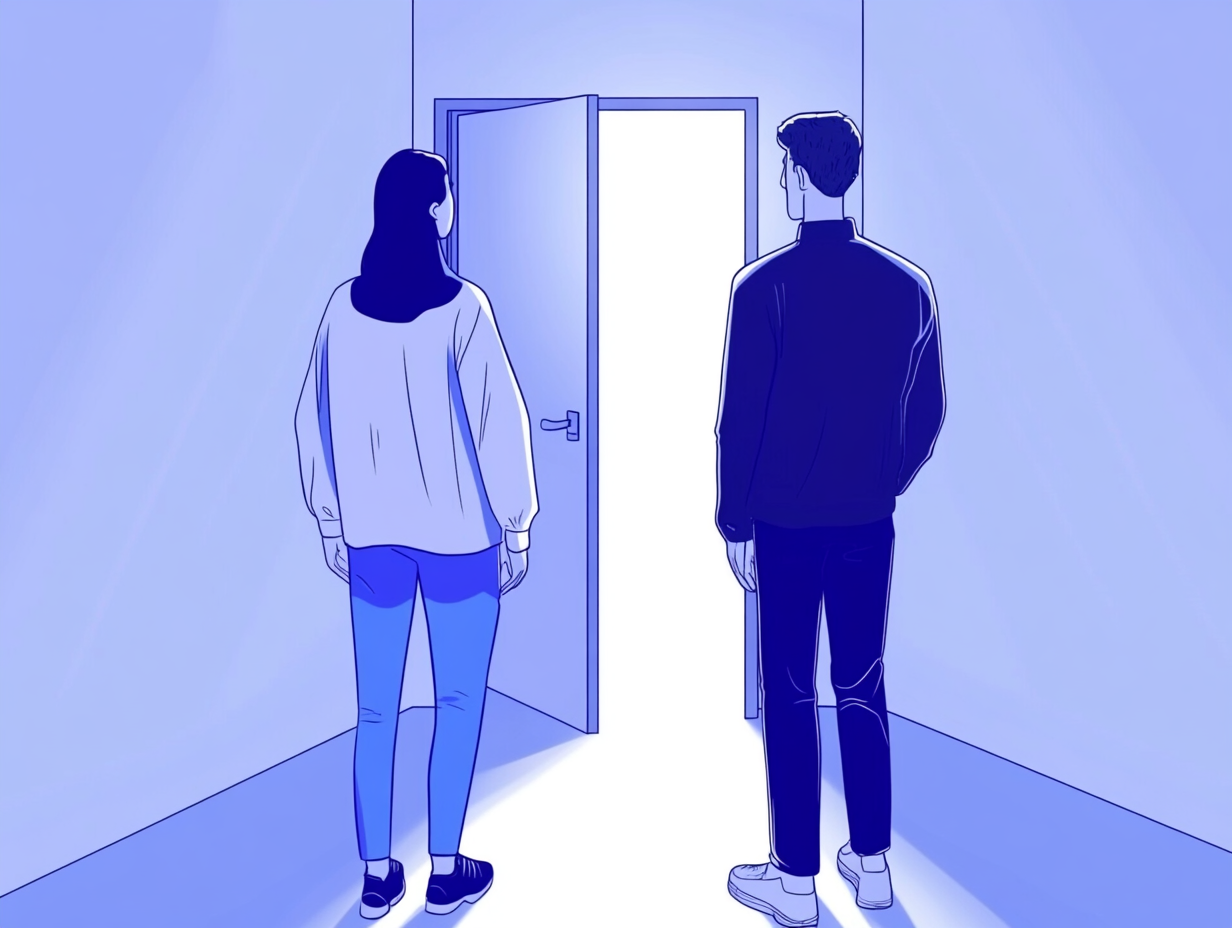
Because both partners deactivate rather than pursue, there is no visible “push-pull” dynamic. Instead, emotional bids simply disappear. Feelings that might lead to closeness are downregulated before they ever reach the surface.
For example, one partner may feel a brief sense of longing or insecurity but quickly dismiss it as irrational. The other partner never sees the signal and therefore never responds. Over time, this repeated internal shutdown becomes the default way the relationship handles emotional tension.
Why conflict stays low but intimacy stays blocked
Many dismissive–dismissive couples report that they “never fight.” On the surface, this seems positive. In reality, low conflict often reflects low emotional engagement, not high relational health.
Conflict requires emotional investment. It requires caring enough to risk discomfort. In dismissive–dismissive relationships, both partners tend to avoid situations that could lead to emotional exposure. Disagreements are handled pragmatically, postponed, or quietly dropped rather than explored.
As a result:
- unresolved emotional issues accumulate without being named;
- partners may feel unseen but struggle to articulate why;
- emotional needs are translated into distance rather than dialogue.
This creates a paradox. The relationship feels stable, yet emotionally thin. There is little drama, but also little emotional nourishment. Over time, partners may experience a vague sense that something is missing, without knowing how to access it.
Because neither partner naturally initiates emotional depth, intimacy does not grow on its own. Without conscious effort, the relationship remains organized around autonomy rather than connection — not because of lack of care, but because closeness was never modeled as safe.
Common patterns in dismissive–dismissive relationships over time
At first, a relationship between two dismissive avoidants may feel smooth and uncomplicated. Daily life works, boundaries are respected, and neither partner feels pressured to be emotionally “on” all the time. Over time, however, predictable patterns tend to emerge — not because either partner is doing something wrong, but because emotional needs are consistently managed through distance.
Below are the most common patterns that develop in dismissive–dismissive relationships as months or years pass.
| Pattern | How it shows up | Emotional cost |
|---|---|---|
| Emotional parallelism | Partners live side by side with limited emotional sharing | Feeling unknown or unseen |
| Delayed loneliness | Realization of emotional distance during stress or transitions | Quiet sadness or emptiness |
| Silent ruptures | Emotional injuries are never discussed or repaired | Gradual emotional withdrawal |
| Low demand intimacy | Closeness limited to practical or physical connection | Lack of emotional bonding |
| Roommate dynamic | Relationship feels functional but emotionally flat | Loss of romantic connection |
One defining feature of these relationships is emotional parallelism. Partners share space, responsibilities, and routines, but rarely share inner emotional worlds. Conversations stay informational rather than relational. When emotions do surface, they are often brief, contained, and quickly redirected.
Another common pattern is delayed loneliness. Because both partners are skilled at self-reliance, the absence of emotional closeness may go unnoticed for a long time. The loneliness often appears during moments when emotional support becomes harder to avoid — illness, grief, career setbacks, or major life decisions. At that point, one or both partners may feel unexpectedly isolated, even within the relationship.
Silent ruptures also accumulate. Small emotional injuries — feeling dismissed, unsupported, or overlooked — are rarely named. Instead of repair, both partners disengage internally. Over time, these unspoken ruptures weaken trust and emotional safety, even though there is little overt conflict.
Intimacy in dismissive–dismissive relationships often becomes low demand. Physical closeness or shared activities may remain, but emotional vulnerability stays limited. Expressions of need, fear, or dependency feel foreign or uncomfortable. As a result, the relationship may begin to resemble a cooperative partnership rather than an emotionally intimate bond.

None of these patterns mean that the partners lack care or commitment. They reflect a shared strategy for staying emotionally safe. The challenge is that what protects both partners from emotional overwhelm also prevents the relationship from deepening.
Can two dismissive avoidants build a healthy relationship?
Yes — but not automatically. A relationship between two dismissive avoidants can become emotionally healthier, but it requires intentional change, not simply time or commitment. Because both partners rely on emotional distance to feel safe, growth depends on developing skills that do not come naturally to either person.
The key challenge is not lack of care. It is the absence of emotional access.
What makes growth possible
For a dismissive–dismissive relationship to deepen, several conditions tend to matter:
- motivation for emotional intimacy;
- tolerance for emotional discomfort;
- emotional literacy;
- slowing down deactivation.
For example, a partner might notice the urge to shut down during a difficult conversation and choose to stay engaged for a few extra minutes rather than changing the subject or leaving the room. These small moments matter more than dramatic gestures.
When both partners begin practicing emotional presence — even inconsistently — intimacy can increase. The relationship becomes less about parallel independence and more about shared emotional reality.
When the relationship tends to stay stuck
Not all dismissive–dismissive relationships change. Growth is unlikely when:
- neither partner experiences emotional distance as a problem;
- vulnerability is consistently reframed as unnecessary or weak;
- emotional needs are denied rather than explored;
- closeness is only tolerated under strict control.
In these cases, the relationship may remain stable but emotionally limited. Partners often function well logistically while avoiding deeper connection. Over time, this can lead to chronic dissatisfaction, emotional disengagement, or a gradual drift apart.
Importantly, wanting more intimacy does not mean a partner is “becoming anxious.” It often means the attachment system is waking up. The question is whether both partners are willing to respond to that signal rather than suppress it.
A healthy dismissive–dismissive relationship is possible when autonomy and closeness stop being treated as opposites. That balance rarely develops without conscious effort — and often benefits from professional support.
When therapy helps — and when it’s necessary
In dismissive–dismissive relationships, therapy is rarely sought because of explosive conflict. More often, it becomes relevant when emotional distance starts to feel unsustainable. One or both partners may notice a persistent sense of loneliness, emotional numbness, or a growing gap between “functioning” and actually feeling connected.
Therapy helps when partners want to understand why closeness feels difficult and are willing to examine long-standing attachment patterns. It becomes necessary when emotional withdrawal begins to affect mental health, relationship satisfaction, or the ability to respond to life stressors together.
| Dynamic | Emotional pattern | Main challenge |
|---|---|---|
| Dismissive–dismissive | Mutual emotional shutdown | Building vulnerability safely |
| Anxious–avoidant | Pursuit–withdrawal cycle | Regulating reactivity |
What therapy focuses on in dismissive–dismissive couples
Attachment-informed couples therapy, such as Emotionally Focused Therapy (EFT), often works by slowing down automatic withdrawal and helping partners recognize emotional signals before they are suppressed. The goal is not to force emotional expression, but to make emotional contact feel safer and more tolerable.
Individual therapy can also play an important role. For many dismissive avoidants, exploring attachment patterns one-on-one feels less threatening than doing so in front of a partner. Individual work can increase emotional awareness, reduce shame around dependency, and prepare partners for deeper relational work.
Common therapy goals include:
- identifying deactivation strategies as they happen;
- learning to stay emotionally present during discomfort;
- practicing small, contained expressions of need;
- developing a shared language for emotional experience.
When support should not be delayed
Professional help is especially important when emotional distance is accompanied by depression, chronic anxiety, or a sense of hopelessness about relationships. If either partner feels emotionally trapped, persistently numb, or disconnected from themselves, therapy should not be postponed.
If distress escalates to thoughts of self-harm or feeling unsafe, immediate support is critical. In the United States, individuals can call or text 988 to reach the Suicide and Crisis Lifeline. If there is immediate danger, calling 911 is the appropriate step. These resources are confidential and available 24/7.
Therapy does not mean something is “wrong” with the relationship. In dismissive–dismissive dynamics, it often means both partners are ready to replace emotional avoidance with conscious choice — and to learn how to stay connected without losing themselves.
References
1. American Psychological Association. Attachment Theory and Close Relationships. 2019.
2. National Institute of Mental Health. Psychotherapies. 2023.
3. Mikulincer, M., & Shaver, P. R. Attachment in Adulthood: Structure, Dynamics, and Change. 2016.
4. American Psychological Association. Ethical Principles of Psychologists and Code of Conduct. 2017.
5. Substance Abuse and Mental Health Services Administration. Find Treatment. 2023.
Conclusion
A relationship between two dismissive avoidants can feel stable, calm, and functional — while quietly lacking emotional closeness. This dynamic is not caused by indifference or lack of commitment, but by shared strategies of emotional self-protection. When both partners deactivate attachment needs, intimacy does not naturally deepen, even in long-term relationships.
These relationships can grow, but only with awareness, motivation, and a willingness to tolerate emotional discomfort. Without that effort, partners may remain emotionally distant while meeting practical needs. Therapy, whether individual or couples-based, often provides the structure and safety needed to interrupt automatic withdrawal and build connection intentionally.
Emotional closeness is a skill, not a personality trait. And for dismissive avoidants, learning that skill is possible — but rarely happens by accident.
If emotional distance is affecting well-being or leading to persistent loneliness, reaching out for licensed professional support can be an important step. If distress ever becomes overwhelming or unsafe, help is available by calling or texting 988 in the United States, or 911 in an emergency.
Frequently Asked Questions
Is a relationship between two dismissive avoidants unhealthy?
Not necessarily. These relationships can be stable and functional, but they often lack emotional intimacy unless both partners intentionally work on emotional connection.
Why does the relationship feel calm but emotionally distant?
Both partners tend to minimize emotional needs and avoid vulnerability. This reduces conflict but also prevents emotional closeness from developing.
Can two dismissive avoidants fall deeply in love?
Yes, but emotional depth usually requires conscious effort. Love may exist, but intimacy grows only when emotional avoidance is addressed.
Is couples therapy helpful for dismissive–dismissive relationships?
Often, yes. Attachment-based approaches like Emotionally Focused Therapy can help partners recognize withdrawal patterns and build safer emotional connection.
When should professional help be considered?
If emotional distance leads to loneliness, depression, or hopelessness, seeking support from a licensed mental health professional is recommended.
What if emotional distress becomes overwhelming?
If someone feels unsafe or at risk of self-harm, immediate help is available in the U.S. by calling or texting 988, or calling 911 in an emergency.